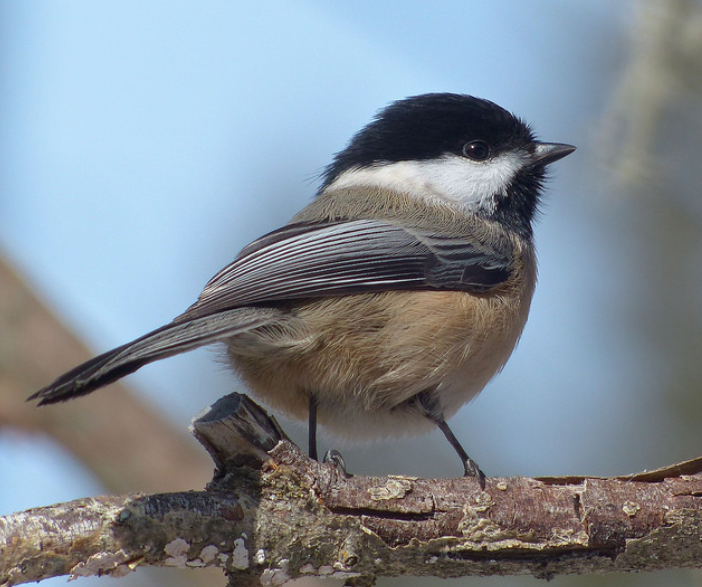
A small, non-migratory bird with a black cap and bib, found in North America. The Black-Capped Chickadee is known for its inquisitive and friendly nature, often approaching humans in wooded areas to forage for food.
Quick Top 10 Facts about Black-Capped Chickadee
| SCIENTIFIC NAME | Poecile atricapillus |
| CLASSIFICATION | KINGDOM: Animalia PHYLUM: Chordata CLASS: Aves ORDER: Passeriformes FAMILY: Paridae GENUS: Poecile |
| SIZE | 4.5 to 5.5 inches (11 to 14 cm) long with a wingspan of 8.3 inches (21 cm) |
| HABITAT | Forests, woodlands, and suburban areas across North America |
| DIET | Primarily seeds, insects, and berries, but they are known to eat small invertebrates and suet from feeders |
| SPECIES | 1 species: Poecile atricapillus (Black-Capped Chickadee) |
| COUNTRY | Found throughout North America, from Canada to the northern United States |
| GESTATION PERIOD | Eggs hatch in about 12–13 days after being laid |
| LIFE SPAN | 2–3 years in the wild, though they can live longer in captivity |
| CONSERVATION STATUS | Least Concern – Black-Capped Chickadees are widespread and abundant across their range |
Amazing Facts About Black-Capped Chickadee
1. Recognizable by its distinctive call
The Black-Capped Chickadee is named for its distinctive “chick-a-dee-dee-dee” call, which it uses for communication and warning.
2. Small and active
Despite being small, they are very active and are often seen hopping around trees and shrubs in search of food.
3. Acrobatic feeders
Black-Capped Chickadees are known for their acrobatic ability to hang upside down while feeding on seeds and insects.
4. They store food for the winter
These birds are smart and will hide food (seeds, nuts) in various locations to eat later during colder months.
5. Highly social
They are often found in flocks and will call out to each other while foraging for food.
6. Can survive extremely cold temperatures
Black-Capped Chickadees can endure cold winters by fluffing up their feathers to trap body heat, staying warm even in freezing conditions.
7. Expert at identifying different sounds
These birds can identify calls of other species and adjust their behavior accordingly. For example, they will adjust their calls in the presence of predators.
8. Can recognize individual humans
Chickadees have been observed recognizing specific human faces and will act differently toward humans they are familiar with.
9. Nest in tree cavities
Black-Capped Chickadees typically nest in tree cavities or birdhouses, where they lay 6–8 eggs that are incubated for 12–13 days.
10. Important for ecosystem health
As insectivores, Black-Capped Chickadees play an important role in controlling insect populations and promoting plant health in forests and woodlands.
Introduction of Black-Capped Chickadee bird
The Black-Capped Chickadee is a common little bird species in North America. Its greyish-brown back and light cheeks contrast sharply with its distinctive black helmet and bib. The bird’s length is around 11–14 cm, and its wingspan is approximately 16–21 cm. The captivating and endearing black-capped chickadee is a delight to both nature lovers and birdwatchers. This little songbird is rather admirable, from its unusual look to its intriguing behaviour and vocalisations.
Information on the Black-Capped Chickadee’s preferred habitats
Owing to their remarkable versatility, these birds may be found in a variety of settings, including woodlands, suburban areas, and forests with both deciduous and coniferous trees. They are well known for their daring antics and are often seen hanging upside down from trees to collect food—seeds and insects. Black-capped chickadees are also known to cache food, keeping it under bark or in tree fissures for future consumption.
Black-Capped Chickadee’s unique vocalizations
One fascinating feature of Black-Capped Chickadees is their ability to communicate with one another via a range of vocalisations. They communicate and warn one another of approaching danger by making their distinctive “chick-a-dee-dee-dee” scream. These birds, which often soar near humans in search of food, are also well known for their boldness and curiosity. Taking everything into account, the Black-Capped Chickadee is a remarkable bird species that exhibits intelligence, flexibility, and social behaviour.

Fascinating facts about black-capped chickadee bird
Native to North America, the black-capped chickadee is a tiny songbird. It is a favourite among birdwatchers because of its highly identifiable black hat and white cheeks. We’ll look at some amazing facts about the black-capped chickadee below:
Black-capped chickadee habitat and distribution
There are many different types of environments where the black-capped chickadee may be found, such as suburban areas with trees and deciduous and mixed woods. They are mostly found in North America, which includes the northern United States, Alaska, and Canada. These birds, which may be found in both urban and rural settings, are well-known for their capacity to adapt to various situations.
Black-Capped Chickadee’s body and appearance
The black-capped chickadee is approximately 5 to 6 inches long, making it a tiny bird. Its body is fat, its wings are short, and its tail is lengthy. This bird is most easily recognised by its black bib and hat, which stand out against its white cheeks. Its underparts are white, while its back is grey. These birds are renowned for being gregarious and inquisitive. They often bounce from branch to branch when foraging in trees and bushes in search of fruit, seeds, and insects. It is also known that black-capped chickadees store food, keeping it beneath bark or in tree cracks for future use.
Chick-a-dee-dee-dee” call of black-capped chickadees
The vocalisations of black-capped chickadees are diverse, and they are very talkative birds. Their name is derived from their most famous cry, which is a peculiar “chick-a-dee-dee-dee” sound. They use this sound to alert other birds to potential danger, as well as for communication within their flock. Black-capped chickadees exhibit a variety of vocalisations, including songs and contact calls, in addition to their well-known call. During the mating season, they frequently sing, using it as a means of luring partners and marking territory. These intricate tunes include a variety of whistles, trills, and buzzes.
Black-Capped Chickadee’s breeding season
Long-lasting pair connections are formed by monogamous black-capped chickadees. Once a year, on average, they breed, with the female creating a nest in a bird box or tree hole. The nest is lined with softer materials and composed of grass, moss, fur, and feathers. The female lays a clutch of six to eight eggs, which she spends around a week and a half incubating. When the eggs hatch, both parents alternate between laying eggs and providing food for the young. After sixteen or seventeen days, the chicks fledge and remain with their parents for a few more weeks until they are able to live on their own.

Black-Capped Chickadee’s adaptations for surviving harsh winters,
To save energy, black-capped chickadees may drop their body temperature on chilly winter nights and reach a condition called controlled hypothermia. These birds have remarkable recall abilities; they can locate thousands of food caches by memory. For safety and feeding, black-capped chickadees have been seen to join mixed-species flocks alongside woodpeckers and nuthatches. Black-capped chickadees, despite their small size, exhibit fearlessness and have been documented as intimidating and driving away bigger avian predators like owls and hawks. Black-capped chickadees may live anywhere from three to seven years; however, some have been known to live up to twelve.
FAQ (Frequently Asked Questions) about Black-Capped Chickadee Bird
Q: What is a Black-Capped Chickadee?
Ans: The Black-Capped Chickadee (Poecile atricapillus) is a small, nonmigratory songbird native to North America. It is known for its distinctive black cap on its head and its cheerful “chick-a-dee-dee-dee” call. This bird is easily recognized by its small size, black and white plumage, and playful nature.
Q: Where does the Black-Capped Chickadee live?
Ans: The Black-Capped Chickadee is found throughout North America, from southern Canada to northern Mexico. It prefers wooded areas such as forests, gardens, parks, and suburban backyards. The bird is highly adaptable and can thrive in both dense woodlands and more open habitats.
Q: What does the Black-Capped Chickadee eat?
Ans: Black-Capped Chickadees are omnivores and have a varied diet. They primarily feed on insects, seeds, berries, and small fruits. They are especially fond of sunflower seeds and are often seen at bird feeders. During the winter, they will cache food to eat later, hiding it in tree bark or crevices.
Q: Is the Black-Capped Chickadee a migratory bird?
Ans: No, the Black-Capped Chickadee is nonmigratory. It stays in its territory year-round, even during the cold winter months. To survive the winter, chickadees have special adaptations, such as growing more feathers for insulation and changing their metabolism to conserve energy.
Q: How big does a Black-Capped Chickadee get?
Ans: The Black-Capped Chickadee is a small bird, measuring around 4 to 5 inches (10 to 13 cm) in length and weighing between 0.3 to 0.4 ounces (8 to 12 grams). Despite its small size, it has a robust and lively personality.
Q: What is the behavior of the Black-Capped Chickadee?
Ans: The Black-Capped Chickadee is known for being inquisitive and social. It will often approach humans and can be seen hopping around on tree branches, looking for food. It has a variety of vocalizations, with the most famous being its “chick-a-dee-dee-dee” call, which is believed to communicate its identity and warn of danger. During the winter, it may form small flocks with other chickadees.
Q: How does the Black-Capped Chickadee survive the winter?
Ans: Black-Capped Chickadees survive winter through behavioral and physiological adaptations. They grow extra feathers to insulate themselves from the cold, and they lower their body temperature during the night to conserve energy. They also cache food, hiding it in tree bark or other sheltered areas, to ensure they have enough to eat when food is scarce.
Q: Can the Black-Capped Chickadee be kept as a pet?
Ans: It is not recommended to keep Black-Capped Chickadees as pets. They are wild birds and require specific habitats and care that cannot be replicated in a home environment. Additionally, they play an important role in the ecosystem, such as controlling insect populations and dispersing seeds, and should be left in the wild.
Q: How long does the Black-Capped Chickadee live?
Ans: The average lifespan of a Black-Capped Chickadee in the wild is around 2 to 3 years, though some individuals may live longer under optimal conditions. Predators, harsh weather, and food shortages can impact their lifespan.
#BlackCappedChickadee #Chickadee #Birdwatching #NorthAmericanBirds #Wildlife #BirdLovers #BirdFeeding #Songbirds #ForestBirds #NaturePhotography #BackyardBirding #BirdConservation
Our sources and references about Black-Capped Chickadee
1: Wikipedia – Black-Capped Chickadee
2: All About Birds – Black-Capped Chickadee
3: Audubon – Black-Capped Chickadee
4: Britannica – Black-Capped Chickadee