Scientific Names in Animal Classification
Animals are classified in biology using a structured system known as taxonomy. This system assigns every species a unique scientific name that allows accurate identification and classification across the globe. Scientific names follow a standardised format called binomial nomenclature, which consists of two parts: the genus and the species. These names are typically derived from Latin or Greek to ensure universal understanding among scientists.
For example, the domestic house cat is scientifically known as Felis catus. The genus Felis includes small wild and domestic cats, while catus identifies the specific domesticated species. This naming system helps scientists recognise evolutionary relationships and distinguish closely related animals with precision.
Importance of Scientific Animal Names
Scientific names play a crucial role in biological research, education, and conservation. They provide a consistent and internationally accepted way to refer to animals, avoiding confusion caused by regional or language-based common names. For instance, the word “cat” may refer to domestic cats, lions, tigers, or other felines depending on context, whereas scientific names eliminate ambiguity.
In addition, scientific names often reveal valuable information about an animal’s characteristics, evolutionary history, or geographic origin. By studying nomenclature, researchers can better understand biodiversity, classify new species, and track endangered populations accurately.
How Scientific Naming Works
The scientific naming of animals follows internationally recognised rules governed by biological classification systems. Binomial nomenclature ensures that each species has a unique and stable name that remains consistent worldwide, regardless of language or culture.
This system allows scientists to communicate clearly, compare species across regions, and study evolutionary relationships. Through scientific nomenclature, researchers gain insight into how animals are related and how life on Earth has diversified over time.

Understanding Scientific Terminology
Scientific names consist of two hierarchical levels. The genus represents a broader group of closely related species, while the species identifies a specific organism within that group. For example, in Canis lupus, Canis refers to the genus that includes dogs and wolves, and lupus specifies the gray wolf.
This structure allows scientists to organise animals logically and reflect their evolutionary relationships within the animal kingdom.
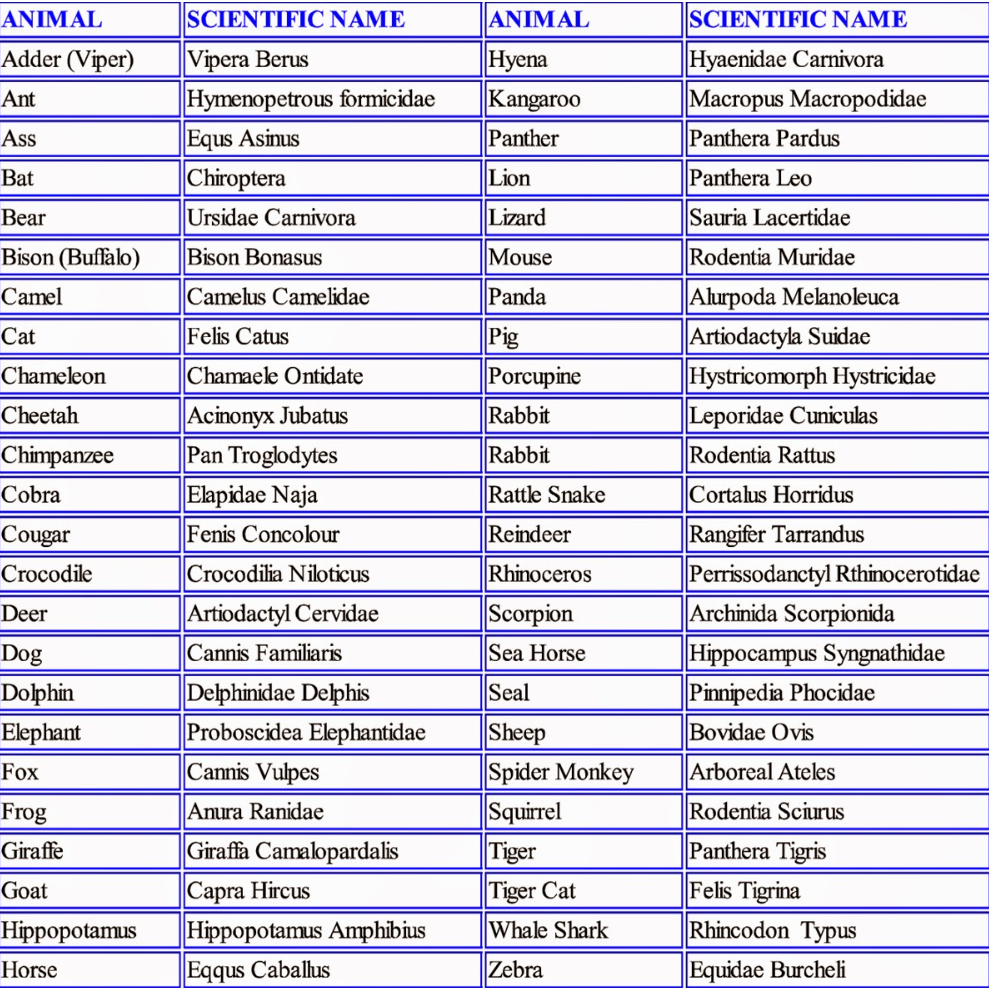
Animals and Their Scientific Names
Mammals
Canis lupus – Gray Wolf
Felis catus – Domestic Cat
Panthera leo – Lion
Equus caballus – Horse
Bos taurus – Cow
Birds
Aquila chrysaetos – Golden Eagle
Corvus corax – Common Raven
Struthio camelus – Ostrich
Tyto alba – Barn Owl
Anas platyrhynchos – Mallard Duck
Reptiles
Crocodylus niloticus – Nile Crocodile
Python reticulatus – Reticulated Python
Testudo graeca – Greek Tortoise
Chelonia mydas – Green Sea Turtle
Vipera berus – European Adder
Amphibians
Rana temporaria – Common Frog
Bufotes viridis – European Green Toad
Hyla arborea – European Tree Frog
Ambystoma mexicanum – Axolotl
Bombina bombina – Fire-bellied Toad
Fish
Sphyraena barracuda – Great Barracuda
Amphiprioninae – Clownfish
Salmo salar – Atlantic Salmon
Pterois volitans – Lionfish
Gadus morhua – Atlantic Cod
Insects
Apis mellifera – Honey Bee
Formica rufa – Red Wood Ant
Papilionoidea – Butterflies
Scarabaeus sacer – Sacred Scarab Beetle
Drosophila melanogaster – Fruit Fly
Why Scientific Names Matter in Biology
Scientific names form the foundation of biological classification and research. They enable precise communication, support accurate species identification, and help prevent misunderstandings caused by varying common names. This standardised naming system is essential for studying biodiversity, tracking species distribution, and protecting endangered animals.
The examples listed above represent only a small fraction of Earth’s immense biological diversity, highlighting the importance of scientific classification in understanding the animal kingdom.