Quick Top 10 Facts about Blue-Gray Gnatcatcher Bird
| SCIENTIFIC NAME | Polioptila caerulea |
| CLASSIFICATION |
KINGDOM: Animalia PHYLUM: Chordata CLASS: Aves ORDER: Passeriformes FAMILY: Polioptilidae GENUS: Polioptila SPECIES: Polioptila caerulea |
| SIZE | Small songbird, about 10–12 cm in length, weighing around 6–10 grams |
| HABITAT | Woodlands, forest edges, and scrubby habitats across North America |
| DIET | Primarily insects, including gnats, flies, and small spiders |
| SPECIES | Only one species, the Blue-Gray Gnatcatcher |
| COUNTRY | Found across North America, primarily in the United States, Mexico, and parts of Central America |
| GESTATION PERIOD | Incubation period for eggs lasts about 12–14 days |
| LIFE SPAN | Typically 3–6 years in the wild |
| CONSERVATION STATUS | Least concern, though habitat loss can impact local populations |
Amazing Facts About Blue-Gray Gnatcatcher Bird
1. Agile and quick
The Blue-Gray Gnatcatcher is known for its energetic foraging, darting through branches and shrubs in search of insects.
2. A tiny bird with a big personality
Despite their small size, these birds are very vocal and often have an active and feisty demeanor.
3. Expert insect hunters
They are skilled at catching small insects, which is why they are often seen flitting among the trees and shrubs, hunting for food.
4. Distinctive tail movement
They often move their tails in an exaggerated manner, which helps them balance while searching for food.
5. Seasonal migration
Blue-Gray Gnatcatchers migrate from the southern United States to Mexico and Central America for the winter.
6. Unique vocalizations
Their calls are high-pitched and can be described as a series of rapid, sharp “tsip” sounds, often used to communicate with mates or defend territory.
7. They build intricate nests
They construct cup-shaped nests in trees and shrubs, using twigs, leaves, and even spider silk to secure them.
8. They have a distinctive blue-gray color
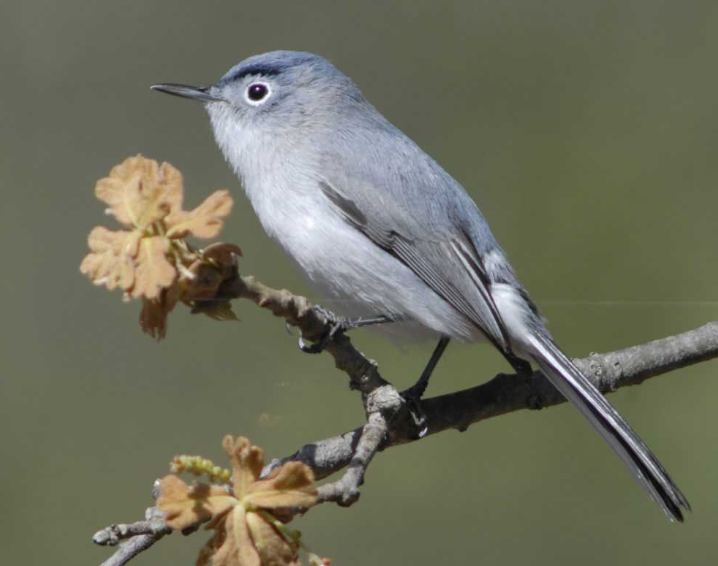
As their name suggests, Blue-Gray Gnatcatchers have a striking blue-gray coloration with a white underside, making them easily recognizable.
9. They are excellent at camouflaging
Their muted blue-gray color helps them blend into their natural habitat, protecting them from predators.
10. They are part of a larger family of small songbirds
The Blue-Gray Gnatcatcher belongs to the Polioptilidae family, which includes other small insect-eating birds found in North and South America.
Small size, blue-gray plumage, and distinctive long tail
The little bird known as the Blue Grey Gnatcatcher is found throughout North America. It may be identified by its distinctive blue-gray plumage and long, thin tail. This bird is small, measuring around 4.5 inches in length and 0.3 ounces in weight. Despite its small size, the Blue Grey Gnatcatcher is a restless and quick bird that often darts about in search of insects to eat.
Blue-Gray Gnatcatcher bird and its significance in the avian world
One interesting feature of the Blue Grey Gnatcatcher is its unique way of foraging. It is said to hover in midair, like a hummingbird, and gather insects on its wings. Its inclination allows it to swiftly and accurately pick insects out of the air. When constructing its nest, the Blue Grey Gnatcatcher is also known to use spider silk to blend in with the tree branches.
Distribution across North and Central America, including specific regions or countries
The blue-grey gnatcatcher is a migratory bird that spends its breeding season in North America before migrating to Central America or the Caribbean in the winter. During the mating season, the male Blue Grey Gnatcatcher participates in intricate courtship displays to woo a mate. These displays are often carried out by the male by fluffing up its feathers, spreading its tail, and singing a challenging song. The female Blue Grey Gnatcatcher selects a mate based on the male’s ability to provide for her and their offspring after these displays.
Fascinating facts about Blue-Gray Gnatcatcher Bird
North and Central America are home to the little, insectivorous Blue Grey Gnatcatcher bird. Birdwatchers and wildlife lovers love this bird for its unique blue-grey coloration and energetic activity. Below is some fascinating information about the Blue Grey Gnatcatcher, including:
Physical appearance of the Blue Gray Gnatcatcher bird
The Blue Grey Gnatcatcher is a little bird, barely a few grammes in weight and around 4.5 inches in length. Its upper body is blue-grey, its underbelly is white, and its tail is long, narrow, and black. The male bird’s blue-grey colouring is somewhat darker than the female’s, although both birds have comparable appearances.
Preferred habitats of the Blue Gray Gnatcatcher bird, such as woodlands, forests, or shrubby areas
These birds like living in shrubby habitats, mixed woods, and deciduous forests. They are also seen in heavily vegetated parks and gardens. The Blue Grey Gnatcatcher is renowned for its skill in navigating through thick vegetation by using its long tail as a balance aid.
Foraging techniques, such as gleaning insects from foliage or catching them mid-air
A bird of great agility and activity is the blue-grey gnatcatcher. It is always moving, darting from branch to branch in its quest for insects. It is well-known for its unusual “gnat-catching” habit, in which it catches insects on the wing by hovering in midair. The bird gets its name from this habit.
Behaviour of the Blue Gray Gnatcatcher bird, including its active and energetic nature
Because they are insectivores, Blue Grey Gnatcatchers mostly consume tiny insects like beetles, flies, and mosquitoes. They’ve also been seen to consume caterpillars and spiders. They fly quickly and perform acrobatic flights during their foraging activities, searching among leaves and branches for prey.
Breeding habits of the Blue Gray Gnatcatcher bird, including its monogamous nature
In most cases, Blue Grey Gnatcatchers breed from April through July. They use lichens, plant fibres, and spider silk to construct tiny, cup-shaped nests. These nests are often concealed by bushes and trees’ foliage. The female spends around two weeks incubating her three to five eggs. Until the hatchlings fly, both parents alternately feed them.
Unique vocalisations of the Blue Gray Gnatcatcher bird
The vocalisations of the Blue Grey Gnatcatcher are renowned for being intricate and diverse. It calls with a nasal, high-pitched sound that resembles a gentle “tsee.” In order to entice a mate and protect its territory, the male sings a sequence of fast, high-pitched notes throughout the breeding season. All day long, one may hear these tunes.
Migration patterns of the Blue Gray Gnatcatcher bird
Birds that migrate are blue-grey gnatcatchers. They travel to regions of Mexico, Central America, and the southern United States throughout the winter. In the spring, they migrate back to North America, where they reproduce. Food availability and the suitability of nesting locations affect their movement patterns.
Information on the conservation status of the Blue Gray Gnatcatcher bird
As of right now, the Blue Grey Gnatcatcher is not considered a threatened species. However, their population faces serious problems because of habitat loss and fragmentation. The major goals of conservation initiatives are to protect and restore the animals’ preferred habitats, which include protecting old forests and establishing migratory routes.

Interesting facts about this unique bird: Blue-Gray Gnatcatcher Bird
The unique coloration, lively activity, and small size of the Blue Grey Gnatcatcher make it an intriguing bird to watch. It is an amazing creature to see because of its capacity to fly, collect insects on the wing, and manoeuvre through thick vegetation. We can grasp the significance of protecting these birds’ habitats and guaranteeing their continued existence by learning more about them.
FAQ (Frequently Asked Questions) about Black Rat Snake
Q: What is a Black Rat Snake?
Ans: The Black Rat Snake (Pantherophis obsoletus) is a non-venomous snake native to North America. Known for its glossy black coloration and impressive size, it is often found in forests, fields, and suburban areas. It is an excellent climber and can often be seen in trees or high vegetation, where it hunts for small mammals, birds, and eggs.
Q: How big does a Black Rat Snake get?
Ans: Black Rat Snakes can grow to impressive lengths, with adults typically measuring between 4 to 6 feet (1.2 to 1.8 meters) long. However, some individuals can reach up to 8 feet (2.4 meters), making them one of the largest snakes in their range. Their long, slender bodies are adapted for climbing and constricting prey.
Q: Where are Black Rat Snakes found?
Ans: Black Rat Snakes are native to the eastern United States and are commonly found in woodlands, grasslands, and agricultural areas. They are also commonly found in suburban and rural areas where they seek shelter in barns, sheds, or even attics. They are adaptable and can thrive in a variety of habitats as long as they have access to suitable prey and shelter.
Q: What do Black Rat Snakes eat?
Ans: Black Rat Snakes are constrictors and primarily feed on small mammals, such as rats, mice, and squirrels. They also prey on birds, bird eggs, and occasionally amphibians. Their excellent climbing ability allows them to hunt birds in trees, and they are known for their ability to control rodent populations in agricultural settings.
Q: Are Black Rat Snakes dangerous?
Ans: No, Black Rat Snakes are non-venomous and pose no direct threat to humans. They are generally calm and will avoid confrontation if given the opportunity. If threatened, they may attempt to flee or, in rare cases, may flatten their bodies and hiss loudly to deter predators. They are beneficial in controlling rodent populations.
Q: How do Black Rat Snakes reproduce?
Ans: Black Rat Snakes reproduce by laying eggs. The female lays between 10 to 30 eggs in a warm, humid location, such as rotting logs, mulch piles, or under rocks. The eggs hatch after about two months, and the baby snakes are fully independent from birth. Juvenile Black Rat Snakes resemble adults, but with a pattern of light and dark markings that fade as they mature.
Q: How long do Black Rat Snakes live?
Ans: Black Rat Snakes can live up to 20 years in captivity, although their lifespan in the wild is typically shorter, around 10 to 15 years, due to predation and environmental factors. Their lifespan can be influenced by factors such as habitat quality, food availability, and human activity.
Q: What is the habitat of a Black Rat Snake?
Ans: Black Rat Snakes are highly adaptable and can be found in a variety of habitats, including forests, grasslands, agricultural fields, and suburban areas. They are excellent climbers and often seek shelter in trees, barns, sheds, or under rocks. They thrive in areas with abundant cover and access to prey like rodents and birds.
Q: How do Black Rat Snakes behave?
Ans: Black Rat Snakes are primarily nocturnal, hunting at night and resting during the day. They are solitary animals, only coming together for mating. They are excellent climbers and swimmers, often seen navigating trees or water. When threatened, they may hiss, vibrate their tails, or even strike, but they typically try to avoid confrontation.
Q: Are Black Rat Snakes good pets?
Ans: Black Rat Snakes can make good pets for experienced snake owners, as they are relatively docile and easy to care for. They are also known for their long lifespan and can adapt well to captivity if provided with proper care, including a suitable enclosure, temperature, humidity, and a proper diet of rodents. However, they require a large space to move and climb, making them better suited for more experienced reptile keepers.
#BlackRatSnake, #Snake, #Constrictor, #NonVenomousSnake, #Wildlife, #SnakeLovers, #ReptileCare, #WildlifeConservation, #RodentControl, #SnakeSpecies, #NorthAmericanSnakes
Our sources and references about Black Rat Snake
1: Wikipedia – Black Rat Snake
2: Virginia Wildlife – Black Rat Snake
3: Reptiles Magazine – Black Rat Snake
4: Snakes for Pets – Black Rat Snake