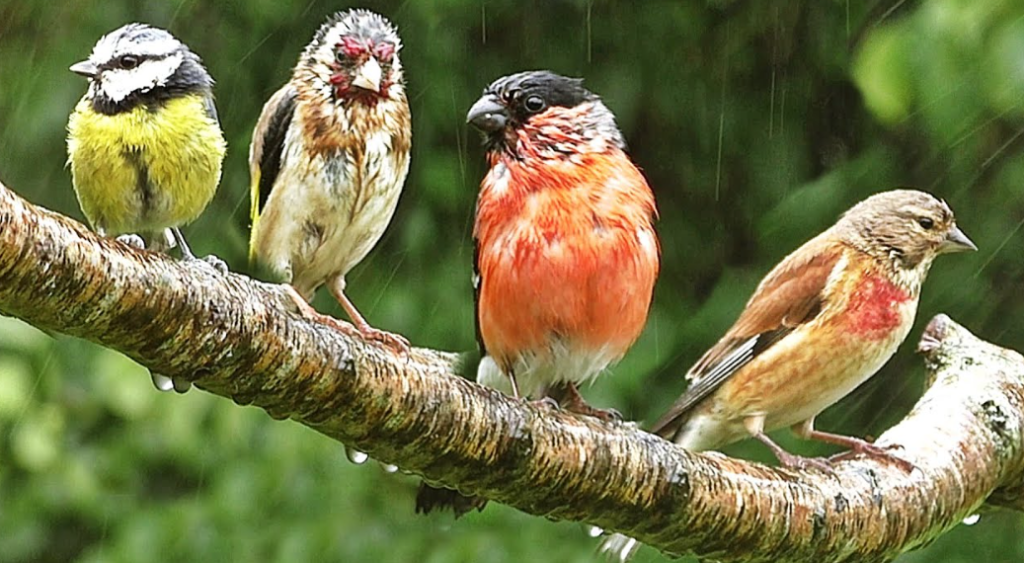
Birds are warm-blooded, egg-laying animals with feathers, wings, and beaks. Found all over the world, they range from tiny hummingbirds to large ostriches. Most birds can fly, though some, like penguins and emus, cannot. Birds play important roles in nature, such as pollination, seed spreading, and pest control. Their songs, colors, and behaviors make them fascinating to observe and study.
Quick Top 10 Facts about Birds
| SCIENTIFIC NAME | Aves |
| CLASSIFICATION | KINGDOM: Animalia PHYLUM: Chordata CLASS: Aves |
| SIZE | Varies by species; from the 2-inch (5 cm) hummingbird to the 9-foot (2.7 m) ostrich |
| HABITAT | Found on every continent and in nearly every environment—forests, wetlands, deserts, mountains, and urban areas |
| DIET | Omnivores, carnivores, herbivores—depends on species; diets include insects, seeds, nectar, fruits, fish, or small mammals |
| SPECIES | Over 10,000 recognized bird species worldwide, ranging from songbirds to birds of prey to flightless birds |
| COUNTRY | Global distribution; every country has native or migratory bird populations |
| GESTATION PERIOD | Varies by species; incubation ranges from 10 days (small birds) to over 80 days (some large birds) |
| LIFE SPAN | From 2–5 years (small birds) to 30–60+ years (parrots, eagles, and other large birds) |
| CONSERVATION STATUS | Varies widely; while many bird species are thriving, others are endangered due to habitat loss, climate change, and human activity |
Amazing Facts About Birds
1. Birds are the only living descendants of dinosaurs
Modern birds evolved from a group of two-legged dinosaurs known as theropods, making them distant relatives of the mighty T. rex.
2. Birds have hollow bones
Their bones are lightweight and hollow, which helps them stay light for flight while still being strong enough to support their bodies.
3. Not all birds can fly
While flight is a defining trait for most birds, some species like ostriches, emus, and penguins have evolved to live without flight.
4. Birds have feathers—unique to them
Feathers are a defining feature of birds, used for flight, insulation, camouflage, and courtship displays.
5. Some birds are incredible navigators
Many bird species, like Arctic Terns and pigeons, can travel thousands of miles using the Earth’s magnetic field and celestial cues.
6. Birds have excellent vision
Birds often have better eyesight than humans, with some species capable of detecting ultraviolet light and seeing with extreme precision.
7. They communicate in complex ways
Birds use songs, calls, and body language to communicate, with some species able to mimic human speech or sounds from their environment.
8. Bird eggs come in many shapes and colors
Birds lay eggs that can be speckled, brightly colored, or camouflaged, depending on the species and nesting environment.
9. Some birds are super smart
Species like crows, ravens, and parrots are among the most intelligent animals on Earth, capable of problem-solving, tool use, and even self-awareness.
10. Birds play vital roles in ecosystems
Birds help control pest populations, pollinate plants, disperse seeds, and even clean up carcasses as scavengers, making them essential to ecological balance.
Intriguing facts about Birds as incredible creatures
Birds are incredible creatures that belong to the Aves class and are differentiated by their ability to fly. They are warm-blooded, beaked, feathery creatures that deposit hard-shelled eggs. There are many different sizes of birds, from the tiny hummingbird to the massive ostrich. They inhabit a range of habitats, including towns, meadows, forests, and deserts.
Incredible diversity of bird species and unique characteristics of every species
One astonishing fact about birds is their tremendous diversity. There are about 10,000 recognised species of birds, and each has unique characteristics and adaptations. The peregrine falcon, for example, is known for its incredible speed during its hunting dives; it has been recorded to reach speeds of up to 240 miles per hour. On the other hand, the kiwi bird, which is native to New Zealand, is unable to fly and has adapted to live at night.
Importance of birds in ecosystems to maintain ecological balance
Ecosystems depend on birds for survival. They are essential for pollinating plants, dispersing seeds, and controlling pest populations. Many plants rely on birds to transfer pollen from one flower to another, aiding in their reproduction. In addition, birds consume a vast quantity of insects, which aids in regulating their population. Some birds, like vultures, are vital in clearing dead animals from the area and gathering food scraps, which prevents the spread of disease.
Physical adaptations of birds for flight and survival
Birds are fascinating creatures with a wide variety of habits and adaptations. Their differences in settings and physical characteristics are astonishing. Recognising the importance of birds and the necessity for their preservation requires an understanding of the varied roles they play in ecosystems.

Classification of birds into different groups based on physical characteristics
With their wide variety of colours and behaviours, along with their ability to soar, birds are among the most amazing animals in the world. These amazing bird facts will astound you and make you appreciate these winged marvels.
Quirky behaviors and characteristics that make birds fascinating creatures
The only animals that can fly are birds. The ability of birds to fly is one of their most amazing traits. The only creatures with the ability to really fly are birds, while other mammals, like bats, may glide through the air. Their distinct skeletal structure, robust wings, and light body allow them to glide gracefully and nimbly through the air.
Examples of bird species known for their remarkable cognitive abilities
Birds, which range in size from the enormous eagle to the small hummingbird, have developed a variety of flying styles to meet their demands. While certain birds, like the hummingbird, can hover in midair, others, like the albatross, can fly great distances without beating their wings. In contrast, the Swift is renowned for its amazing speed—it can reach up to 69 miles per hour.
Features help birds adapt to their environments and perform various functions
The Amazing Adaptations of Birds can survive in a variety of habitats thanks to the vast range of adaptations that they have developed. One such adaptation is the size and form of their beaks, which vary according to the food that the bird eats. For instance, an eagle’s sharp, hooked beak is appropriate for ripping into food, while a hummingbird’s long, curved beak is wonderful for drinking nectar from blossoms.
Unique physical features of birds, including feathers, beaks, and wings
Feathers are yet another amazing adaptation seen in birds. Feathers are essential for flying, in addition to providing insulation and protection. Birds are able to produce lift and regulate their direction in the air due to the distinctive structure of their feathers. Furthermore, birds employ their amazing variety of colour-changing feathers for concealment, mating displays, and communication.
The importance of communication in bird behavior and social interactions
Birds communicate and have complex behaviours with other birds. Birds have sophisticated behaviours and sophisticated communication, in addition to being visually stunning. To entice mates, several bird species perform complex courting rituals. These customs may include complex dances, breathtaking feather displays, and beautiful singing.
The various ways in which birds communicate with each other
When it comes to singing, birds are renowned for having amazing vocal range. Every type of bird uses a different song to communicate with other species. Birds sing to mark their territory, entice mates, and alert others to impending danger. Certain birds may even replicate the melodies of other bird species, such as the mockingbird.
Communication with calls and body language of birds
Birds use visual displays as a means of communication in addition to vocals. For instance, the penguin engages in complex courting rituals that include elaborate displays and motions, while the peacock uses its lavish tail feathers to entice females.

Learning about and appreciating the beauty and importance of birds in nature
With their astounding adaptations, sophisticated behaviours, and sophisticated communication systems, birds are really amazing animals. Learning more about birds may enhance your enjoyment of the natural world, regardless of whether you’re an aficionado or just find these feathery animals to be beautiful. Consider the beauty of nature and the astounding range of bird species that call our planet home the next time you see a bird flying through the skies or singing its beautiful song.
FAQ (Frequently Asked Questions) about Birds
Q: What are birds?
Ans: Birds are warm-blooded vertebrates characterized by feathers, beaks, and laying hard-shelled eggs. They belong to the class Aves and are known for their ability to fly, although some species, like ostriches and penguins, are flightless. Birds are found all over the world and inhabit diverse ecosystems, from forests and deserts to wetlands and oceans.
Q: How many species of birds are there?
Ans: There are over 10,000 known species of birds around the world. These species vary greatly in size, shape, color, behavior, and habitat. From tiny hummingbirds to large flightless birds like the ostrich, birds represent one of the most diverse classes of animals on Earth.
Q: What do birds eat?
Ans: Birds have a wide range of diets depending on the species. Some birds eat seeds, fruits, and nectar, while others feed on insects, small mammals, fish, or carrion. Birds like hawks and eagles are carnivorous predators, while species like finches and parrots are primarily herbivorous or omnivorous.
Q: How do birds fly?
Ans: Birds are able to fly due to their lightweight skeletons, powerful flight muscles, and specially adapted wings. Their feathers help provide lift and control. Not all birds can fly, though — some, like penguins and ostriches, have evolved for swimming or running instead of flight.
Q: Where do birds live?
Ans: Birds live in almost every environment on Earth. They can be found in forests, grasslands, deserts, wetlands, oceans, cities, and mountains. Each species is adapted to its habitat with specialized behaviors, nesting preferences, and feeding strategies.
Q: How do birds communicate?
Ans: Birds communicate through songs, calls, and visual displays. Vocalizations can serve many purposes, including attracting mates, defending territory, warning of predators, or coordinating movement within flocks. Some birds are also known for their ability to mimic sounds and human speech.
Q: How do birds reproduce?
Ans: Most birds reproduce by laying eggs. After mating, the female lays eggs in a nest, and either one or both parents may incubate them until they hatch. Bird chicks may be born helpless (altricial) and require care, or more independent (precocial), depending on the species.
Q: Why do birds migrate?
Ans: Many birds migrate seasonally to take advantage of favorable climates and food availability. For example, some species breed in the northern hemisphere during summer and fly south for the winter. Migration helps birds access the best resources for survival and reproduction throughout the year.
Q: Are birds intelligent?
Ans: Yes, many bird species are highly intelligent. Birds such as crows, parrots, and ravens have demonstrated problem-solving abilities, tool use, and complex social behaviors. Some species can mimic human speech and have excellent memories and learning capabilities.
Q: Are birds endangered?
Ans: Unfortunately, many bird species are endangered or threatened due to habitat destruction, climate change, pollution, and hunting. Conservation efforts are underway globally to protect bird populations and their habitats through protected areas, education, and research.
#Birds, #BirdWatching, #Wildlife, #Feathers, #Flight, #Aves, #BirdFacts, #BirdHabitat, #EndangeredBirds, #BirdMigration, #NatureLovers, #AnimalKingdom
Our sources and references about Birds
1: Wikipedia – Birds
2: Encyclopaedia Britannica – Bird
3: Audubon Society – All About Birds
4: Cornell Lab of Ornithology – All About Birds