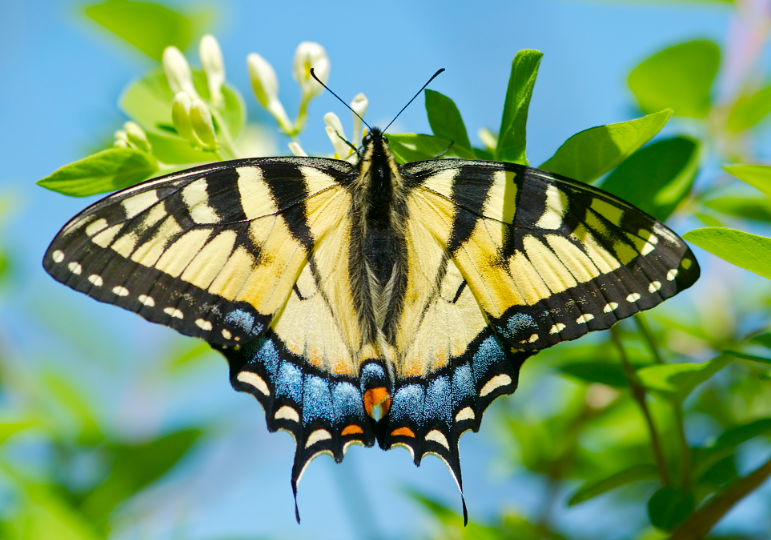
The Swallowtail Butterfly is a large and colorful member of the family Papilionidae, known for its striking wing patterns and tail-like extensions on the hindwings that resemble the tail of a swallow. Found across the world, these butterflies are known for their beauty, agility in flight, and important role as pollinators. Swallowtails often emerge from bright green or brown chrysalises after completing their caterpillar stage and can be seen fluttering around gardens and wildflower meadows. Their vibrant colors often serve as a warning to predators, and many species are mimicked by other butterflies.
Quick Top 10 Facts about Swallowtail Butterfly
| SCIENTIFIC NAME | Papilio spp. (various species) |
| CLASSIFICATION | KINGDOM: Animalia PHYLUM: Arthropoda CLASS: Insecta ORDER: Lepidoptera FAMILY: Papilionidae GENUS: Papilio SPECIES: Various (e.g., Papilio machaon, Papilio polyxenes) |
| SIZE | Wingspan: 2.5–6 inches (6–15 cm) |
| SPECIES | There are over 550 species of Swallowtail butterflies around the world, including the Old World Swallowtail, Eastern Tiger Swallowtail, and Giant Swallowtail. |
| APPEARANCE | Swallowtails are easily recognized by their large, colorful wings and distinctive “tails” on their hindwings. Colors range from yellow and black to blue, green, and red, often with intricate patterns. |
| LIFE SPAN | 2 weeks to 1 month as adult butterflies |
| HABITAT | They inhabit meadows, gardens, forests, riverbanks, and open fields, especially in warm and temperate climates where host plants are available. |
| DIET | Adult Swallowtail butterflies feed primarily on nectar from flowers. Some may also feed on rotting fruit, sap, or even animal dung for minerals. |
| NATURAL PREDATORS | Birds, spiders, frogs, and predatory insects. Their bright colors, fast flight, and mimicry help protect them from predation. |
| COUNTRY | Found globally in North America, Europe, Asia, Africa, and Australia |
| GESTATION PERIOD | Butterflies do not gestate; females lay eggs on host plants. Eggs hatch in 3–9 days into caterpillars, which pupate after 2–4 weeks and then emerge as butterflies. |
| CONSERVATION STATUS | Many Swallowtail species are of Least Concern, but some (like the Palos Verdes Blue and Jamaican Swallowtail) are endangered due to habitat loss and climate change. |
Amazing Facts About Swallowtail Butterfly
1. Unique Hindwing Tails
Swallowtail butterflies are named after the tail-like extensions on their hindwings, which resemble a swallow’s tail and may confuse predators.
2. Important Pollinators
Swallowtails play a key role in pollination, transferring pollen as they move from flower to flower to feed on nectar.
3. Bright and Bold Colors
Their vibrant colors not only make them beautiful but also serve as a warning to predators about their unpalatability.
4. Mimicry for Survival
Some Swallowtail butterflies mimic toxic species like the Pipevine Swallowtail to deter predators, a survival tactic known as Batesian mimicry.
5. Complex Metamorphosis
Like all butterflies, Swallowtails undergo complete metamorphosis—egg, larva (caterpillar), pupa (chrysalis), and adult.
6. Some Are Migratory
Certain Swallowtail species migrate long distances in search of food or better breeding grounds.
7. Sexually Dimorphic
In many species, males and females look different—sometimes drastically so—with variations in size, shape, or coloration.
8. Excellent Fliers
Swallowtails are agile and powerful fliers, making them hard for predators to catch and fun to observe in gardens.
9. Diverse Range of Species
Swallowtail butterflies include hundreds of species spread across almost every continent, adapted to a wide range of ecosystems.
10. Cultural Symbols
In many cultures, Swallowtail butterflies represent transformation, joy, and the soul due to their beauty and metamorphic life cycle.
Intriguing facts about black swallowtail butterfly
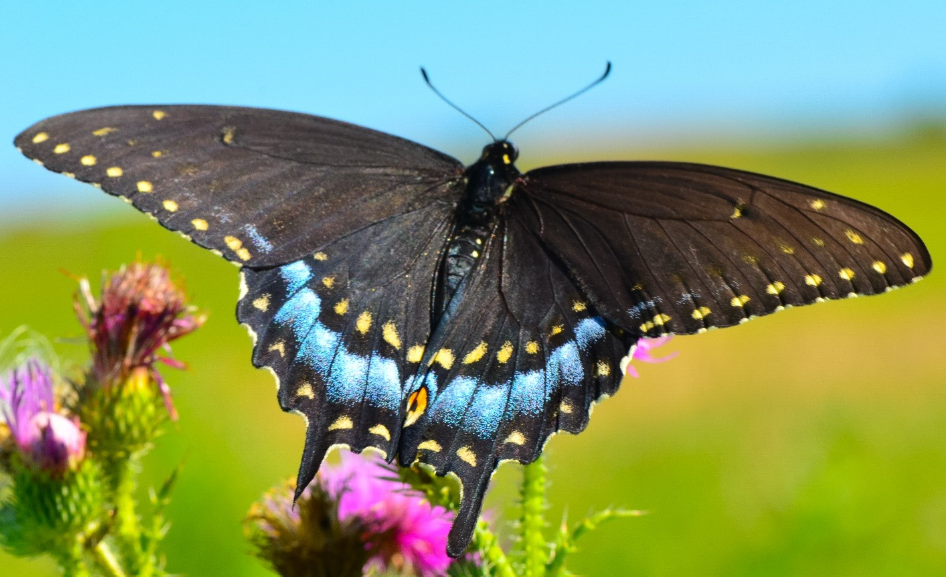
The black swallowtail, or Papilio polyxenes, is a species of butterfly that is found over most of North America. It is well known for having an amazing appearance, with patterns on its wings that alternate between black and yellow. Compared to the male Black Swallowtail, the female has more blue on her hindwings. The wing patterns of the two swallowtail species vary somewhat.
Life cycle of the black swallowtail butterfly
The Black Swallowtail undergoes a complete metamorphosis, starting with an egg and culminating in a stunning butterfly, pupa, and caterpillar. The plant that the caterpillars usually lay their eggs on serves as their primary food source, along with carrot tops, dill, parsley, and fennel. The black caterpillars with white and yellow markings travel through several moults before turning into chrysalis.
Unique behaviours or characteristics of black swallowtail butterflies
Because the Black Swallowtail may mimic the deadly Pipevine Swallowtail butterfly, predators are deterred from pursuing it. Predators find it challenging to distinguish between the two species because they imitate the behaviour and wing patterns of their victims. The Black
Defense mechanisms such as camouflage and mimicry of the black swallowtail butterfly
Swallowtail has a unique defence mechanism called “osmeteria,” which enables it to expel an unpleasant stink from glands behind its head in an effort to deter predators even more. Black Swallowtail is a magnificent species of butterfly that showcases the wonders of nature with its spectacular look, life cycle, and defence mechanisms. This beautiful butterfly demonstrates its adaptability and survival strategies by mimicking other species and using an awful odour as a protective mechanism.
Fascinating facts about black swallowtail butterflies
In North America, the Black Swallowtail (Papilio polyxenes) is a common species of butterfly. It is a favourite among butterfly aficionados because of its stunning black colouring and lovely markings. We shall look at some amazing Black Swallowtail facts below:
Description of physical characteristics of black swallowtail butterflies
The female Black Swallowtail is somewhat bigger than the male, having a wingspan of around 2.5 to 4 inches. The majority of the top half of the wings is black, with a row of yellow patches close to the margins. Orange dots and a blue stripe adorn the hindwings. The majority of the underside of the wings is yellow, with orange dots and black veins.
Natural habitats for black swallowtail butterflies
There are several areas where the black swallowtail may be found, including fields, gardens, meadows, and open forests. They are drawn to places with plenty of host plants and nectar sources, such as carrots, dill, fennel, and parsley. The larvae eat these plants, while the adult butterflies drink their nectar.
Life cycle of black swallowtail butterflies, including egg, caterpillar, chrysalis, and adult stages
There are four phases in the life cycle of a black swallowtail butterfly: the egg, caterpillar, pupa, and adult. Usually on the underside of the leaves of the host plants, the female butterfly deposits her eggs. The spherical little eggs hatch in four to ten days.
Black swallowtail butterfly caterpillar, its diet, and growth
The caterpillars emerge from the eggs and begin eating the host plants. As they develop, the caterpillars go through many instars and lose their skin. Their look is distinctive, including orange dots and black and white stripes. 2-4 weeks is how long the caterpillar stage lasts, depending on the environment and the availability of food.
Chrysalis formation and transformation process of black swallowtail butterflies
The black swallowtail transforms into a chrysalis after reaching the caterpillar stage. Usually green or brown, the chrysalis disappears into the surrounding foliage. Over the course of 10–20 days, the caterpillar within the chrysalis changes into a butterfly.
Process of forming of black swallowtail butterflies
After completing its metamorphosis, the mature butterfly emerges from its cocoon. The wings of the freshly emerging butterfly are crinkled and damp, but they soon spread out and become dry. The butterfly gets prepared for its first flight after a few hours.
Beauty and uniqueness of black swallowtail butterflies
Strong in flight, the Black Swallowtail is often seen soaring through the skies with elegance. Because they are diurnal, they are active throughout the day, with sunny days being their most active times. It is particularly difficult to photograph them in flight due to their unpredictable flying style.
Puddling behavior in black swallowtail butterflies
In a behavior known as “puddling,” these butterflies congregate in swarms to feed on decomposing organic debris, mud, or animal droppings. It is thought that the butterflies get vital nutrients and minerals from this behaviour.
Black swallowtail butterfly and its natural beauty
A captivating butterfly species, the black swallowtail enthrals with its refined beauty and exquisite flight. These magnificent animals have a lot to teach us about their remarkable black colouring and unusual life cycle. Pause and appreciate the wonder and beauty of the Black Swallowtail, whether you see them in your backyard or in the wild.
FAQ (Frequently Asked Questions) about Swallowtail Butterfly
Q: What is a Swallowtail Butterfly?
A: The Swallowtail Butterfly belongs to the family Papilionidae. It includes over 550 species known for their size, colors, and tail-like wing extensions.
Q: Where do Swallowtail Butterflies live?
A: These butterflies live on every continent except Antarctica. They thrive in forests, grasslands, gardens, and meadows.
Q: What do Swallowtail Butterflies eat?
A: Adults feed on flower nectar using their long proboscis. Caterpillars eat host plants like citrus, parsley, fennel, or pipevine.
Q: How big are Swallowtail Butterflies?
A: Their wingspans usually range from 3 to 6 inches. Some tropical species reach up to 8 inches (20 cm).
Q: Why do they have “tails” on their wings?
A: These tails help protect them. Predators may mistake the tails for heads and attack the wrong part, letting the butterfly escape.
Q: Are Swallowtail Butterflies endangered?
A: Most species are not endangered, but some, like the Palos Verdes Blue and Schaus’ Swallowtail, face threats from habitat loss and climate change.
Q: How long do Swallowtail Butterflies live?
A: Adults live for a few weeks to about a month. Their full life cycle may last several weeks to months.
Q: What is the life cycle of a Swallowtail Butterfly?
A: They go through complete metamorphosis: egg, larva (caterpillar), pupa (chrysalis), and adult.
Q: Do Swallowtail Butterfly migrate?
A: Some species, like the Anise Swallowtail, migrate locally. However, most do not migrate long distances like Monarchs.
Q: How can I attract Swallowtail Butterflies to my garden?
A: Plant nectar-rich flowers and host plants like dill and parsley. Avoid pesticides to make your garden butterfly-friendly.
#SwallowtailButterfly, #Butterflies, #Pollinators, #InsectFacts, #Papilionidae, #NatureLovers, #ButterflyGarden, #ButterflyLifeCycle, #WildlifeConservation, #CaterpillarToButterfly
Our sources and references about Swallowtail Butterfly
1: Wikipedia – Swallowtail Butterfly
2: USDA Forest Service – Swallowtail Butterflies
3: National Geographic – Swallowtail Butterflies
4: University of Florida – Giant Swallowtail