Salamanders are a diverse group of amphibians known for their ability to regenerate limbs, their secretive nature, and their unique habitats. These fascinating creatures can be found in various environments, from forests to caves, and are often associated with damp, cool areas. While many salamanders have external gills when young, most adults breathe through their skin or lungs. Salamanders are crucial to their ecosystems, acting as both predators and prey.
Quick Top 10 Facts about Salamanders
| SCIENTIFIC NAME | Caudata or Urodela |
| CLASSIFICATION | KINGDOM: Animalia PHYLUM: Chordata CLASS: Amphibia ORDER: Caudata (Urodela) |
| SIZE | Length: 3 cm to 1.8 meters (depending on the species) |
| SPECIES | Examples include the Eastern Newt, Axolotl, and the Giant Salamander. |
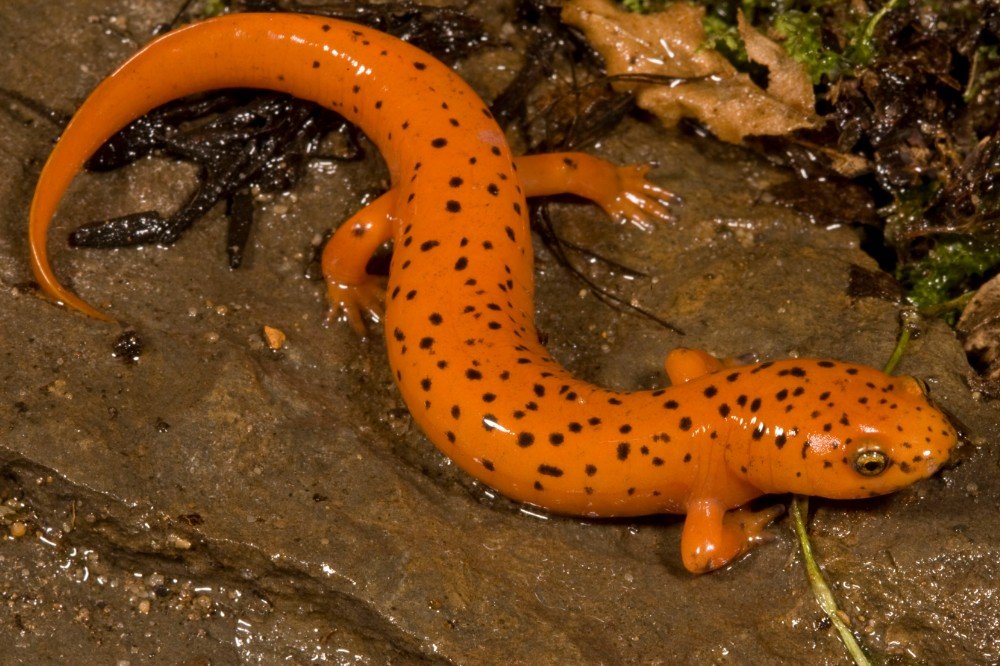
| APPEARANCE | Salamanders have elongated bodies, short legs, and smooth, moist skin. Many species are brightly colored to warn predators of their toxicity. |
| LIFE SPAN | Typically 5–20 years, depending on species |
| HABITAT | Salamanders thrive in moist, cool environments such as forests, caves, and freshwater streams. |
| DIET | Insects, earthworms, small invertebrates, and other small animals depending on their size. |
| NATURAL PREDATORS | Snakes, birds, larger amphibians, and mammals. |
| CONSERVATION STATUS | Many species are threatened or endangered due to habitat destruction, climate change, and pollution. |
Amazing Facts About Salamanders
1. Regeneration Powers
Salamanders are famous for their ability to regenerate lost limbs, spinal cords, and even parts of their hearts and eyes. This extraordinary ability has made them a subject of intense scientific study.
2. Aquatic and Terrestrial Stages
Many salamanders begin life in water with gills, but some, like the Axolotl, retain their aquatic form throughout their lives. Others transition to land once they mature.
3. Skin Breathers
Salamanders don’t rely on lungs alone. They breathe through their skin, which is why they need to stay moist. Their skin is also used for absorbing oxygen and expelling carbon dioxide.
4. Amazing Camouflage
Salamanders are often masters of camouflage. Many species have patterns that help them blend seamlessly into their environments, whether on the forest floor or under the water.
5. A Wide Range of Sizes
Salamanders come in many sizes. The smallest species, like the tiny Thorius, are just a few centimeters long, while the Chinese Giant Salamander can grow up to 1.8 meters (6 feet).
6. Vital to Ecosystems
Salamanders play an important role in controlling insect populations. They are both predators and prey, providing a food source for a wide variety of other animals while helping to maintain balance in their habitats.
7. Toxic Defenses
Some salamanders, like the Eastern Newt, produce toxins through their skin to deter predators. Their bright colors act as a warning signal, a phenomenon known as aposematism.
8. Species with a Secret: The Axolotl
The Axolotl is a species that can reproduce while still in its juvenile aquatic form, a phenomenon known as “neoteny.” This allows it to stay in the water throughout its entire life.
9. Ancient Creatures
Salamanders are among the oldest living amphibians, having existed for more than 150 million years. Their evolutionary history has been shaped by a variety of environmental changes.
10. Salamanders Are Silent
Unlike frogs and toads, salamanders do not vocalize. They communicate through body language and by secreting chemicals from their skin.
Salamander: An Intriguing Amphibian of Ancient Origins
Salamanders are captivating amphibians that intrigue biologists and nature enthusiasts due to their mysterious behaviours, diverse species, and remarkable adaptability. Found worldwide, they trace their origins back hundreds of millions of years. Salamanders belong to the order Caudata, which includes both aquatic and terrestrial species. Their wide range of sizes, colours, and ecological roles makes them a fascinating subject of study.
What is a Salamander?
A salamander is an amphibian with an elongated body, smooth skin, and a distinct tail. Often confused with lizards, salamanders belong to a separate taxonomic group, more closely related to frogs and toads. A defining characteristic is their tail, which persists throughout life.
There are over 700 species, distributed across North America, Europe, and Asia. Most prefer moist, temperate habitats, though some have adapted to caves, forests, and wetlands.
The Evolution of Salamanders
Salamanders have a rich evolutionary history, dating to the Late Devonian period over 350 million years ago. Early ancestors were among the first vertebrates to transition from water to land, yet they retained aquatic features like soft, permeable skin and a dependence on moisture. Over time, salamanders adapted to diverse environments while maintaining these ancient traits.
One remarkable adaptation is their regenerative ability. Many salamanders can regenerate lost limbs, tails, and even parts of the heart and eyes, a trait that has fascinated researchers and influenced regenerative medicine studies.
Physical Characteristics of Salamanders
Salamanders vary in shape, size, and colour, yet share common traits:
Body Structure
They typically have long, slender bodies with a head and distinct tail. Limbs are short and generally equal, though some species, like the axolotl, appear limbless. Salamanders have no scales; their smooth, moist skin aids respiration by allowing oxygen and moisture absorption.
Size
Species size varies from the Chinese giant salamander, reaching nearly 6 feet (1.8 m), to small lungless salamanders just a few inches long. Most species measure 3–8 inches (7–20 cm), though some grow larger.
Skin Colouration
Salamanders display a range of colours, from earthy browns and greens to vibrant orange, red, and yellow. Bright hues, like those of the Eastern newt, warn predators of toxicity. Others, such as axolotls, are pale pink or white. Mucus on their skin prevents dehydration and aids oxygen absorption.
Eyes and Senses
Salamander eyes are adapted to their environment. Cave-dwelling species may have reduced vision, relying on smell, touch, and vibration. Species in open areas often have larger eyes to detect movement.
Habitat and Distribution
Salamanders inhabit diverse environments, from lakes and rivers to damp forests and caves. North America hosts over half of all species, with others found in Europe, Asia, and parts of North Africa.
Aquatic vs. Terrestrial Habitats
Some salamanders are fully aquatic, like sirens, while others are semi-aquatic or terrestrial. Many newts transition from aquatic larvae to terrestrial adults. Moist habitats are essential for skin hydration, so salamanders thrive near streams, wetlands, or shaded forests.
Adaptations for Moisture
Highly aquatic species remain submerged throughout life. Terrestrial species, like lungless salamanders, absorb oxygen through their skin and rely on damp environments to survive.
Diet and Feeding Habits
Salamanders are carnivorous, feeding on invertebrates such as earthworms, insects, snails, slugs, and arthropods. Larger species may eat fish, frogs, and small mammals. Young larvae feed on plankton and aquatic insects, transitioning to larger prey as adults. Hunting generally involves ambush predation, striking when prey approaches.
Reproduction and Life Cycle
Salamanders exhibit diverse reproductive strategies. Most lay eggs in water, where larvae hatch and undergo metamorphosis. Some species, such as axolotls, remain neotenic, retaining juvenile traits and reproducing in their larval form.
Breeding and Courtship
Courtship varies by species. Males may deposit spermatophores for females to fertilise eggs, or use visual displays and scent to attract mates.
Egg Laying
Females lay eggs in protected, moist environments like soil, under rocks, or submerged in water. Eggs may hatch into aquatic larvae or direct-developing juveniles, depending on the species.

Conservation Status and Threats
While many salamanders are abundant, several face threats from habitat loss, pollution, climate change, and invasive species. Amphibians are among the most vulnerable animals, with some salamanders listed as endangered.
Climate Change
Rising temperatures and extreme weather disrupt breeding cycles and reduce suitable habitats for moisture-dependent species.
Habitat Destruction
Urbanisation, deforestation, and agriculture reduce wetlands and forest areas, endangering breeding and foraging grounds. Species like the Eastern hellbender and Chinese giant salamander face population declines due to pollution, habitat loss, and overexploitation.
Keeping Salamanders as Pets
Many species adapt well to captivity but require moist, controlled environments. Terrariums with shallow water features and regulated humidity are ideal. Proper diet, enclosure maintenance, and water quality monitoring are essential. Research species-specific requirements before keeping salamanders as pets.
FAQ (Frequently Asked Questions) about Salamanders
Q: Can salamanders regenerate their limbs?
Ans: Yes, salamanders are well-known for their remarkable ability to regenerate lost limbs, tails, and even parts of their spinal cords and organs.
Q: Where do salamanders live?
Ans: Salamanders prefer cool, moist environments. They are often found in forests, caves, and near freshwater sources like streams and ponds.
Q: Are salamanders dangerous?
Ans: Some species of salamanders produce toxins as a defense mechanism. However, most salamanders are not harmful to humans.
Q: How long do salamanders live?
Ans: Salamanders typically live between 5 and 20 years, although some species can live longer under optimal conditions.
Q: What do salamanders eat?
Ans: Salamanders are carnivorous and eat a variety of small prey, including insects, worms, snails, and other small invertebrates.
Q: Can salamanders breathe underwater?
Ans: Many salamanders have gills during their larval stage, but some species, such as the Axolotl, retain gills throughout their lives. Adult salamanders can also absorb oxygen through their skin.
Q: Why are salamanders important to ecosystems?
Ans: Salamanders help maintain the balance of ecosystems by controlling insect populations and serving as a food source for a variety of predators.
Q: What is the largest species of salamander?
Ans: The Chinese Giant Salamander is the largest species, reaching lengths of up to 1.8 meters (6 feet).
Q: Are salamanders endangered?
Ans: Many species of salamanders are threatened or endangered due to habitat destruction, climate change, and pollution. Conservation efforts are underway to protect them.
Q: How do salamanders communicate?
Ans: Salamanders communicate through body movements and chemical signals secreted from their skin. They do not make sounds like frogs or toads.
#Salamander #Amphibians #Wildlife #Regeneration #Nature #Axolotl #Ecosystems #EndangeredSpecies #ToxicDefenses #AnimalFacts
Our sources and references about Salamanders
1: Wikipedia – Salamander
2: National Geographic – Salamanders
3: ARKive – Salamanders