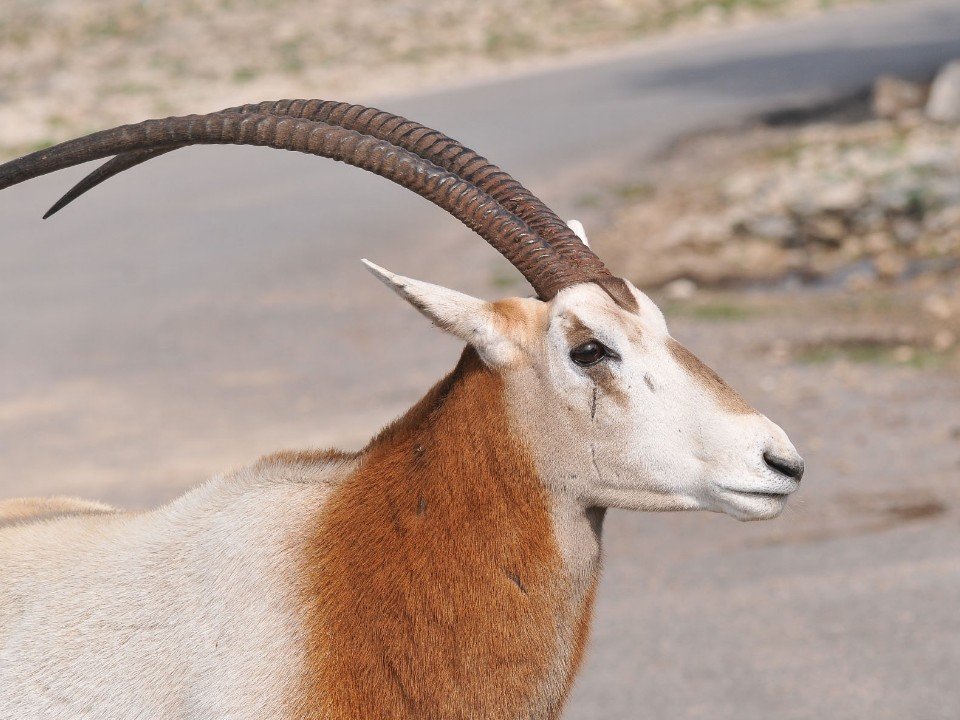
The Scimitar-horned Oryx is a striking antelope native to the Sahel and Sahara regions of North Africa. Once extinct in the wild due to overhunting and habitat loss, it has been successfully reintroduced through global conservation efforts. Recognizable by its long, backward-curving horns and white coat with reddish-brown markings, the Scimitar-horned Oryx is a symbol of successful wildlife restoration.
Quick Top 10 Facts about Scimitar-horned Oryx
| SCIENTIFIC NAME | Oryx dammah |
| CLASSIFICATION | KINGDOM: Animalia PHYLUM: Chordata CLASS: Mammalia ORDER: Artiodactyla FAMILY: Bovidae GENUS: Oryx SPECIES: O. dammah |
| SIZE | Height at shoulder: 90–136 cm (3–4.5 ft.) Weight: 90–210 kg (200–460 lbs.) Length: 1.5–2.3 m (4.9–7.5 ft.) |
| SPECIES | Single species: Oryx dammah |
| APPEARANCE | White coat with reddish-brown neck and chest; long, backward-curving horns; black markings on face; dark tail tuft. |
| LIFE SPAN | Up to 20 years in the wild; possibly longer in human care. |
| HABITAT | Sahelian grasslands and semi-desert regions of North Africa, particularly Chad, Niger, and Tunisia. |
| DIET | Grasses, herbs, acacia seedpods, wild melons, and other desert vegetation. |
| NATURAL PREDATORS | Spotted hyenas, African wild dogs, cheetahs, golden jackals, and vultures. |
| COUNTRY | Chad, Niger, Tunisia (reintroduced populations); formerly widespread across North Africa. |
| GESTATION PERIOD | Approximately 8–9 months; typically one calf per birth. |
| CONSERVATION STATUS | Endangered (IUCN Red List); previously extinct in the wild; successful reintroduction efforts ongoing. |
Amazing Facts About Scimitar-horned Oryx
1. Once Extinct in the Wild
The Scimitar-horned Oryx was declared extinct in the wild in 2000 due to overhunting and habitat loss. However, successful reintroduction programs have been initiated in Chad, Niger, and Tunisia.
2. Adapted to Desert Life
This antelope is well-adapted to life in arid environments. It can tolerate high body temperatures and go without water for extended periods, obtaining moisture from its diet.
3. Distinctive Horns
Both males and females possess long, backward-curving horns that can reach up to 1.5 meters (5 feet) in length. These horns are used for defense and in social interactions.
4. Social Behavior
Scimitar-horned Oryx are social animals, typically found in herds ranging from 15 to 30 individuals. These herds are led by a dominant male.
5. Night Grazers
They are primarily nocturnal, grazing during the cooler hours of the night and early morning to avoid the intense midday heat.
6. Reproductive Cycle
Females give birth to a single calf after a gestation period of 8–9 months. Calves are typically born during the rainy season when food is abundant.
7. Conservation Success
Through international conservation efforts, the Scimitar-horned Oryx has been reintroduced into protected areas in Chad, with around 400 individuals currently roaming the grass steppe.
8. Symbol of Restoration
The successful reintroduction of the Scimitar-horned Oryx serves as a model for other wildlife restoration projects and highlights the importance of conservation efforts.
9. Easily Managed in Captivity
Scimitar-horned Oryx adapt well to captive breeding programs, which has played a crucial role in their recovery and reintroduction to the wild.
10. Named for Their Horn Shape
The name “Scimitar-horned” refers to the shape of their long, curved horns, which resemble the scimitar sword traditionally used in the Middle East.
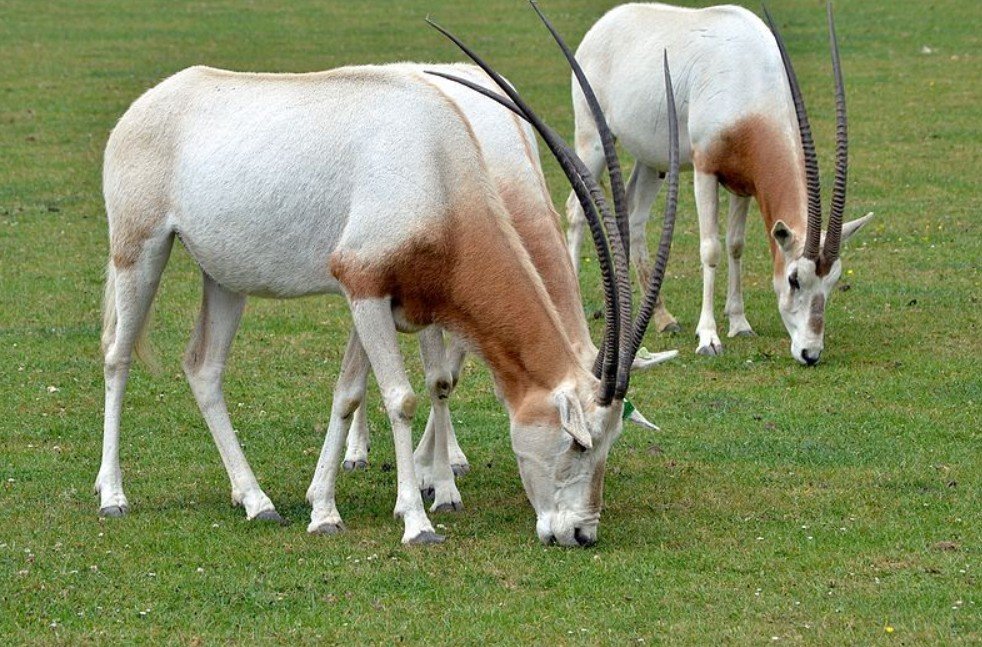
Oryx with Scimitar Horns: A Magnificent Desert Animal
One of the desert’s most amazing and magnificent creatures is the Scimitar‑Horned Oryx (Oryx dammah). This species has long captivated conservationists and wildlife lovers with its impressive scimitar‑shaped horns and elegant but robust body. Although considerable conservation and breeding efforts have raised hopes for the Scimitar‑Horned Oryx’s restoration to its natural habitats, the species was unfortunately proclaimed extinct in the wild in the early 2000s owing to habitat degradation, poaching, and other threats.
Below are the details for Scimitar‑Horned Oryx’s past, history, physical traits, behaviour, habitat, and conservation initiatives.
1. History and Habitat of the Oryx with Scimitar Horns
Original Range and Environmental Adaptation
The savannas and desert fringes of North Africa, especially those in Chad, Egypt, Mali, Mauritania, and Sudan, were previously home to the Scimitar‑Horned Oryx. It was well suited to the arid environments, where water was limited and daytime highs might reach very high levels.
Ecological Role and Nomadic Behavior
The Scimitar‑Horned Oryx, a herbivore that feeds on grasses, shrubs, and woody plants, has historically been an important member of its environment. It had a reputation for being nomadic, often moving to find food and water. Because of their strong herd instincts, they gathered in big numbers to defend themselves from predators and inclement weather.
Decline and Extinction in the Wild
Despite its flexibility, human activities has made the Scimitar‑Horned Oryx a greater danger over time. The species was driven to the verge of extinction by habitat degradation, domestic cattle grazing, and hunting pressures. The Scimitar‑Horned Oryx was deemed extinct in the wild by the early 2000s.
2. Physical Attributes of the Scimitar‑Horned Oryx
Size, Dimensions & Body Mass
- Height: Scimitar‑Horned Oryxes usually have a shoulder height of 4 to 4.5 feet (1.2 to 1.4 meters).
- Length: They typically measure 7 to 8 feet (2.1 to 2.4 meters) from the tip of the snout to the tail.
- Weight: Male oryxes are typically bigger than females, with a range of 400 to 600 pounds (180 to 270 kg) in weight.
Coloration & Camouflage
Because of its unique colour pattern, the Scimitar‑Horned Oryx blends in well with the arid desert environments. With deeper brown or black patterns on the face, legs, and shoulders, its coat is a gentle shade of white to light tan. In the desert habitat, these marks act as natural camouflage, helping the animal avoid predators and cope with the extreme heat of the desert sun.
Horns: Signature Feature
The greatest characteristic of the male and female Scimitar‑Horned Oryx is its scimitar‑shaped horns. These scimitar-shaped horns may reach lengths of 3 to 4 feet (90 to 120 cm) and curl backward. Keratin, the same protein found in human hair and nails, is what gives the horns their structure. They are used in male rivalry for mating privileges as well as defence.
Additional Anatomical Characteristics
With big, expressive eyes that are suited for identifying predators in its expansive desert habitat, the Scimitar‑Horned Oryx has a slightly elongated face. Its lengthy legs enable it to move effectively across the arid landscape and cover great distances in pursuit of food and water.
3. Diet and Behaviour in Harsh Environments
Daily Activity Cycle & Behavior
Being mostly diurnal, the Scimitar‑Horned Oryx is active throughout the day, particularly in the cooler early morning and late afternoon hours. Like many desert residents, it avoids the noon sun, when temperatures may rise sharply, but it can withstand the extreme heat of the desert.
Feeding Habits & Water Conservation
As a herbivore, the Scimitar‑Horned Oryx consumes woody plants, grasses, and shrubs. Being a browsing species, it will also eat fruit and leaves when they are available. It may turn to consuming the leaves of desert shrubs or tree bark to satisfy its nutritional demands during dry spells when grasses are in short supply.
It’s interesting to note that the Scimitar‑Horned Oryx can survive for long stretches of time without drinking water since it can get the majority of its hydration from the plants it eats. The oryx has a special adaption that enables it survive in the dry desert environment.
Social Organization and Herd Dynamics
Scimitar‑Horned Oryx are gregarious creatures that usually live in groups of 10 to 30. Males often live alone or in smaller groups, particularly during the mating season, while females and young make up the majority of these herds.
Dominant individuals are in charge of the group, and the herds have a strong sense of hierarchy. Herds are always moving in search of water and new plants. They are shielded from lions, hyenas, and wild dogs by the group’s attentiveness and vigilance.
4. Lifespan and Reproduction
Breeding Seasons & Mating Behavior
Like many desert species, Scimitar‑Horned Oryx reproduce slowly, which makes conservation efforts difficult.
When food is more plentiful during the rainy season, mating often takes place. To compete for the attention of females, the males battle head-to-head with their long, scimitar-shaped horns.
Gestation, Calving & Young Growth
Following mating, the female gives birth to a single calf after a gestation period of around eight to nine months. Calves may take advantage of the superior vegetation during their first few months of life since they are born during the early dry season.
Typical Lifespan
The Scimitar‑Horned Oryx usually lives 18 to 20 years in the wild, but in captivity, where there are less predatory risks and more reliable food sources, they may live longer.
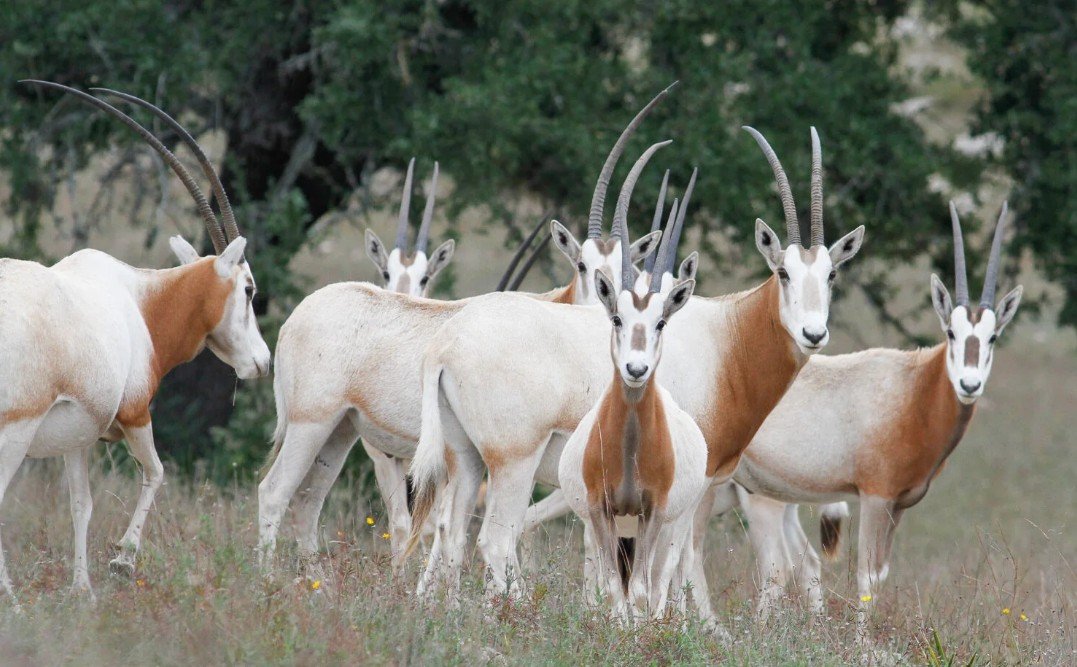
5. Conservation Activities and Situation
Historical Decline and The Need for Action
Because of competition from cattle, habitat erosion, and poaching, the Scimitar‑Horned Oryx had severe population decreases throughout the 20th century. There were very few of the species left in captivity by the 1980s, and it was already extinct in the wild.
Captive Breeding & Reintroduction Efforts
- Captive Breeding: Several zoos and wildlife reserves worldwide have successfully produced Scimitar‑Horned Oryxes. In regulated settings, these breeding initiatives have created a robust population of oryxes and contributed to the preservation of genetic diversity.
- Reintroduction Programs: Since the 2000s, attempts have been undertaken to return the Scimitar‑Horned Oryx to its natural habitat in Chad and other North African countries. These restored populations have been regularly monitored and managed by the Wildlife Conservation Society (WCS) and other organisations.
- Protected Reserves: To ensure that Scimitar‑Horned Oryx remain secure from human encroachment, poaching, and competition from domestic cattle, some of the places where they are being reintroduced have been declared as protected areas or reserves.
International Cooperation & Long‑Term Strategies
The International Union for Conservation of Nature (IUCN) is one of many wildlife organisations collaborating with local governments to develop sustainable management plans for the Scimitar‑Horned Oryx population. This entails developing educational initiatives to increase public knowledge of the value of preserving desert ecosystems and offering assistance for the restoration of healthy populations in their natural environment.
FAQ (Frequently Asked Questions) about Scimitar-horned Oryx
Q: What is a Scimitar-horned Oryx?
Ans: It is a desert-dwelling antelope once extinct in the wild, known for its long curved horns and white body with reddish markings.
Q: Where can Scimitar-horned Oryx be found today?
Ans: Reintroduced populations live in protected reserves in Chad, Niger, and Tunisia, while many exist in zoos and breeding programs worldwide.
Q: Are Scimitar-horned Oryx endangered?
Ans: Yes, they are listed as Endangered by the IUCN, though they were previously classified as extinct in the wild.
Q: How long do Scimitar-horned Oryx live?
Ans: They can live up to 20 years in the wild and longer in captivity.
Q: What do Scimitar-horned Oryx eat?
Ans: They feed on grasses, herbs, and desert vegetation, and can go long periods without drinking water.
Q: How do they survive in the desert?
Ans: They are highly adapted to arid environments and can regulate body temperature and extract moisture from their food.
Q: Do both male and female oryx have horns?
Ans: Yes, both sexes have long, scimitar-shaped horns that can reach up to 5 feet in length.
Q: Why did the Scimitar-horned Oryx go extinct in the wild?
Ans: Due to overhunting, habitat destruction, and political instability in their native range.
Q: Are there any conservation programs for the oryx?
Ans: Yes, numerous global breeding and reintroduction programs have helped reestablish wild populations.
Q: How many Scimitar-horned Oryx are in the wild today?
Ans: As of recent reports, there are approximately 400 individuals in protected areas, with more planned for release.
#ScimitarHornedOryx #DesertAntelope #WildlifeConservation #OryxFacts #EndangeredSpecies #SaharaWildlife #AnimalRestoration #Rewilding
Our sources and references about Scimitar-horned Oryx
1: Wikipedia – Scimitar Oryx
2: Smithsonian’s National Zoo – Scimitar-horned Oryx
3: IUCN Red List – Scimitar-horned Oryx
4: Sahara Conservation Fund
5: Marwell Wildlife – Scimitar-horned Oryx


