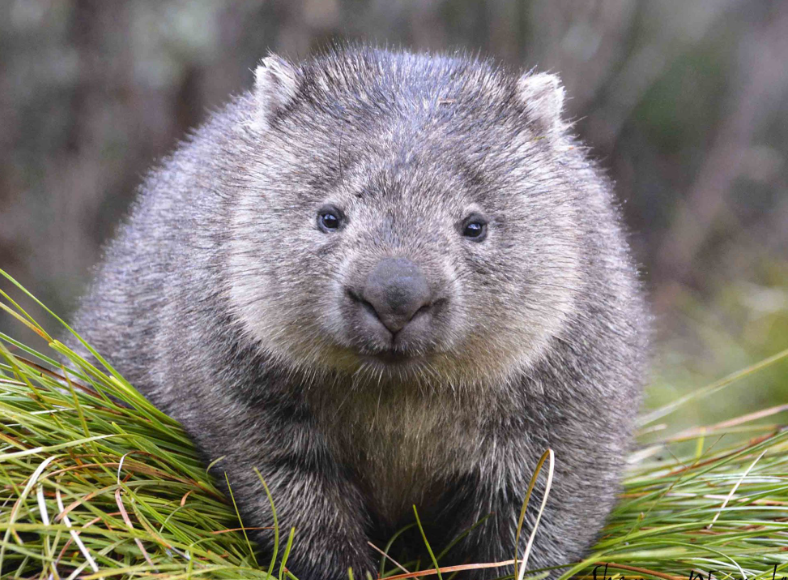
The Wombat is a burrowing marsupial found in Australia. They are known for their stocky, muscular bodies and backward-facing pouches. Wombats are herbivores, feeding primarily on grasses, roots, and shrubs. They are excellent diggers and spend a significant amount of time in underground burrows.
Quick Top 10 Facts about Wombat
| SCIENTIFIC NAME | Vombatus ursinus |
| CLASSIFICATION | KINGDOM: Animalia PHYLUM: Chordata CLASS: Mammalia ORDER: Diprotodontia FAMILY: Vombatidae GENUS: Vombatus SPECIES: V. ursinus |
| SIZE | Length: 39–48 inches (1–1.2 meters), Weight: 20–35 pounds (9–16 kg) |
| HABITAT | Woodlands, grasslands, and forests across Australia |
| DIET | Herbivorous; primarily feeds on grasses, roots, and bark |
| SPECIES | Wombat, a marsupial known for its burrowing behavior and stocky appearance |
| COUNTRY | Australia |
| GESTATION PERIOD | Approximately 20–30 days |
| LIFE SPAN | 5–15 years in the wild |
| CONSERVATION STATUS | Least Concern; some species, such as the Northern Hairy-nosed Wombat, are endangered |
Amazing Facts About Wombats
1. Wombats are known for their burrowing abilities
Wombats dig extensive burrows for shelter, which can be up to 100 feet long (30 meters).
2. They have strong, powerful limbs
Their short, stocky legs and strong claws are perfect for digging and creating elaborate burrow systems.
3. Wombats are nocturnal
These creatures are active at night, foraging for food and avoiding the heat of the day.
4. They have backward-facing pouches
Female wombats have pouches that face backward, preventing dirt from entering while they dig.
5. Wombats are herbivores
Their diet consists mainly of grasses, roots, and bark, and they are particularly adept at consuming tough plant material.
6. They are solitary animals
Wombats are generally solitary, coming together only to mate or in rare social interactions.
7. Wombats are slow movers
Despite their strong build, wombats move slowly, averaging about 1 mph (1.5 km/h) while foraging.
8. Wombat poop is cube-shaped
Wombats are famous for producing cube-shaped feces, which help keep their poop from rolling away and mark their territory.
9. They have a low metabolic rate
Wombats have one of the slowest metabolisms of any mammal, which helps them survive on a low-calorie diet.
10. Wombats are often found in protected areas
While some species are considered “Least Concern,” others, like the Northern Hairy-nosed Wombat, are critically endangered and protected by conservation efforts.
Fascinating facts about wombats: unique creatures in the animal kingdom
Wombats are marsupials that are native to Australia. They have a wide head, short legs, and a strong, muscular physique. As herbivores, wombats consume bark, roots, and grasses. The capacity to excavate burrows is among wombats’ most characteristic traits. They can dig large subterranean tunnels because of their sharp claws and muscular legs. They find refuge and defence against predators in these burrows.
Wombat Classification and Habitat: Natural Habitats and Their Preferred Environments
Another characteristic of wombats is their unusual digestive system. They can live on very little water and have a sluggish metabolism. They can absorb more nutrients from their diet thanks to a unique adaptation in their intestines, which aids in energy conservation in their hostile surroundings. Australian native wombats are amazing animals. Since they are marsupials, their young are carried in a pouch. Here are a few fascinating wombat facts.
1. Physical attributes
With their short legs and barrel-shaped bodies, wombats are robust creatures. Their thick fur coat is colored in shades of grey and sandy brown. Their powerful claws are ideal for excavating tunnels.
2. Natural Environment
Australia is home to wombats in a variety of settings, such as grasslands, mountains, and forests. They can construct intricate tunnel networks and are ideally suited to live in burrows.
3. Nutrition
As omnivores, wombats mostly consume bark, roots, and grass. They can chew through thick plants because of their powerful jaws and teeth. It’s interesting to note that wombats have a special digestive mechanism that enables them to get the most nutrition possible from their diet.
4. Action
Because they are nocturnal creatures, wombats are most active at night. They are solitary animals that use smell markers to identify their territory. Another well-known attribute of wombats is their quickness—they can sprint up to 25 mph.

5. Status of Conservation
Regretfully, wombats are threatened by a number of factors, such as habitat degradation and automobile accidents. Nonetheless, conservation measures are being taken to preserve their existence, and they are legally protected in Australia.
Physical features facts about wombats: size, weight, and body structure
Wombats are plump marsupials that are native to Australia and are distinguished by their strong legs and curled claws. These adorable creatures have some fascinating information about them.
1. Of all terrestrial animals, wombats have the strongest legs. They can build subterranean cavern networks and bridges because of their strong hindquarters.
2. Wombats can communicate with one another thanks to their cube-shaped excrement. To demarcate their domain, the cubes are arranged in a line outside den openings.
3. Wombats are nocturnal creatures, meaning they spend the day sleeping and emerge at night to hunt food.
4. Wombats are very nimble creatures that can sprint up to 25 mph.
5. Wombats may grow to a length of 3–4 feet and weigh up to 35 kg.
Wombat Diet and Feeding Habits: Unique Adaptations and Survival Strategies
1. Wombats are gregarious creatures that share burrows with one another.
2. Wombats’ thick fur helps them remain cool in the summer and warm in the winter.
3. In the wild, wombats have a 25-year lifespan.
4. Wombats consume a wide range of vegetation, insects, and tiny animals since they are omnivores.
5. Wombats can detect predators thanks to their big ears.

Fascinating facts about wombats and their intriguing characteristics
Amazing natural animals, like wombats, are indigenous to Australia. Since they are marsupials, they use pouches to carry their young. We will examine a few fascinating wombat facts in this blog article.
1. Visual Appeal
With their big heads, short legs, and stocky bodies, wombats have a distinctive look. They weigh around 55 pounds on average, and they resemble small dogs in size. Their skin is strong and leathery, protecting them from bites and scratches. Their fur may range in color from sandy brown to gray.
2. Environment
Wombats are mostly found in Australia, where they live in a variety of settings, such as mountains, grasslands, and forests. They dwell in large, intricate tunnel networks with several chambers and exits that are ideally suited to their digging lifestyle.
3. Food Plan
Wombats are herbivores, mostly consuming bark, roots, and grasses. Their powerful jaws and teeth enable them to gnaw through dense plants. It is well known that wombats have a sluggish metabolism and may go for extended periods of time without eating or drinking.
4. Evening Conduct
Wombats are nocturnal creatures, meaning that nighttime is when they are most active. After sleeping in their burrows for the majority of the day, they emerge at night to hunt for food. They can discover food and travel in the dark because of their keen senses of hearing and smell.
5. Distinctive Modifications
Wombats have a number of special adaptations that aid in their survival in the wild. Their reversible pouch is one of their most remarkable adaptations. As a result, while the wombat is digging, dirt and debris cannot get into the pouch. They are also protected from predators by their thick, robust skin, and they can dig tunnels swiftly because of their powerful legs and claws.
6. Social Interaction
Wombats often live alone and in overlapping home ranges. They do not, however, have territoriality issues and will often put up with other wombats in the area. They use vocalizations, scent marking, and grooming as physical forms of communication.
7. Creating Offspring
The reproductive system of female wombats is distinct. They hold their young in a pouch with their backs to the viewer. Wombats give birth to a single joey following a gestation period of 20 to 30 days. Before going out on its own, the joey spends around 6–7 months in the pouch.
8. State of Conservation
Currently, the International Union for Conservation of Nature (IUCN) has wombats listed as a species of least concern. Nevertheless, habitat degradation and competition from invasive species have rendered some wombat species—like the northern hairy-nosed wombat—endangered.

FAQ (Frequently Asked Questions) about Wombats
Q: What is a Wombat?
Ans: A wombat is a marsupial native to Australia, known for its stocky body, short legs, and burrowing habits. They are herbivores and are most active at night (nocturnal). Wombats are unique for their backward-facing pouch, which helps prevent dirt from getting into it as they dig.
Q: How big do Wombats get?
Ans: Wombats are medium-sized animals, with adult wombats typically weighing between 20 to 35 kg (44 to 77 lbs) and measuring around 1 meter (3.3 feet) in length. They have a compact, muscular body and short legs, which are perfectly adapted for digging.
Q: Where do Wombats live?
Ans: Wombats are found in various regions of Australia, including forests, woodlands, and heathlands. They typically reside in underground burrows, which they dig with their powerful claws. Wombats can be found in the wild in southern and eastern Australia, including Tasmania.
Q: What do Wombats eat?
Ans: Wombats are herbivores, primarily feeding on grasses, roots, and bark. They have a slow metabolism, which allows them to extract the maximum amount of nutrients from the plants they consume. They are known for eating a large variety of vegetation, including leaves, flowers, and mosses.
Q: Are Wombats dangerous?
Ans: Wombats are generally not dangerous to humans. They are shy, nocturnal creatures that tend to avoid confrontation. However, if threatened or cornered, they can become aggressive and use their powerful claws and sharp teeth to defend themselves. Their burrowing behavior and solid bodies make them well-equipped to protect themselves.
Q: How long do Wombats live?
Ans: Wombats have a relatively long lifespan for a marsupial, typically living between 5 to 15 years in the wild. In captivity, with proper care, wombats can live even longer. Their slow metabolism and solitary lifestyle contribute to their longevity.
Q: Do Wombats hibernate?
Ans: Wombats do not hibernate. However, during the hotter months, they may become less active, spending more time in their burrows to stay cool. Wombats are adapted to deal with the extreme temperatures in their environment by burrowing to regulate their body temperature.
Q: How do Wombats dig their burrows?
Ans: Wombats are skilled diggers. They use their strong, clawed front paws to dig extensive burrow systems. Their burrows can be as long as 30 meters (98 feet) and are used for shelter, protection from predators, and maintaining a cool environment in the summer heat.
Q: Are Wombats endangered?
Ans: Some species of wombats, such as the Northern Hairy-nosed Wombat, are critically endangered. Habitat destruction, predation by introduced species (like foxes and dogs), and disease have significantly impacted their populations. However, the Common Wombat is still relatively abundant and not at immediate risk of extinction.
Q: Can Wombats be kept as pets?
Ans: While wombats may be adorable, they are not suitable as pets. They are wild animals with complex needs, including large spaces to roam and a diet of natural vegetation. Additionally, in many regions, it is illegal to keep wombats as pets due to their protected status and specialized care requirements.
#Wombat, #AustralianWildlife, #Marsupial, #WildlifeConservation, #WombatFacts, #WildAustralia, #NocturnalAnimals, #AustralianAnimals, #AnimalLovers, #WombatBurrows, #EndangeredSpecies, #NaturePhotography
Our sources and references about Wombats
1: Wikipedia – Wombat
2: Australian Geographic – Why Wombats Are Fascinating
3: ABC Education – Why Are Wombats So Weird?
4: WWF – Wombat