Animal Adaptations and Evolution
Animals form a fascinating and diverse group of living organisms found across the planet. They exist in many sizes and forms, ranging from tiny insects to enormous whales. Scientists group animals based on shared characteristics, which helps explain their evolutionary relationships. Mammals, for example, are warm-blooded animals with hair or fur that give birth to live young. In contrast, birds are warm-blooded, feathered animals that lay eggs. Other major animal groups, including fish, amphibians, and reptiles, display their own distinct biological traits and survival adaptations.
Animal Adaptation to Environments
Animals play a crucial role in maintaining ecosystem balance. Their importance extends beyond their own survival to supporting other species and overall environmental health. Predators such as wolves and lions regulate herbivore populations and prevent overgrazing, while bees act as essential pollinators that enable flowering plants to reproduce. Animals also provide humans with valuable resources, including food, clothing, and medicine. For instance, sheep supply wool for clothing, while cows provide milk and meat that support human nutrition.
Questions About Animal Life
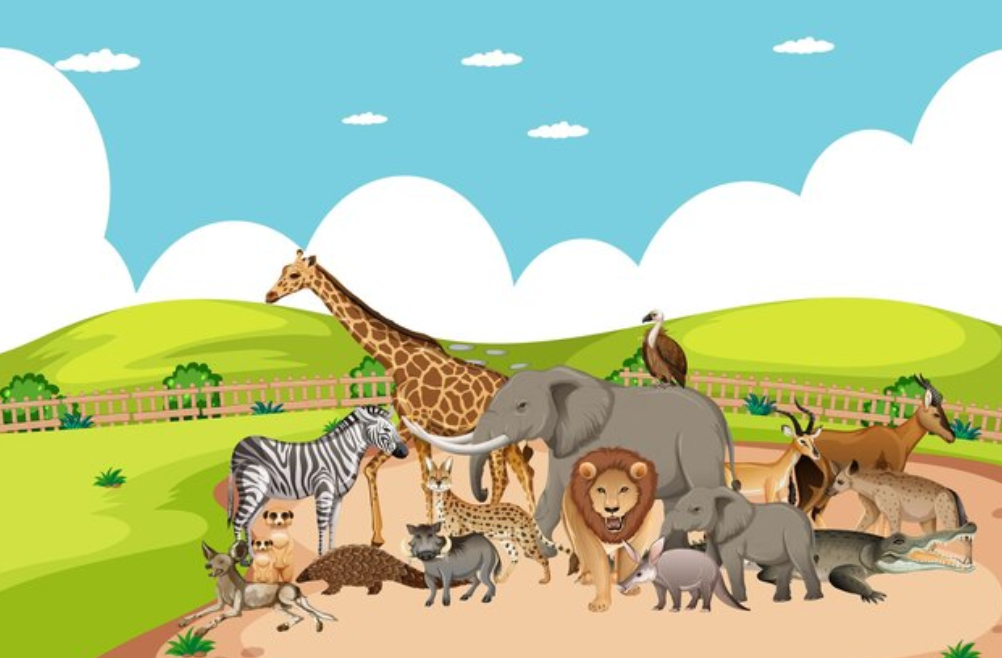
Animals show remarkable adaptability to their environments and have evolved many survival strategies. Many species use camouflage to blend into their surroundings, helping them avoid predators or ambush prey. Other animals develop specialised body parts or behaviours that improve feeding efficiency. Giraffes, for example, use long necks to reach high tree foliage, while ducks rely on webbed feet to swim and dive for food in aquatic habitats.
Physical and Behavioural Adaptations
Animals also communicate using various methods, including chemical signals, body language, and vocal sounds. These communication strategies, combined with physical and behavioural adaptations, allow animals to thrive in diverse environments worldwide. This trivia-based exploration highlights the rich diversity of animal life and encourages deeper engagement with the natural world. By answering thought-provoking questions, learners can explore animals ranging from the smallest insects to the largest mammals, making the experience both educational and enjoyable.
Learning Through Animal Trivia
This trivia activity allows learners to test their knowledge of the animal kingdom. The questions cover a wide range of topics, including habitats, behaviours, adaptations, and unique traits. Participants explore animals from open savannahs to deep ocean environments, gaining insight into how species survive and interact with their surroundings. By examining the complexities of animal life, learners expand their understanding and continue developing knowledge about Earth’s remarkable biodiversity.
Below are some practice questions on animals:
| QUESTION | ANSWER |
What do you mean by the term bug? | An insect used for sucking food that has mouthparts resembling needles. |
What do you mean by the term camouflage? | when an animal’s design or color helps it fit in with its natural environment. |
What do you mean by the term canid? | a canine family member. |
What do you mean by the term cannibalistic? | a creature that devours members of its own kind. |
What do you mean by the term carapace? | a tough outer layer resembling a shell that protects the bodies of creatures like turtles and tortoises. |
What is the living place of Rook? | rookery, nest |
What do you mean by the term bivalve? | a clam with two about equal-sized shells. |
What do you mean by the term Blubber? | a substantial layer of fat that is found immediately under the aquatic creatures’ epidermis in cold water. |
What do you mean by the term brachiation? | the swinging motion monkeys make as they go from branch to limb through trees. |
What do you mean by the term brackish? | Freshwater mixed with saltwater is found in coastal lagoons and near river mouths. |
What do you mean by the term Breeding Season? | a certain season when animals congregate to breed. The majority of men and women only interact at this time. |
What is the living place of Sealion? | rookery, nest |
What do you mean by the term ancestor? | an older, similar version of the creatures we see today. |
What do you mean by the term annelids? | an extensive class of worms with several body segments. |
What do you mean by the term antennae? | two touch, taste, and smell-sensitive structures on an insect’s head. |
What do you mean by the term anti-venin? | a medication that works as opposed to venom’s effects. |
What is the living place of a sparrow? | nest |
What do you mean by the term antlers? | Horns made of keratin are found on deer. |
What do you mean by the term apex predator? | predators that, in a considerable portion of their range, are not often preyed upon by other big animals in the wild as adults. Apex predators play a critical role in preserving the health of ecosystems since they are often found at the top of lengthy food chains. |
What do you mean by the term aquatic? | an organism that can survive in freshwater, brackish water, or the ocean. |
What do you mean by the term arachnid? | an eight-legged arthropod, like a spider. |
What is the living place of Tiger? | lair |
What do you mean by the term herpetology? | study of reptiles and amphibians. |
What do you mean by the term hexapod? | a six-legged arthropod that is not an insect. |
What do you mean by the term brille? | a permanent translucent scale that shields a snake or lizard’s eye. |
What do you mean by the term brood parasite? | a bird, like cuckoos, whose eggs are born and raised by another bird. |
What do you mean by the term bovine? | an individual from the cattle family. |
What do you mean by the term Bufagin? | a poisonous, repulsive material secreted by toads and other amphibians. |
What do you mean by the term hibernate? | when an animal hibernates or goes dormant in order to withstand the cold. |
What do you mean by the term Hominids? | monkeys that comprise early humans and other primates. |
What is the living place of Viper? | hole, burrow |
What do you mean by the term abdomen? | the third part of an insect’s body, which is located behind the thorax and head. |
What do you mean by the term Acanthodian? | a school of fish with jaws. |
What do you mean by the term Adapted? | development of unique traits or behaviors necessary for survival in a certain environment. ideal for a certain way of life. |
What do you mean by the term aestivation? | an organism that, like many amphibians and reptiles, remains dormant to endure protracted dry spells. |
What is the living place of Wallaby? | hollow tree |
What do you mean by the term cerci? | Some insects have sensory extensions on the ends of their abdomens. |
What do you mean by the term cetacean? | a member of the family Whale |
What do you mean by the term Chelicerae? | The arachnid’s powerful mouth. Fangs are accommodated by a spider’s chelicerae. |
What do you mean by the term chelonion? | the species name for turtles or tortoises. |
What is the living place of Wombat? | burrow |
What do you mean by the term ammonite? | a kind of cephalopod with a shell shaped like a spiral. |
What do you mean by the term amphibian? | creatures that are cold-blooded vertebrates that spend their larval years in the water and mostly mature on land before returning to the water to reproduce. |
What do you mean by the term amplexus? | a kind of pseudocopulation when a male amphibian mates by grabbing a female with his front legs. He fertilizes the female eggs with fluid-containing sperm, either simultaneously or after a short interval. |
What is the living place of Woodpecker? | nest |
What do you mean by the term book? | Monkeys have muzzles like those of dogs. |
What do you mean by the term backbone? | a long, spine-like support bone that runs the length of an animal’s back and is composed of tiny vertebrae. |
What do you mean by the term Baleen? | A whale’s mouth has long, dangling portions that are utilized to filter food particles out of the water. |
What do you mean by the term barbs? | The majority of a bird’s feathers are made up of thin strands that are kept together by microscopic barbules, which resemble tiny hooks. |
What do you mean by the term bask? | Cold-blooded animals do this action to get warm in the sun. |