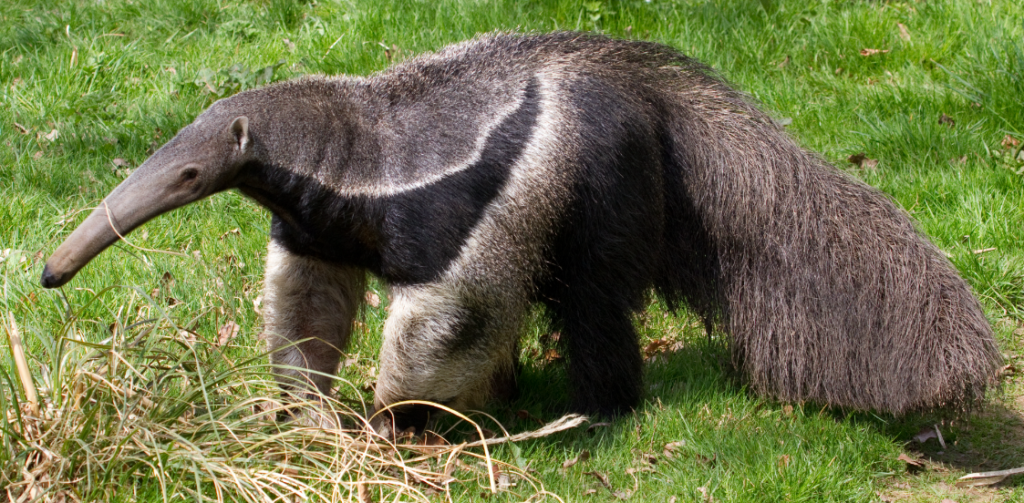
A mammal found in Central and South America, famous for its long snout and specialized tongue, which it uses to consume ants and termites. Anteaters are solitary and nocturnal.
Quick Top 10 Facts about Anteaters
| SCIENTIFIC NAME | Myrmecophagidae (Family – includes several genera such as Myrmecophaga, Tamandua) |
| CLASSIFICATION | KINGDOM: Animalia PHYLUM: Chordata CLASS: Mammalia ORDER: Pilosa FAMILY: Myrmecophagidae GENUS: Myrmecophaga, Tamandua, Cyclopes |
| SIZE | Ranges from 6 inches (pygmy anteater) to 7 feet (giant anteater, including tail) |
| HABITAT | Grasslands, forests, rainforests, and savannas in Central and South America |
| DIET | Mainly ants and termites – they can eat up to 30,000 insects per day |
| SPECIES | Four living species: Giant Anteater, Northern Tamandua, Southern Tamandua, Silky Anteater |
| COUNTRY | Native to countries in Central and South America including Brazil, Colombia, and Mexico |
| GESTATION PERIOD | Approximately 6 months for giant anteaters; varies by species |
| LIFE SPAN | Up to 14 years in the wild, and 20+ years in captivity |
| CONSERVATION STATUS | Varies by species – Giant Anteater is classified as Vulnerable due to habitat loss and roadkill |
Amazing Facts About Anteaters
1. Anteaters don’t have teeth
Instead of chewing, they use their long, sticky tongue—up to 2 feet long—to lap up insects.
2. Solitary creatures
Anteaters are mostly solitary animals, only coming together to mate or when a mother is raising a young.
3. They have powerful claws
Used to tear open anthills and termite mounds—and as defense against predators.
4. Strong sense of smell
Anteaters rely heavily on smell to find food, with a sense 40 times more powerful than humans.
5. Giant Anteaters walk on their knuckles
To protect their massive claws, they curl their front feet inward and walk on their knuckles.
6. Picky eaters
Even though they eat insects, they often avoid aggressive ants or those with strong chemical defenses.
7. Long digestive system
Their stomach acts like a gizzard and helps grind insects, aided by swallowed sand and small rocks.
8. Good swimmers
Anteaters can swim well and use their long snouts like snorkels in the water.
9. Tamanduas can climb trees
Not all anteaters are ground dwellers—the tamanduas are semi-arboreal and often found in trees.
10. Threatened by human activity
Habitat destruction, fur harvesting, wildfires, and road accidents are major threats to anteater populations.
Introduction of anteaters as unique and fascinating creatures
Anteaters are fascinating creatures with distinct characteristics. They are recognized by their lengthy tongues and snouts and are members of the Vermilingua family. As implied by their name, these creatures are mostly fed on termites and ants. With the aid of their keen claws, anteaters can reach into termite mounds and anthills to retrieve their meal.
An overview of the different species of anteaters
The giant anteater, the silky anteater, the northern tamandua, and the southern tamandua are the four species of anteaters. The biggest of them all, growing to a maximum length of seven feet, is the gigantic anteater. Anteaters are little animals with weak vision, but they make up for it with a strong sense of smell, which they use to find food.
Distribution across Central and South America
The majority of anteaters’ range is in Central and South America. They live in a range of environments, including savannas, grasslands, and woodlands. These amazing animals maintain the equilibrium of ant and termite populations by playing a critical role in population control. Anteaters never cease to pique the curiosity of scientists and naturalists alike with their unique adaptations and fascinating activities.
Intriguing and lesser-known facts about anteaters
Anteaters are amazing animals that have evolved to survive in a variety of environments across South and Central America. These creatures are misunderstood despite being present in large quantities.
1. They can detect ants and other delicious insects from a great distance because of their extraordinary sense of smell.
2. Anteaters have evolved strong digging claws for excavating anthills and lengthy, sticky tongues for sloughing off the delicious food therein.
3. The big, tamandua, silky, and pygmy anteaters are the four species of anteaters that exist in the wild.
4. Depending on the species, they may live anywhere from hollow trees to dirt burrows.
5. Anteaters are remarkably agile for their size, with the ability to sprint up to 35 km/h and climb trees.
6. Although they mostly consume termites, ants, and other tiny insects, certain anteaters have also been seen to consume fruits, reptiles, and even small animals.
The Enthralling Universe of Anteaters
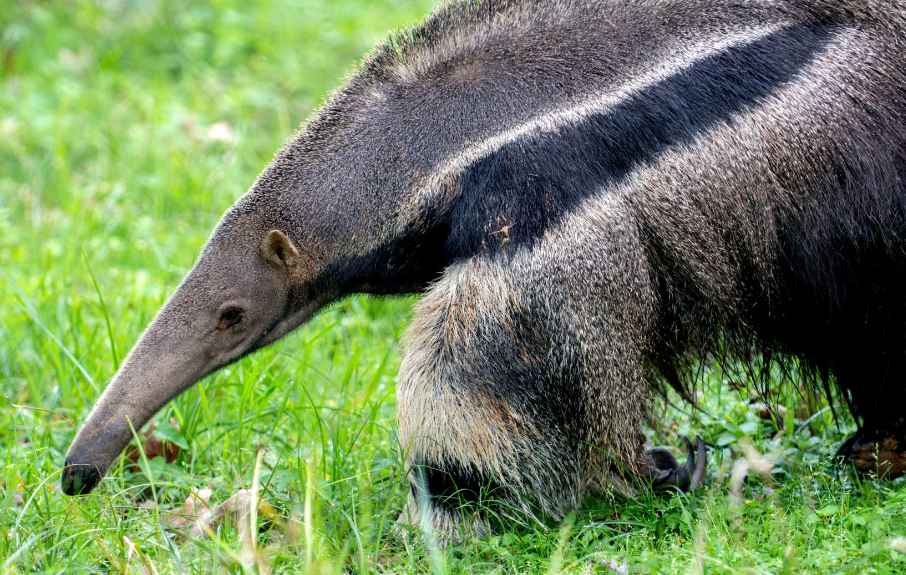
Anteaters are unusual animals found in the tropical areas of South and Central America. These intriguing creatures are distinguished by their lengthy snouts and adhesive tongues, which they use to consume termites and ants. We’ll look at several fascinating anteater facts in this post, which will undoubtedly spark your interest.
1. Physical characteristics and classification of different species of anteaters
The Giant Anteater, the Silky Anteater, the Southern Tamandua, and the Northern Tamandua are the four primary species of anteaters. Every species has unique traits and preferences for habitats. For instance, the silky anteater is the smallest species, growing to a length of just around 14 inches, while the giant anteater is the biggest, reaching up to 7 feet in length and having long snouts, tongues, and claws.
2. Feeding habits of anteaters, focusing on their preference for ants and termites
Anteaters mostly consume termites and ants, as their name implies. They can penetrate deep into termite mounds and ant hills thanks to their two-foot-long, sticky tongues. With their effective eating strategy, anteaters may devour thousands of insects in a single day. Anteaters are typically peaceful animals that pose little threat to people, even though their primary food source is insects.
3. Adaptations help them in their specialized diet of ants and termites
Anteaters are well-suited for their insectivorous diet due to a number of physical modifications. Their tongues are housed in long snouts that are adapted to squeeze into small spaces and snare insects. Anteaters also have keen claws, which they employ to crack up termite mounds and ant hills. In addition, these claws may be used to defend oneself against predators.
4. Remarkable behaviors like long tongues and slow metabolism
Due to their low metabolic rate, ants are recognized for their sluggish movements. They may preserve energy and become less noticeable to prospective predators by moving slowly and blending in with their environment. Anteaters may move swiftly when needed, particularly while pursuing prey or fleeing danger, despite their slow demeanor.
5. Feeding techniques and the incredible number of insects they consume daily
Anteaters are toothless, in contrast to most other mammals. Rather, they catch and swallow their meal whole using their lengthy, sticky tongue. Their stomachs are uniquely designed to break down the hard exoskeletons of termites and ants, enabling them to get the most nutrition possible from the insects they eat.
6. The solitary nature of anteaters and their primarily nocturnal habits
Being solitary creatures, ants enjoy living by themselves. To communicate with other anteaters, they use smell glands to designate their vast territories. They are not gregarious creatures, although they do sometimes interact, especially around the mating season. Anteaters that are female have a single child, which they nurse until it is mature enough to take care of itself.
7. Threats they face, including habitat loss, poaching, and road accidents
Regrettably, there are currently dangers to the survival of some anteater species. Deforestation and urbanization are the main causes of habitat loss, which is one of the main reasons for their decrease. Their numbers are also seriously threatened by illicit hunting for their flesh and body parts. Although these rare animals are being protected and conserved, more has to be done to guarantee their long-term existence.
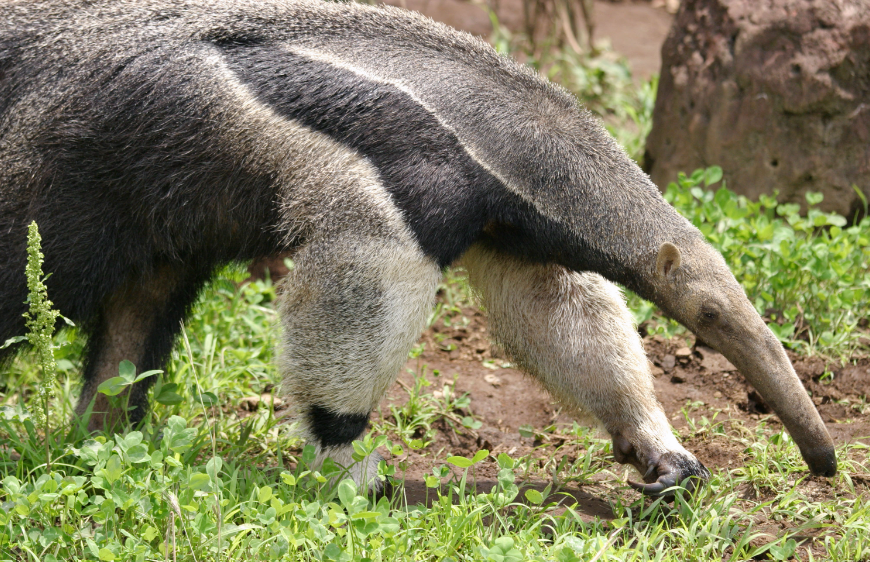
Efforts being made to protect and preserve their habitats
Anteaters are fascinating creatures that have evolved to fill a specific ecological niche. They are very intriguing animals because of their distinct physical characteristics, particular food, and solitary lifestyle. To guarantee that future generations will enjoy these amazing species’ beauty and significance in our environment, we must strive for their protection as we continue to learn more about them.
Anteaters are amazing animals that have evolved, especially for their role of searching for ants in the environment. We can guarantee their continued existence in the wild for future generations with a little effort and information.
FAQ (Frequently Asked Questions) about Anteaters
Q: What is an Anteater?
Ans: An anteater is a mammal belonging to the family Myrmecophilidae, known for its elongated snout, large claws, and specialized diet of ants and termites. There are four species of anteaters, including the Giant Anteater, the Silky Anteater, the Northern Tamandua, and the Southern Tamandua. They are native to Central and South America.
Q: What do Anteaters eat?
Ans: Anteaters are specialized insectivores and primarily eat ants and termites. They use their long, sticky tongues to capture insects, which can be up to 2 feet long. They have no teeth, and their diet consists almost exclusively of these small insects, although some may also consume fruits and other plant matter occasionally.
Q: How do Anteaters find their food?
Ans: Anteaters use their keen sense of smell to locate ant and termite mounds. Once they find a mound, they use their sharp claws to tear it open and then insert their long, sticky tongue to collect insects. Their long claws are also used for defense.
Q: Are Anteaters dangerous?
Ans: Anteaters are generally not dangerous to humans. However, they can be quite protective and will use their strong claws to defend themselves if they feel threatened. Their claws are designed for tearing open insect mounds, but they are also capable of inflicting injury if used in self-defense.
Q: How big do Anteaters get?
Ans: Anteaters vary in size depending on the species. The Giant Anteater, the largest species, can grow up to 8 feet long, including the tail, and can weigh up to 100 pounds. Smaller species, like the Silky Anteater, are much smaller, weighing only about 1.5 pounds and measuring around 1.5 feet in length.
Q: How do Anteaters defend themselves?
Ans: Anteaters primarily use their powerful front claws to defend themselves. These claws can be deadly to predators such as jaguars, and an anteater will often stand on its hind legs and use its claws to strike if threatened. They also have sharp teeth in their jaws, though they rarely use them for eating.
Q: Are Anteaters endangered?
Ans: Some species of anteaters, particularly the Giant Anteater, are considered vulnerable due to habitat loss, hunting, and traffic accidents. Conservation efforts are underway to protect anteater populations, but they still face significant challenges in the wild.
Q: Where do Anteaters live?
Ans: Anteaters are found in a variety of habitats across Central and South America, ranging from grasslands and savannas to rainforests. They are solitary animals that typically live in areas with abundant ant and termite populations.
Q: How long do Anteaters live?
Ans: Anteaters can live up to 14 years in the wild, although they may live longer in captivity. Their lifespan can be affected by factors such as food availability, habitat conditions, and human-related threats.
#Anteater #Mammals #Wildlife #Insectivores #Ants #Termites #GiantAnteater #Conservation #EndangeredSpecies #SouthAmericanAnimals #NatureIsAwesome #WildlifeProtection
Our sources and references about Anteaters
1: Wikipedia – Anteater
2: National Geographic – Anteater
3: WWF – Giant Anteater
4: Smithsonian – Meet the Anteater


