Geographical Distribution during the Eocene Epoch
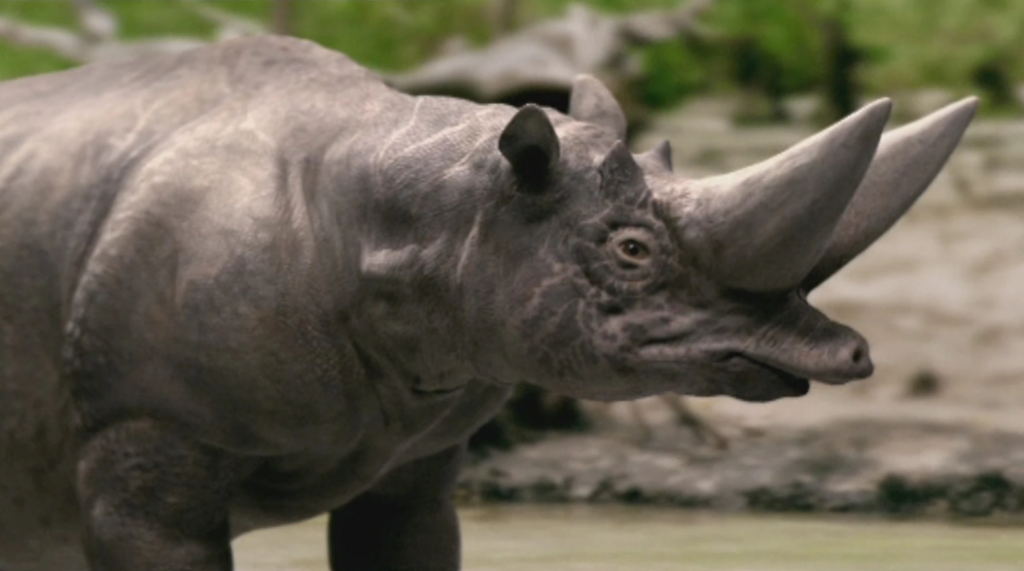
The intriguing Arsinoitherium is an extinct animal that lived in the ancient African landscapes during the late Eocene period. This herbivorous mammal had a distinct appearance that set it apart from all other animals of its time. It was roughly the size of a modern rhinoceros. Its two massive, forward-facing horns, which were covered in a hard keratin sheath and made of bone, distinguished it from other animals. Arsinoitherium had a formidable presence in its environment due to its enormous horns, which it likely used for defence and territorial disputes.
Quick Top 10 Facts about Arsinoitherium
| SCIENTIFIC NAME | Arsinoitherium zitteli (Arsinoitherium) |
| CLASSIFICATION | KINGDOM: Animalia CLASS: Mammalia ORDER: Proboscidea (or possibly Embrithopoda) FAMILY: Arsinoitheriidae PHYLUM: Chordata GENUS: Arsinoitherium |
| SIZE | Estimated to have been around 3 meters (10 feet) in length and weighed about 800-1,000 kg (1,760-2,200 lbs) |
| HABITAT | Fossils found in the Eocene deposits of Africa, likely lived in forested areas |
| DIET | Herbivorous – Likely fed on soft vegetation, such as leaves and fruit |
| SPECIES | Arsinoitherium (Arsinoitherium zitteli) |
| COUNTRY | Fossils found in regions that are present-day Egypt and other parts of North Africa |
| GESTATION PERIOD | Unknown, but likely similar to other large herbivores |
| LIFE SPAN | Exact life span unknown, but it is believed to have been relatively short compared to modern large mammals |
| CONSERVATION STATUS | Extinct – The species lived during the Eocene period, around 37 to 30 million years ago |
Unique Features, such as the Large Horn-like Structures on Its Head
Arsinoitherium could support its weight and move with relative ease due to its strong body and short, stocky legs, in addition to its impressive horns. It had a small head with powerful jaws, equipped with sharp teeth, and a long, flexible neck. Arsinoitherium’s distinctive morphological traits suggest it was well-adapted to its environment, possibly using its horns to fend off predators and its strong jaws to consume plants.
Study of Arsinoitherium Contributes to Our Understanding of Ancient Ecosystems
Arsinoitherium’s fossil record provides crucial insights into the evolution of mammals. It is believed to have been one of the first creatures in the order Embrithopoda, which comprised herbivorous mammals before their extinction. The discovery of Arsinoitherium fossils in Egypt and other parts of Africa has illuminated the variety of mammalian life during the Eocene era and the ancient ecosystems of the continent. By examining Arsinoitherium’s morphology and behaviour, scientists have reconstructed a clearer picture of the evolutionary processes that shaped Africa’s mammalian fauna millions of years ago.
Study of Prehistoric Animals: Significant Fossil Findings in Different Regions
Arsinoitherium existed around 36 million years ago during the Eocene period. Its influence on palaeontology and our understanding of the planet’s evolutionary past endures to this day. With its unique features and adaptations, Arsinoitherium remains a fascinating creature to study. Its legacy lives on through well-preserved fossils and museum exhibits. It could weigh up to 3,000 kg, making it one of the largest land animals of its time. Here are some fascinating facts about Arsinoitherium:
1. When and Where Its Fossils Were First Discovered:
British palaeontologist Richard Markham discovered the first Arsinoitherium bones in the late 19th century in Egypt’s Fayum Depression. They were found around an ancient waterhole, suggesting this herbivorous species was a water-loving creature.

2. Taxonomic Classification of Arsinoitherium:
Named after Queen Arsinoe II, who ruled the area when it was discovered, the name “Arsinoitherium” comes from the Greek words “Arsinoe” (meaning “woman from marshes”) and “therion” (meaning “beast”). It was classified as a member of the hornless browsing mammals, or Embrithopoda, an extinct order.
3. Physical Characteristics: Size and Appearance:
Arsinoitherium resembled a modern rhinoceros in size, standing around 2.5 metres (8.2 feet) tall at the shoulder and 4 metres (13 feet) long. It had four sturdy legs, a long, thick tail, and a massive torso. The most distinctive feature was its three pairs of large bony protrusions on its skull, called pseudo-horns, as they were hollow inside.
4. Ferocious Tooth Evidence Supporting Its Feeding Behaviour:
Despite its herbivorous diet, Arsinoitherium possessed vicious teeth that it likely used to defend itself from predators. Its lower jaw featured two large pairs of bone-like horns, which helped it break fruits, seeds, and leaves. Its molars, with high-ridged enamel, were well-suited for crushing tough plant material.
5. Adaptations for Obtaining and Consuming Food:
Arsinoitherium was well-adapted to its environment. Its strong legs allowed it to walk across the muddy lake beds of the Fayum Oasis, and its solid bones enabled it to swim in deep water. Its remarkably flexible nose allowed it to grasp leaves and branches for feeding.
6. Social Behaviour and Structure:
Arsinoitherium likely travelled in groups to find food and water. The discovery of multiple individuals’ remains buried together suggests that they were social creatures. Their size would have offered protection from predators.
7. End of Its Reign:
Although the exact date of Arsinoitherium’s extinction is uncertain, it likely occurred around 33.9 million years ago, at the end of the Eocene period. This may have been due to environmental changes, such as reduced water availability or competition from other herbivores for food.
8. Ancestor to Modern-Day Mammals:
Because of Arsinoitherium’s unique characteristics, scientists now believe it is a distant relative of modern mammals like hippopotamuses, elephants, and rhinoceroses. It is thought to have inherited its semi-aquatic traits and broad tail from a single common ancestor.
9. Museum Depictions of Arsinoitherium in Art or Literature:
Despite its extinction, detailed fossil reconstructions have managed to bring Arsinoitherium back to life. The Natural History Museum in London houses the largest collection of Arsinoitherium fossils, including its skull and other anatomical features.
10. Significance in Evolutionary Research:
Arsinoitherium plays a crucial role in evolutionary research, providing valuable insights into the development of large terrestrial animals. Scholars find it an intriguing subject due to its distinctive characteristics and adaptations, which shed light on the diversity and evolution of extinct mammal species.

FAQ (frequently asked questions) about Arsinoitherium
Q: What is Arsinoitherium?
Ans: Arsinoitherium is an extinct genus of large, herbivorous mammals that lived during the Eocene epoch, around 37 to 33 million years ago, and is closely related to modern elephants and manatees.
Q: Where did Arsinoitherium live?
Ans: Arsinoitherium lived in Africa, particularly in regions that are now modern-day Egypt and Libya. It roamed the lush, forested areas of the prehistoric landscape.
Q: What did Arsinoitherium eat?
Ans: Arsinoitherium was herbivorous, feeding on a variety of plants, including leaves, fruits, and other vegetation that grew in its forested habitat.
Q: How did Arsinoitherium defend itself?
Ans: Arsinoitherium likely relied on its large size and tusks for defense against predators. Its thick skin may have also provided some protection from attacks.
Q: How did Arsinoitherium reproduce?
Ans: As an extinct species, the reproductive habits of Arsinoitherium are not well documented. However, like other mammals, it likely reproduced through live birth, with females giving birth to one offspring at a time.
Q: Is Arsinoitherium closely related to modern animals?
Ans: Yes, Arsinoitherium is part of a group of ancient mammals called “Proboscidea,” which is related to modern elephants. It is also closely related to the sirenians (manatees and dugongs).
Q: How long did Arsinoitherium live?
Ans: Arsinoitherium lived during the Eocene epoch, which lasted from approximately 56 to 33 million years ago, before it went extinct due to changing environmental conditions.
Q: What were the characteristics of Arsinoitherium?
Ans: Arsinoitherium had a large, bulky body, with long tusks and a broad, flat face. It resembled a cross between a rhinoceros and an elephant, and it had hooves instead of toes.
Q: Why did Arsinoitherium go extinct?
Ans: Arsinoitherium went extinct likely due to environmental changes, such as shifts in climate and habitat, which altered the availability of food and water, and the competition with other species.
Q: Are there any fossils of Arsinoitherium?
Ans: Yes, fossils of Arsinoitherium have been found, primarily in Africa, and these fossils have provided key insights into its anatomy and the ecosystem in which it lived.
#Arsinoitherium, #PrehistoricAnimals, #Fossils, #AncientCreatures, #ExtinctSpecies, #Paleontology, #AncientWildlife, #PrehistoricLife, #DinosaursAndMore, #WildlifeHistory, #PaleontologicalFinds, #Extinction, #EarlyMammals, #FossilRecords, #ArsinoitheriumFossils
Our sources and references about Arsinoitherium
1: Wikipedia
2: Encyclopaedia Britannica
3: Paleobiology Database
4: ResearchGate