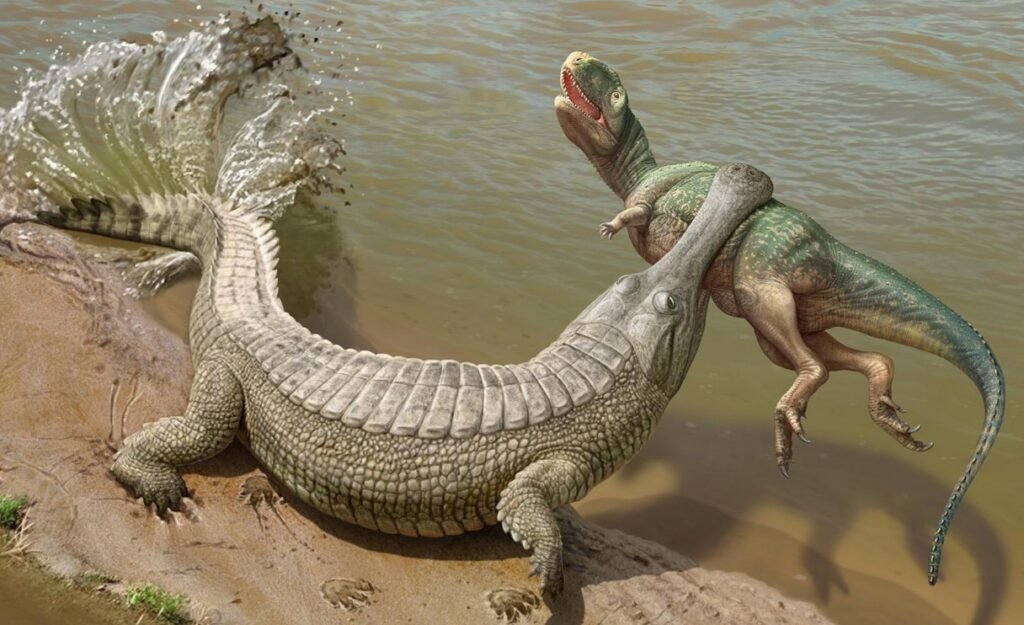
Sarcosuchus, often referred to as the “super croc,” was a massive, prehistoric crocodyliform that lived during the Cretaceous period, around 112 million years ago. Known for its enormous size and terrifying hunting capabilities, Sarcosuchus was one of the largest crocodile-like creatures ever to have existed. With a length of up to 12 meters (39 feet), it dwarfed today’s largest crocodiles. They inhabited river systems and preyed on a variety of animals, including large fish, dinosaurs, and other reptiles.
Sarcosuchus Scientific Classification
| SCIENTIFIC NAME | Sarcosuchus imperator |
| CLASSIFICATION | KINGDOM: Animalia PHYLUM: Chordata CLASS: Reptilia ORDER: Crocodylia FAMILY: Pholidosauridae GENUS: Sarcosuchus |
| SIZE | Length: Up to 12 meters (39 feet) Weight: Around 8–10 tons |
| SPECIES | Sarcosuchus imperator is the only known species. |
| APPEARANCE | Sarcosuchus had a massive, elongated body with a large head, armored skin, and an incredibly powerful jaw. Its snout was long and crocodile-like, with large teeth for catching and holding onto prey. |
| LIFE SPAN | Estimated to be around 50–60 years, though exact data is scarce due to the lack of direct evidence. |
| HABITAT | Sarcosuchus lived in freshwater river systems, lakes, and marshes, primarily in what is now the Sahara Desert region of Africa. |
| DIET | Sarcosuchus was a carnivorous predator, feeding on large fish, early dinosaurs, and other large reptiles that ventured near the water’s edge. |
| NATURAL PREDATORS | As one of the largest and most powerful predators of its time, Sarcosuchus likely had few natural predators, with only other large prehistoric reptiles posing a potential threat. |
| COUNTRY | Sarcosuchus fossils have been found in the Sahara Desert region of Africa, specifically in present-day Niger and Algeria. |
| CONSERVATION STATUS | Extinct, with no living descendants. |
Sarcosuchus Facts
1. The Super Croc
Sarcosuchus earned its nickname, “super croc,” due to its immense size, reaching lengths of up to 12 meters (39 feet) and a weight of around 8–10 tons.
2. Massive Bite Force
Its jaw was incredibly powerful, with estimates suggesting a bite force capable of crushing bones and easily overpowering large prey like dinosaurs.
3. Long Snout
Sarcosuchus had a long, narrow snout similar to modern-day crocodiles, designed for catching fish and other prey with precision.
4. Preyed on Large Reptiles
In addition to fish, Sarcosuchus likely hunted large reptiles, including early dinosaurs that ventured too close to the water.
5. Lived in Freshwater Habitats
Sarcosuchus inhabited freshwater environments such as rivers and lakes, where it could ambush prey from the water.
6. Armored Skin
Like modern crocodiles, Sarcosuchus had tough, armored skin that protected it from predators and provided defense during battles with rival reptiles.
7. Estimated Life Span of 50–60 Years
While precise details are unknown, Sarcosuchus likely lived for several decades, with estimates placing its life span at around 50–60 years.
8. Fossils Found in the Sahara
Fossils of Sarcosuchus have been discovered in the Sahara Desert region of Africa, which was once a lush, water-filled environment during the Cretaceous period.
9. Not a True Crocodile
Though often referred to as a “croc,” Sarcosuchus was actually more closely related to an ancient group of crocodyliforms called Pholidosauridae, making it distinct from modern crocodiles.
10. Extinct, but a Dominant Predator
Sarcosuchus went extinct around 93 million years ago, but during its reign, it was one of the most dominant and terrifying predators in its ecosystem.
Prehistoric Giant
One of the most amazing and enormous animals to have ever existed is the Sarcosuchus, sometimes known as the “SuperCroc.” A intriguing episode in the evolutionary history of crocodilians, it was a prehistoric reptile that resembled a crocodile that inhabited the Earth millions of years ago. In its day, the Sarcosuchus was a top predator, distinguished by its enormous size, strong jaws, and skill as a hunter. The history, physical traits, habitat, behaviour, and extinction of the Sarcosuchus, as well as its position within the larger framework of ancient life, will all be covered in this article.
Discovery History
In the 1940s, the Sarcosuchus was first found in northern Africa’s Sahara Desert. Palaeontology made significant strides with the finding of its remains, which shed light on the crocodilians’ evolutionary history.
Name Origins
“Sarcosuchus” is a combination of the Greek term “sarkos,” which means flesh, and the Egyptian word “souchos,” which refers to the crocodile deity Sobek. This name emphasises the creature’s crocodilian traits and flesh-eating behaviour.
Early Discoveries
In 1946, a group of palaeontologists led by the French researcher Albert-Félix de Lapparent discovered the first fossils of Sarcosuchus. Dinosaur and other ancient reptilian fossils have been abundant in the Nigerian Sahara’s Elrhaz Formation, where these fossils were found. With the discovery of more fossils throughout time, such as pieces of the skull, teeth, and limb bones, scientists were able to construct a more comprehensive image of this enormous reptile.
More complete Sarcosuchus fossils have been discovered in more recent decades, especially during early 2000s expeditions led by the University of Chicago and other international paleontological teams.
Physical Traits
Given its size, the Sarcosuchus was a powerful animal and among the most frightening ancient reptiles ever found. Here are a few of its salient physical characteristics:
Massive Size
The Sarcosuchus was a massive crocodyliform that could reach a maximum length of 12 meters (39 ft). It is thus among the biggest crocodiles that have ever existed. It is thought to have weighed between 8 and 10 tonnes, which is far more than any crocodile that is alive today.
Comparatively speaking, the Sarcosuchus is much larger than the saltwater crocodile (Crocodylus porosus), the biggest crocodile species currently in existence. It may grow up to 7 meters (23 feet) in length.
Skull Teeth
The Sarcosuchus has a long, cylindrical cranium that may reach a length of 1.5 meters (5 feet). As a result, its mouth was extraordinarily enormous and lined with conical, sharp teeth. As is common in contemporary crocodiles, the teeth were specialised for grasping and retaining prey.
- Jaw Power: Sarcosuchus has a very strong jaw that could provide a tremendous biting force. Its bite is thought to have a force of between 2,000 and 3,000 pounds per square inch (psi), which is more than enough to break the bones of huge prey, however the precise amount is hard to pinpoint.
Body Structure
The Sarcosuchus’s long, sleek body and tail, which would have been employed for swimming propulsion, were similar to those of contemporary crocodiles. It was likely well-suited for swimming since its limbs were small in relation to its body and its feet possessed webbed toes, like those of contemporary crocodiles.
The Sarcosuchus could probably move quickly in the water despite having small legs because of its strong tail, which let it to travel at remarkable speeds.
Armoured Skin
It was thought that the Sarcosuchus had thick, bone-like plates called osteoderms buried in its skin. By acting as armour, these bone barriers kept it safe from predators or attackers. In the same way that contemporary crocodiles have strong, scaly coats, the Sarcosuchus’ armoured skin probably made it even more formidable and resilient.
Diet Habitat
The Sarcosuchus existed between 110 and 93 million years ago during the Cretaceous era, and its remains have mostly been discovered in the Sahara Desert in North Africa. There used to be wetlands, lakes, and river systems in this area, which was considerably more humid and lush.
Freshwater Environment
The Sarcosuchus flourished in the early Cretaceous freshwater habitats, which would have included lakes, marshes, and rivers. The Sarcosuchus had an abundance of prey and a perfect hunting environment thanks to these bodies of water.
- Water Predator: The Sarcosuchus was a semi-aquatic predator, spending most of its time in the water but sometimes going ashore to enjoy the sun, much like contemporary crocodiles. Like contemporary crocodiles, it would have been able to quickly ambush animals from underwater because to its strong tail.
Carnivorous Diet
As an apex predator, the Sarcosuchus consumed a wide range of food, including dinosaurs and huge fish. Its size would have allowed it to hunt bigger species, such as huge reptiles and plant-eating dinosaurs.
- Meat Eater: The Sarcosuchus ate meat, and its big jaws were perfect for gripping its victims. It probably used the same “death roll” technique as contemporary crocodiles, which involves grabbing its victim and spinning in the water to dismember it.
- Likely Prey: Based on fossil evidence, the Sarcosuchus most likely hunted herbivorous dinosaurs, such as smaller sauropods and other creatures that lived close to water sources.
Behaviour Hunting
Given its morphological characteristics and resemblance to contemporary crocodiles, scientists may deduce certain elements of the Sarcosuchus’s existence, even if most of its behaviour is still conjectural owing to the paucity of fossil data.
Ambush Predator
The Sarcosuchus was probably an ambush predator, much as contemporary crocodiles. It would have waited for an unwary prey species to approach by staying concealed under the water’s surface thanks to its size and disguised nature. The Sarcosuchus would have attacked unexpectedly once it was within range, snagging its victim with its strong jaws.
- Swimming Speed: The Sarcosuchus’s strong tail likely helped it swim swiftly despite its massive size, enabling it to attack fast.
Land Movement
Although it could move on land, the Sarcosuchus would have spent the most of its time in the water. However, it probably did not go great distances on land because of its small and short legs. Rather, it would have favoured staying in places where it could readily get water supplies.
Extinction Causes
Around 93 million years ago, in the late Cretaceous epoch, the Sarcosuchus became extinct. This was probably caused by a combination of environmental changes and competition from other predators.
Climate Changes
During this period, there were major changes occurring in the Earth’s ecosystems and climate. The decrease of the Sarcosuchus’s native habitats may have been caused by shifting continents, shifting sea levels, and environmental changes. The rivers and luxuriant wetlands that provided food for giant crocodile predators diminished in number as the globe became drier and colder.
New Predators
The demise of the Sarcosuchus may have also been influenced by the emergence of other huge carnivores, such dinosaurs. Competition for food and territory grew as new species adapted to fill comparable ecological niches as habitats changed.
Popular Culture
Many individuals have been captivated by the Sarcosuchus because of its enormous size and fearsome predatory attitude. It has appeared in a number of documentaries, publications on palaeontology, and even some works of science fiction.
- SuperCroc Name: The Sarcosuchus is often referred to as “SuperCroc” in the media, emphasising its enormous size and capacity for predation. The creature’s status as one of the biggest predators of prehistory is highlighted by its name.
Sarcosuchus FAQ (Frequently Asked Questions)
Q: What was Sarcosuchus?
Ans: Sarcosuchus was an enormous, prehistoric crocodyliform that lived during the Cretaceous period, known for its size, powerful bite, and fearsome hunting abilities.
Q: How big was Sarcosuchus?
Ans: Sarcosuchus reached lengths of up to 12 meters (39 feet) and weighed approximately 8–10 tons, making it one of the largest crocodile-like creatures ever to have lived.
Q: What did Sarcosuchus eat?
Ans: Sarcosuchus was a carnivore, feeding on large fish, early dinosaurs, and other reptiles that came near the water’s edge.
Q: Where did Sarcosuchus live?
Ans: Sarcosuchus lived in freshwater river systems, lakes, and marshes in what is now the Sahara Desert region of Africa.
Q: How did Sarcosuchus hunt?
Ans: Sarcosuchus likely ambushed prey from the water, using its long, powerful jaws to capture and kill large fish, reptiles, and possibly dinosaurs.
Q: Is Sarcosuchus related to modern crocodiles?
Ans: While Sarcosuchus resembled crocodiles, it was not a true crocodile. It belonged to a different family of crocodyliforms called Pholidosauridae.
Q: When did Sarcosuchus go extinct?
Ans: Sarcosuchus went extinct around 93 million years ago, during the late Cretaceous period.
Q: How powerful was Sarcosuchus’ bite?
Ans: Sarcosuchus had an incredibly powerful bite, capable of crushing bones and overpowering large prey, thanks to its massive jaws and teeth.
Q: Where have Sarcosuchus fossils been found?
Ans: Fossils of Sarcosuchus have been found in the Sahara Desert region of Africa, specifically in present-day Niger and Algeria.
Q: How long did Sarcosuchus live?
Ans: It is estimated that Sarcosuchus lived for about 50–60 years, though exact data on its life span is difficult to determine.
#Sarcosuchus #SuperCroc #PrehistoricReptiles #Crocodyliforms #DinosaurPredator #SaharaDesert #AncientPredators #CretaceousPeriod #Fossils
Our sources and references about Sarcosuchus
1: Wikipedia – Sarcosuchus
2: Britannica – Sarcosuchus
3: National Geographic – Sarcosuchus
4: Science Daily – Sarcosuchus