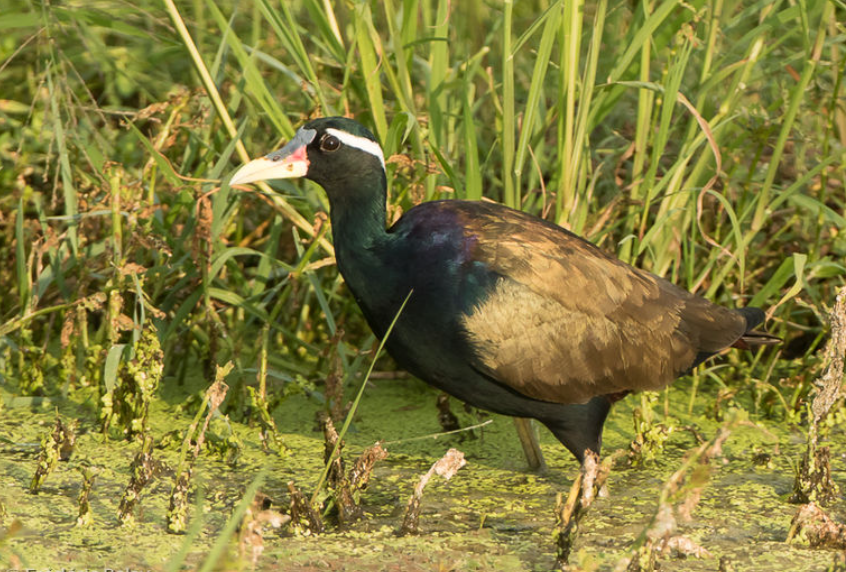
A type of wader bird found in wetlands of Southeast Asia and parts of Africa. The Bronze-winged Jacana is known for its striking plumage and unique way of walking on floating vegetation, using its long toes to spread its weight.
Quick Top 10 Facts about Bronze-winged Jacana
| SCIENTIFIC NAME | Metopidius indicus |
| CLASSIFICATION |
KINGDOM: Animalia PHYLUM: Chordata CLASS: Aves ORDER: Charadriiformes FAMILY: Jacanidae GENUS: Metopidius SPECIES: M. indicus |
| SIZE | Length: 29–31 cm (11.4–12.2 inches), Wingspan: approx. 50 cm |
| HABITAT | Freshwater wetlands, ponds, marshes with floating vegetation |
| DIET | Insects, invertebrates, and seeds found among aquatic vegetation |
| SPECIES | The only species in the genus Metopidius |
| COUNTRY | South and Southeast Asia – India, Sri Lanka, Nepal, Bangladesh, Myanmar, and Thailand |
| GESTATION PERIOD | Incubation lasts 22–24 days; eggs are cared for by the male |
| LIFE SPAN | Typically around 5–7 years in the wild |
| CONSERVATION STATUS | Least Concern – stable population across range |
Amazing Facts About Bronze-winged Jacana
1. They have extremely long toes
Bronze-winged Jacanas have long toes and claws that help them walk on floating vegetation like lily pads.
2. Males care for the eggs
In a rare role reversal, it’s the male who incubates the eggs and cares for the chicks.
3. Females are larger and polyandrous
Females mate with multiple males and leave each to care for a clutch of eggs, which is unusual among birds.
4. Their wings have a bronze sheen
The bird gets its name from the metallic bronze coloration on its wings, which shines in sunlight.
5. They are excellent swimmers and walkers
While they don’t fly often, Bronze-winged Jacanas are great at swimming and walking across floating vegetation.
6. Their call is sharp and loud
They produce a range of sharp, chattering calls that are especially common during breeding season.
7. Found mostly in India and Southeast Asia
They are a common sight in still, freshwater bodies in South Asia and parts of Southeast Asia.
8. They build floating nests
Their nests are made on aquatic plants and float on the water surface.
9. Chicks can swim right after hatching
Jacana chicks are precocial, meaning they are born relatively mature and can swim and feed themselves almost immediately.
10. They’re often mistaken for wading birds
Despite their resemblance to wading birds, jacanas are more closely related to shorebirds like plovers and sandpipers.
Information on the bronze-winged jacana bird family and species
The bronze-winged jacana is one of the Jacanidae family’s most spectacular bird species. It is well known for its peculiar appearance and fascinating behaviour. The bronze-winged jacana is a bird with a variety of intriguing traits. This bird’s remarkable look and intriguing nesting habits fascinate researchers and bird lovers alike.
Physical appearance: long toes for walking on floating vegetation
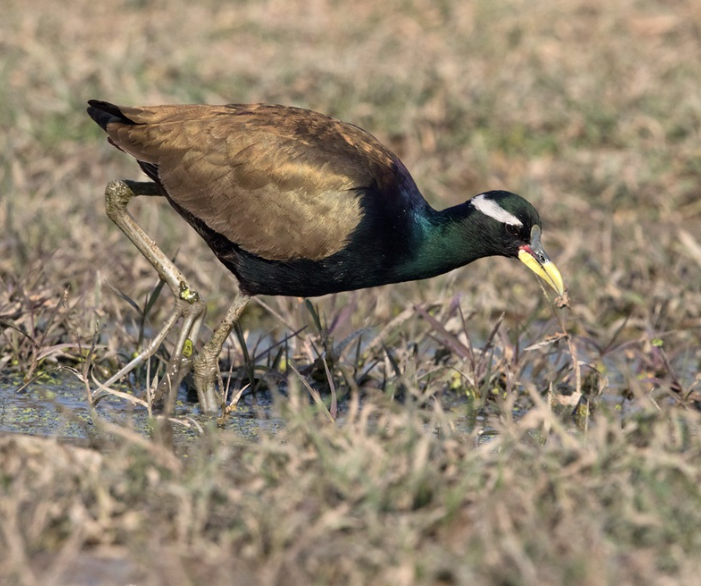
The large foot and long, slender legs of the bronze-winged jacana make it easy to identify. This bird’s feet have adapted uniquely to allow it to walk on floating plants, like lily pads, without sinking. The bird’s ability to traverse its marsh environment is nearly miraculous due to its adaptation.
Unique characteristics of the bronze-winged jacana bird
Another noteworthy characteristic of the bronze-winged jacana is its amazing plumage. The bird’s upperparts are mostly brown, but its underparts have an amazing white colour. However, the bird’s bronze-coloured wings are what really set it out and gave it its name. These wings’ intricate patterns stand out sharply against the rest of their body.
Parenting behaviour of the bronze-winged jacana bird
The extremely territorial bronze-winged Jacana is a tiny, group-oriented bird of prey. The male of the species is responsible for caring for the young and incubating the eggs; however, the female may mate with more than one male. This unique breeding technique, called polyandry, is very rare among bird species.
Origin and Habitat: Adaptations of the bronze-winged jacana bird
The bronze-winged jacana inhabits many wetland settings, including marshes, swamps, and shallow lakes. Across the world, this very adaptable bird may be found, although populations are concentrated in parts of Africa, Asia, and Australia. Its ability to travel on floating vegetation allows it to reach locations that other birds would consider unreachable.
Food and Dietary preferences of the bronze-winged jacana bird
This kind of bird eats mostly water, vegetation, seeds, and insects. It uses its long, narrow beak to search for food in the vegetation and in the water. Furthermore, the bronze-winged jacana is said to engage in a behaviour called “leaf flipping,” when it flips over leaves to expose microscopic food, such as insects, concealed underneath them.
Unique Characteristics and behaviour of the bronze-winged jacana bird
When everything is said and done, the bronze-winged jacana is an incredible bird species with peculiar physical characteristics and intriguing behaviours. Its ability to walk on water and rear its young via a polyandrous reproductive system makes it an immensely fascinating species to study and observe in its natural habitat.
Fascinating facts about Bronze-winged jacana bird
Nestled in the marshes of South and Southeast Asia is the unusual and interesting bronze-winged jacana (Metopidius indicus). The bronze-winged jacana is a wonderful bird to learn about, distinguished by its unique look and unique behaviour. We’ll look at some fascinating information about this fascinating bird below:
Coloured wings of bronze-winged jacana bird
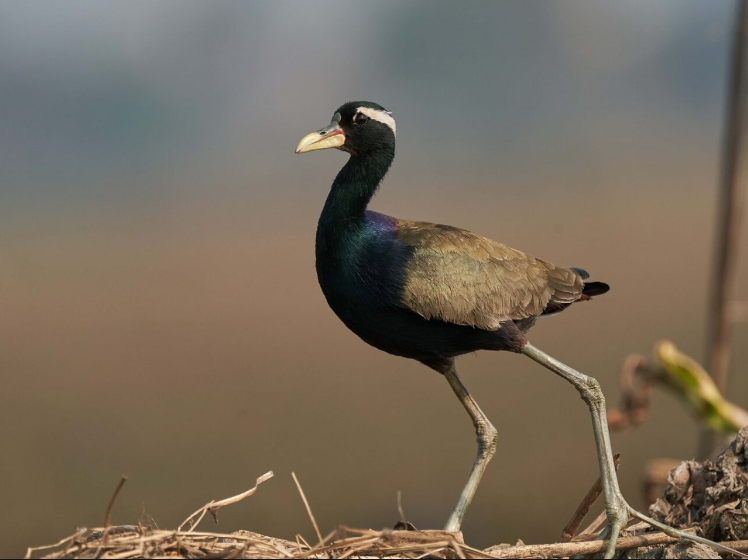
The medium-sized bronze-winged jacana has remarkable traits. Its legs and long neck are designed to allow it to walk on floating plants. When this bird is in flight, its bronze-coloured wings are its most striking characteristic. Its beak is red, and its underside is white; the majority of its body is black.
Habitat and Behavioural adaptations for survival
Lakes, ponds, and marshes are examples of freshwater wetlands where the bronze-winged jacana is often seen. It prefers environments with much vegetation so that it may wander about and search for food, especially aquatic lilies and other floating plants. Using their strong toes and claws to hold and balance on the floating foliage, these birds are renowned for their ability to navigate through thick vegetation.
Food preferred by the Bronze-winged jacana bird
The Bronze-winged Jacana has a very unusual eating habit. Its main food sources include insects, tiny invertebrates, and seeds that are found in the plants or on the water’s surface. It searches for prey by walking on the floating plants with its large toes. It can select and probe for food in small spaces and between plant sections thanks to a unique bill.
Unusual behaviour of bronze-winged jacana bird
It’s interesting to note that female bronze-winged Jacanas engage in a behaviour called polyandry, in which they take on numerous partners. While the ladies continue to mate with other men, the males are in charge of incubating the eggs and tending to the babies. Because of its unusual behaviour, the bronze-winged jacana is an intriguing species to research.
Unusual breeding behaviour of bronze-winged jacana bird
During the monsoon season, when there is an abundance of food and good nesting locations, bronze-winged jacanas often breed. The males build plant-filled, floating nests that are often fastened to the stems of water plants. The males are left to incubate and tend to the eggs after the ladies place them in the nests. Another feature that distinguishes the bronze-winged jacana from other bird species is its unusual breeding behaviour.
Threats and conservation efforts for bronze-winged jacana bird
The IUCN Red List presently lists the bronze-winged jacana as a species of least concern. But like many species that rely on wetlands, it is threatened by things like pollution, climate change, and habitat loss brought on by human activity. To guarantee this amazing bird’s existence, efforts are being made to maintain and safeguard its habitats. Gaining more knowledge about the bronze-winged jacana allows us to recognise the richness and beauty of the bird kingdom and contribute to its preservation.
FAQ (Frequently Asked Questions) about Bronze-winged Jacana
Q: What is a Bronze-winged Jacana?
Ans: The Bronze-winged Jacana (Metopidius indicus) is a striking wading bird known for its long toes and claws, which allow it to walk on floating vegetation in shallow lakes and wetlands. It gets its name from the bronze sheen on its wings, which becomes especially visible in sunlight.
Q: Where do Bronze-winged Jacanas live?
Ans: Bronze-winged Jacanas are found across South and Southeast Asia, including countries like India, Nepal, Sri Lanka, Bangladesh, and parts of Southeast Asia. They inhabit freshwater wetlands, marshes, ponds, and lakes with abundant floating vegetation.
Q: What does a Bronze-winged Jacana eat?
Ans: Bronze-winged Jacanas feed primarily on insects and other invertebrates found on floating plants. They also consume seeds, small aquatic animals, and plant matter. Their long toes allow them to move easily across lily pads and floating vegetation while foraging.
Q: What makes the Bronze-winged Jacana unique?
Ans: One of the most fascinating traits of the Bronze-winged Jacana is its reversed sex roles. Females are larger and more dominant, while males take on the responsibility of incubating the eggs and caring for the young. Their long toes, which allow them to “walk on water,” are also a remarkable adaptation.
Q: What does the Bronze-winged Jacana look like?
Ans: This bird has a dark body, with bronze-colored wings that shimmer in the light. It has a white eye-stripe that contrasts sharply with its dark plumage and a red frontal shield above the beak. The legs and toes are very long and grayish, perfect for balancing on floating plants.
Q: How does the Bronze-winged Jacana reproduce?
Ans: The female lays a clutch of eggs in a floating nest made of aquatic vegetation. The male then incubates the eggs and takes care of the chicks. This role reversal is uncommon in the bird world and is a notable feature of jacana species.
Q: Are Bronze-winged Jacanas good fliers?
Ans: They are not strong fliers and prefer to stay close to water bodies. When disturbed, they often run across floating vegetation or make short, fluttering flights. Their habitat and long legs are better suited to walking than flying.
Q: Are Bronze-winged Jacanas endangered?
Ans: No, the Bronze-winged Jacana is currently listed as a species of Least Concern by the IUCN. While habitat destruction and pollution pose threats to local populations, the species as a whole remains stable across its range.
Q: Can Bronze-winged Jacanas be seen in urban areas?
Ans: They are generally not found in densely urbanized areas but can be seen near city outskirts where wetlands, marshes, or ponds exist. Birdwatchers can spot them in protected wetlands and nature reserves.
Q: Why are the male and female roles reversed in Bronze-winged Jacanas?
Ans: In jacana species, including the Bronze-winged Jacana, this reversal allows females to mate with multiple males, thereby increasing their reproductive success. Males focus on raising the offspring, which ensures higher survival rates for the young.
#BronzeWingedJacana, #WetlandBirds, #JacanaBird, #WaterBirds, #BirdWatching, #Waders, #TropicalBirds, #BirdLovers, #NaturePhotography, #WildlifeAsia, #BirdsOfIndia, #UniqueBirdSpecies
Our sources and references about Bronze-winged Jacana
1: Wikipedia – Bronze-winged Jacana
2: eBird – Bronze-winged Jacana
3: HBW – Bronze-winged Jacana
4: IUCN Red List – Bronze-winged Jacana