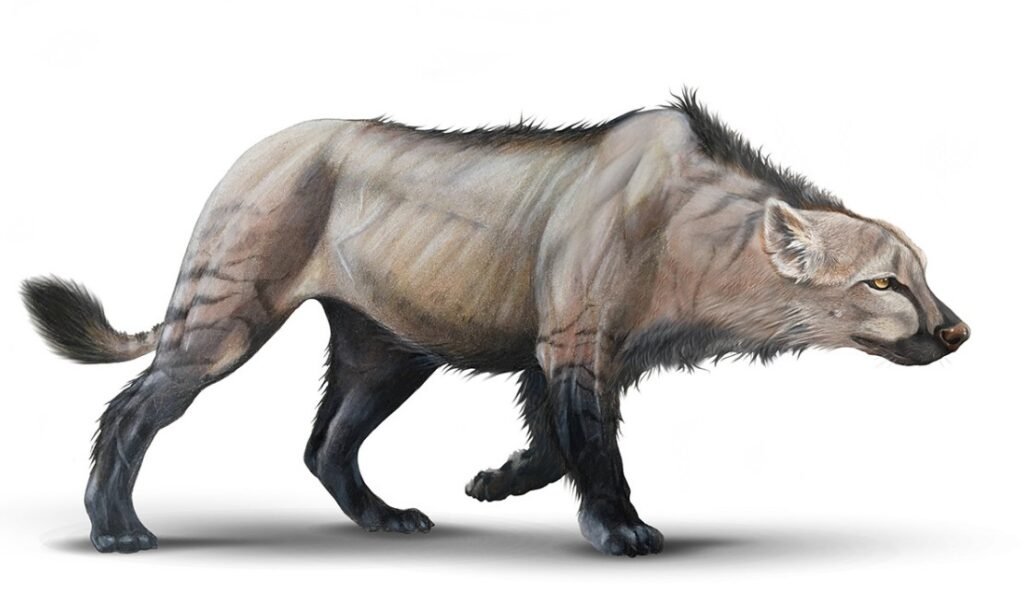
Simbakubwa is an extinct genus of giant carnivorous mammal that lived during the Miocene epoch, around 23 to 5 million years ago. This creature, which resembled a large cat or hyena, was one of the apex predators in its ecosystem, inhabiting what is now East Africa. Simbakubwa had incredibly powerful jaws and large teeth, and it was capable of taking down prey much larger than itself. It was among the largest carnivores of its time, with a body that may have weighed around 1,500 kg (3,300 lbs). Despite its fearsome attributes, Simbakubwa was not closely related to modern big cats like lions or tigers but belonged to an entirely different family of carnivores.
Quick Top 10 Facts about Simbakubwa
| SCIENTIFIC NAME | Simbakubwa kutokaafrika |
| CLASSIFICATION | KINGDOM: Animalia PHYLUM: Chordata CLASS: Mammalia ORDER: Carnivora FAMILY: Hyaenodontidae (an extinct family of carnivores) |
| SIZE | Estimated weight: 1,500 kg (3,300 lbs); Length: Over 4 meters (13 feet) from head to tail. |
| SPECIES | Simbakubwa is represented by a single species, Simbakubwa kutokaafrika. |
| APPEARANCE | Simbakubwa was a massive, heavy-built carnivore with large teeth, powerful jaws, and a muscular body built for taking down large prey. It resembled a hybrid between a hyena and a large cat, but with some distinct differences in skull structure. |
| LIFE SPAN | The lifespan of Simbakubwa is unknown, but it is estimated that it lived around 10 to 20 years, similar to modern large carnivores. |
| HABITAT | Simbakubwa lived in a variety of environments across Africa, primarily in forests, savannas, and grasslands, where it could hunt large prey such as herbivores and other mammals. |
| DIET | Simbakubwa was a hypercarnivore, preying on large mammals, including ungulates and other herbivores. Its large teeth and jaws suggest it was capable of consuming tough, meaty prey and scavenging when necessary. |
| NATURAL PREDATORS | Being one of the largest carnivores of its time, Simbakubwa likely had no natural predators, though it may have faced competition from other large carnivores in its ecosystem. |
| COUNTRY | Simbakubwa fossils have been found in East Africa, primarily in what is now Kenya, where it once roamed. |
| GESTATION PERIOD | The exact gestation period of Simbakubwa is not known, but it would have been similar to large carnivorous mammals, likely around 6 to 9 months. |
| CONSERVATION STATUS | Simbakubwa is an extinct species, with no living relatives. It lived during the Miocene epoch and became extinct before the Pliocene period. |

Amazing Facts About Simbakubwa
1. Gigantic Carnivore
Simbakubwa was one of the largest carnivorous mammals of its time, with estimates suggesting it weighed up to 1,500 kg (3,300 lbs), making it much larger than modern big cats like lions and tigers.
2. Apex Predator
Simbakubwa was the apex predator of its ecosystem, preying on large herbivores and dominating the food chain in its environment.
3. Powerful Jaws
With its massive, powerful jaws, Simbakubwa could crush bones and tear through the flesh of large prey, showcasing its extreme carnivorous adaptations.
4. Prehistoric Hyena-like Appearance
Although it resembled a large cat in some respects, Simbakubwa had features more akin to a hyena, such as its robust build and large teeth, suggesting it shared some ecological similarities with modern hyenas.
5. Ancient African Beast
Simbakubwa lived in Africa during the Miocene epoch, around 23 to 5 million years ago, a time when Africa was home to a variety of strange and massive animals.
6. A Different Family of Carnivores
Unlike modern big cats or hyenas, Simbakubwa was part of the Hyaenodontidae family, an extinct group of carnivorous mammals that dominated the Miocene period.
7. Fossil Discovery
Fossils of Simbakubwa were first discovered in East Africa, specifically in Kenya, offering valuable insights into the prehistoric predators that once roamed the continent.
8. Hypercarnivorous Diet
Simbakubwa’s diet primarily consisted of large herbivores, using its strength and large teeth to capture and consume sizable prey, but it also scavenged when the opportunity arose.
9. Lived in Diverse Environments
Simbakubwa inhabited a variety of environments, including savannas and forests, where it had access to a wide range of prey species.
10. Extinct Before Modern Carnivores
Simbakubwa went extinct long before the appearance of modern big cats, leaving behind only fossils as evidence of its reign as a top predator in Miocene Africa.
Simbakubwa: The Pliocene Era’s Giant Predator
Overview of Simbakubwa – Prehistoric Apex Carnivore
Around 20 million years ago, during the Pliocene Epoch, Simbakubwa lived as a powerful mammalian predator. This prehistoric carnivore ranked among the most formidable hunters of ancient ecosystems. Simbakubwa gained recognition for its immense size and exceptional predatory abilities. Its unique combination of physical traits made it one of the largest land carnivores of its era. These remarkable remains continue to fascinate palaeontologists and evolutionary researchers.
Meaning of the Name Simbakubwa and Scientific Classification
The name Simbakubwa comes from Swahili and loosely means “big lion,” reflecting its lion-like appearance. Despite this resemblance, it shared no close evolutionary relationship with modern big cats. This apex predator belonged to the hyaenodonts, an extinct order of carnivorous mammals. These predators once dominated ecosystems across Africa and Asia.
What This Guide Covers About Simbakubwa Fossils
This article explores Simbakubwa’s biology, ecological role, fossil discoveries, and evolutionary importance in ancient environments.
1. The Simbakubwa Discovery
Fossil Discovery and Initial Identification of Simbakubwa
Palaeontologists first identified Simbakubwa in 2005 after uncovering fossils in Kenya, Africa. Researchers found these remains within Pliocene-era sediment deposits. Most fossils came from the Lothagam region, a site rich in prehistoric discoveries. The skull and jaw fragments proved especially valuable. They revealed critical details about body size and predatory behaviour.
Significance of Simbakubwa Fossil Evidence
The fossil evidence shows that Simbakubwa was a massive carnivore. It likely rivalled today’s largest predators, including lions, tigers, and hyenas.
2. Simbakubwa’s Physical Attributes
Dimensions and Body Mass of Simbakubwa
Simbakubwa ranked among the largest terrestrial carnivores known to science. Fossil estimates suggest it weighed around 1,500 kilogrammes and reached up to five metres in length. These measurements place it among history’s biggest land predators.
Body Structure and Muscular Build
Despite its enormous size, Simbakubwa displayed a hyena-like body structure. It did not resemble lions or tigers in shape. Muscular limbs and a compact, powerful frame supported both hunting and scavenging behaviours.
Teeth and Skull Adaptations of Simbakubwa
Simbakubwa possessed an exceptionally large and robust skull. Its jawbones supported an extremely powerful bite. Large, sharp teeth allowed it to slice through flesh and crush bones. Palaeontologists believe its jaw muscles delivered devastating force during attacks.
Comparison With Modern Carnivorous Mammals
Researchers believe Simbakubwa’s skull exceeded that of any living carnivore today. This includes modern lions and other big cats. Its skull design suggests both active hunting and efficient scavenging. Powerful jaws allowed it to overpower prey and steal carcasses from rivals.
3. Simbakubwa’s Evolutionary Background
Hyaenodont Family and Evolutionary Lineage
Simbakubwa belonged to the Hyaenodontidae family of carnivorous mammals. These predators once ranged across Africa, Europe, and Asia. Hyaenodonts evolved during the Paleocene Epoch and thrived through the Eocene and Oligocene periods. The family included species ranging from small predators to giants like Simbakubwa.
Evolutionary Adaptations and Hunting Traits
Hyaenodonts developed specialised predatory and scavenging adaptations over time. These included strong jaws, enlarged canine teeth, and slicing molars. Simbakubwa shared many of these traits with smaller relatives. However, its immense size and power clearly set it apart.
Decline and Extinction of the Hyaenodonts
Hyaenodonts once filled the role of apex predators within ancient ecosystems. They represented some of the earliest true carnivores. Over time, dogs, cats, and bears evolved and spread. These new predators eventually replaced the hyaenodonts, leaving fossils as their only legacy.
4. Simbakubwa Predatory Behaviour and Habitat
Habitat of Simbakubwa in Prehistoric Africa
Simbakubwa inhabited eastern Africa during the late Miocene and early Pliocene periods. It lived across open savannas and wooded landscapes. The region supported a humid climate during that era. Large herbivores, grazing animals, and early primates thrived there.
Diet and Hunting Behaviour of Simbakubwa
As a dominant predator, Simbakubwa likely consumed a wide range of prey. Its diet probably included small mammals, early antelopes, and large herbivores such as giraffids. Powerful jaws and large teeth enabled it to tear through thick flesh. It likely scavenged carcasses while competing with early hyenas.
Energy Requirements and Survival Strategy
Maintaining such a massive body required an enormous food intake. Simbakubwa likely combined hunting and scavenging strategies. This approach helped it remain at the top of the prehistoric food chain.
5. Legacy and Extinction of Simbakubwa
Environmental Changes and Predator Competition
Simbakubwa lived during a time of major environmental transformation. Earth’s climate gradually shifted towards cooler and drier conditions. New predators such as big cats and early canids emerged. These competitors increasingly challenged the hyaenodonts.
Causes Behind the Extinction of Simbakubwa
Environmental change played a major role in Simbakubwa’s extinction. The rise of more efficient predators reduced its ecological advantage. Climate shifts and declining prey availability further contributed to its disappearance.
Scientific Importance of Simbakubwa Fossils
Simbakubwa fossils offer valuable insight into early mammalian predator evolution. They reveal life before modern carnivores dominated ecosystems. Its size, crushing bite, and hunting strategies highlight ancient ecological complexity. These discoveries deepen understanding of prehistoric food webs.
FAQ (Frequently Asked Questions) about Simbakubwa
Q: What is Simbakubwa?
Ans: Simbakubwa is an extinct genus of giant carnivorous mammal that lived during the Miocene period. It was a massive predator with large teeth and jaws, and it was one of the largest carnivores of its time.
Q: Where was Simbakubwa found?
Ans: Simbakubwa fossils have been discovered in East Africa, particularly in Kenya, where it once roamed during the Miocene epoch.
Q: How big was Simbakubwa?
Ans: Simbakubwa was estimated to weigh around 1,500 kg (3,300 lbs) and could grow over 4 meters (13 feet) in length, making it a massive carnivore.
Q: What did Simbakubwa eat?
Ans: Simbakubwa was a hypercarnivore, preying on large herbivores and scavenging when necessary. Its large teeth and jaws allowed it to consume tough, meaty prey.
Q: Is Simbakubwa related to modern big cats?
Ans: No, Simbakubwa was not closely related to modern big cats like lions or tigers. It belonged to a different family of carnivorous mammals, the Hyaenodontidae, which is now extinct.
Q: When did Simbakubwa live?
Ans: Simbakubwa lived during the Miocene epoch, around 23 to 5 million years ago.
Q: Why did Simbakubwa go extinct?
Ans: Simbakubwa went extinct during the Miocene period, possibly due to environmental changes, competition with other carnivores, and the rise of new predatory species.
Q: What is the significance of Simbakubwa?
Ans: Simbakubwa is significant because it represents one of the largest and most fearsome carnivores of the Miocene epoch, providing valuable insight into the ancient ecosystems of Africa.
#Simbakubwa #PrehistoricCarnivores #MioceneEpoch #GiantPredators #AncientAfrica #ExtinctCarnivores #FossilDiscovery #Hyaenodontidae
Our sources and references about Simbakubwa
1: Wikipedia – Simbakubwa
2: Britannica – Simbakubwa
3: Smithsonian – Simbakubwa
4: Nature – Miocene Predators