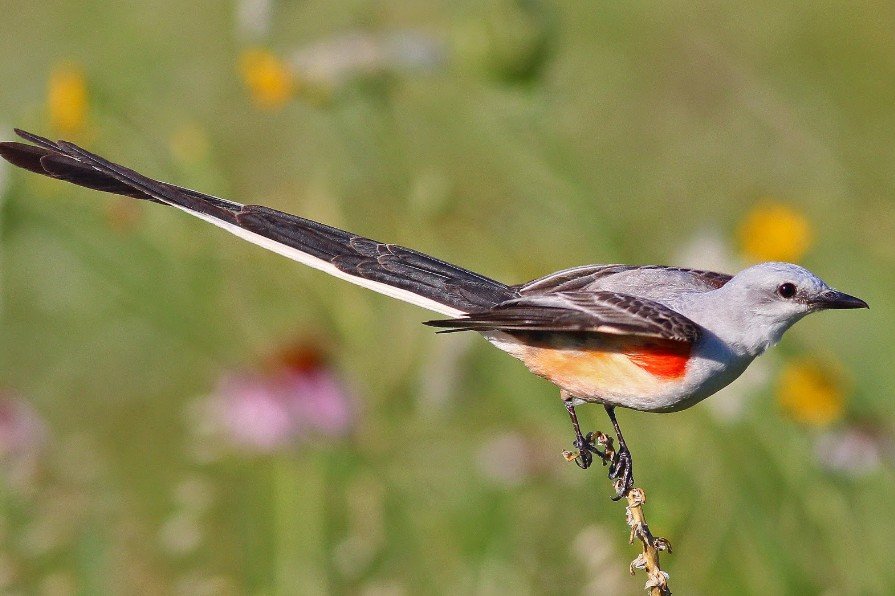
The Scissor-tailed Flycatcher is an elegant bird native to the southern United States and parts of Central America. Known for its strikingly long, forked tail and graceful flight patterns, this bird is a master of aerial acrobatics. It is commonly seen perched on fence wires or utility lines, where it waits to catch insects mid-flight. During the breeding season, males perform elaborate courtship displays to attract mates. Their diet primarily consists of insects, and they are known for their aggressive defense of nesting sites.
Quick Top 10 Facts about Scissor-tailed Flycatcher
| SCIENTIFIC NAME | Tyrannus forficatus |
| CLASSIFICATION | KINGDOM: Animalia PHYLUM: Chordata CLASS: Aves ORDER: Passeriformes FAMILY: Tyrannidae |
| SIZE | Length: 10–14.8 inches (25–37.5 cm) Wingspan: 15 inches (38 cm) Weight: Up to 43 grams |
| SPECIES | Single species: Tyrannus forficatus |
| APPEARANCE | Gray head and back, white underparts, salmon-pink flanks and underwing coverts, and a distinctive long, forked tail. Males have longer tails than females. |
| LIFE SPAN | Up to 10 years in the wild |
| HABITAT | Open country with scattered trees and shrubs, including grasslands, pastures, and urban areas. Breeds in the southern United States and migrates to Central America for winter. |
| DIET | Primarily insects such as grasshoppers, beetles, and dragonflies. Occasionally consumes berries during winter. |
| NATURAL PREDATORS | Birds of prey and larger mammals |
| COUNTRY | United States (primarily southern regions), Mexico, and Central America |
| GESTATION PERIOD | Egg incubation lasts 13–23 days; chicks fledge 14–17 days after hatching. |
| CONSERVATION STATUS | Least Concern; however, populations are decreasing due to habitat loss and climate change. |
Amazing Facts About Scissor-tailed Flycatcher
1. Spectacular Courtship Displays
During breeding season, males perform aerial displays, flying up to 100 feet and descending in zigzag patterns while calling loudly to attract mates.
2. Master of Aerial Acrobatics
The long, forked tail aids in maneuverability, allowing the flycatcher to execute sharp turns and quick dives to catch prey mid-air.
3. Aggressive Nest Defenders
Both male and female defend their nesting territory aggressively, often chasing away larger birds and intruders.
4. Seasonal Migrant
Breeds in the southern United States and migrates to Central America for winter, covering significant distances.
5. State Bird of Oklahoma
The Scissor-tailed Flycatcher is the state bird of Oklahoma and is featured on the state’s official quarter.
6. Unique Feeding Behavior
Feeds by perching and waiting for insects, then flying out to catch them in flight or picking them from foliage or the ground.
7. Brightly Colored Underwings
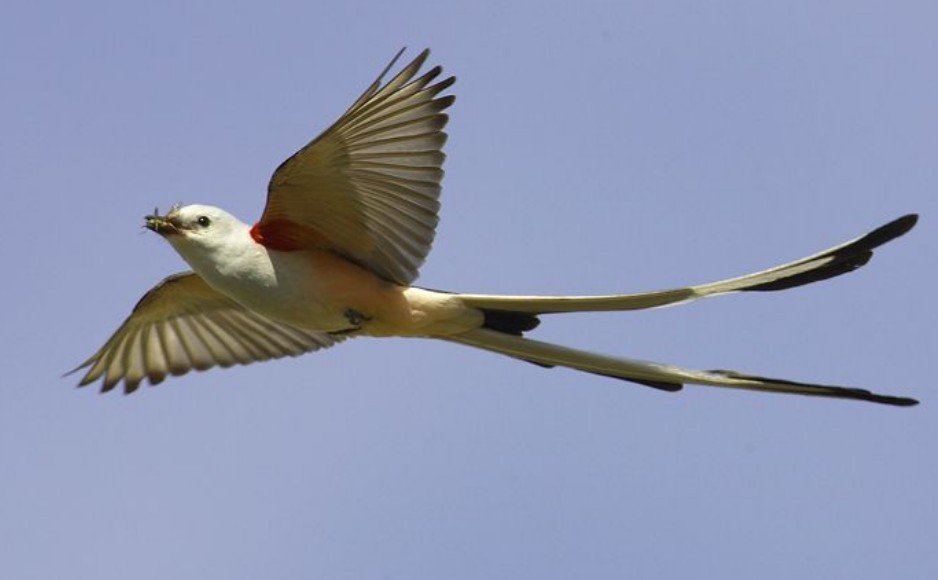
Exhibits bright red axillary (underwing) patches that are visible in flight.
8. Adaptable Nesting Sites
Nests in isolated trees, shrubs, and occasionally on artificial structures like telephone poles and utility wires.
9. Short Incubation Period
Eggs incubate for 13–23 days, with both parents feeding the hatchlings.
10. Declining Populations
While not endangered, populations are decreasing due to habitat loss and climate change.
The Scissor‑tailed Flycatcher: A Breathtaking Aerial Acrobat
An very fascinating bird endemic to North America, the Scissor‑tailed Flycatcher (Tyrannus forficatus) is well-known for its amazing looks and acrobatic skills. The long, scissor-shaped tail, colourful plumage, and dramatic aerial displays of this flycatcher make it one of the most attractive and unique birds in the area. The Scissor‑tailed Flycatcher consistently draws the attention of both nature lovers and birdwatchers, whether it is sitting atop a fencepost in the countryside or swooping elegantly through the air to hunt insects.
1. Physical Attributes
Dimensions and Form
Because of its graceful and unique characteristics, the Scissor-tailed Flycatcher is a bird that is easy to identify.
- Length: The male Scissor-tailed Flycatcher has a little longer tail than the female, and the bird is medium in size, ranging in length from 12 to 14 inches (30 to 35 cm).
- Wingspan: The bird can do amazing aerial manoeuvres because to its wingspan, which is normally between 15 and 16 inches (38 and 41 cm).
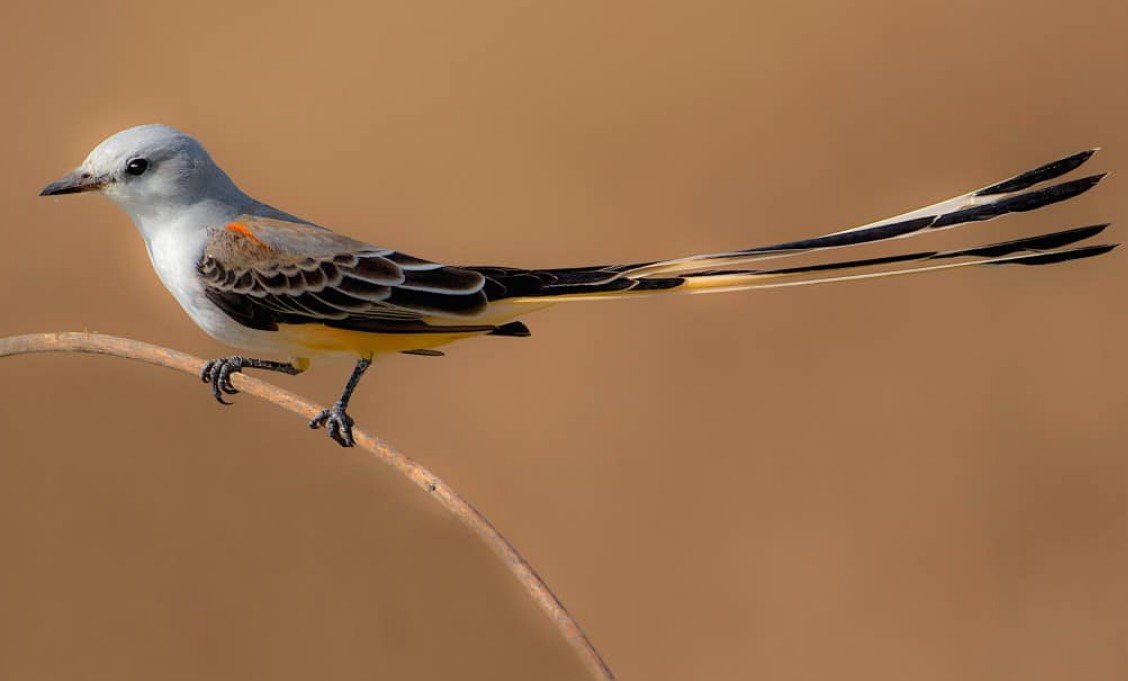
- Tail: The Scissor-tailed Flycatcher’s long, forked tail, which may grow up to 8 inches (20 cm) in length, is its most striking characteristic. With lengthy outer feathers and a sharp fork at the end, the tail has a pronounced scissor form. This characteristic contributes to courting displays and is particularly noticeable in men.
Coloration and Distinctive Markings
Upperparts: The Scissor-tailed Flycatcher’s upperparts are mostly greyish, with the sides and breast having a faint pinkish tint.
Underparts: The bird’s remarkable beauty is enhanced by the white belly and underparts that have a little peachy or pinkish tint.
Head: Its dark grey head and black mask around the eyes accentuate its piercing, intent gaze.
Tail Feathers: The bird’s distinctive appearance is further enhanced by its long, black tail feathers with white tips.
Eyes and Beak: The long, narrow beak of the Scissor-tailed Flycatcher is ideal for capturing insects in midair. As it flies across the sky, its dark, keen eyes are well-suited to locating prey.
2. Distribution and Habitat
Geographic Range
The Scissor-tailed Flycatcher is mostly found in North America’s wide grasslands, savannas, and sparsely forested regions, particularly in the Central United States, which stretches from Kansas and Missouri to Texas and Oklahoma. The species migrates to Mexico and portions of Central America in the winter, although it is most often seen in temperate and subtropical areas during the summer.
Habitat Preferences and Adaptability
Preference for Open Areas: In order to perch and capture insects, the Scissor-tailed Flycatcher needs wide areas with few trees or towering plants. It often perches on wires, trees, or fence posts, waiting for the ideal moment to dive down and capture flying insects. It is also known that these birds may adapt to ecosystems that have been altered by humans, such as residential areas, pastures, and farmlands.
Habitat Variety: The Scissor-tailed Flycatcher may live in a number of different types of habitats, but it prefers open areas with plenty of food sources and a good mix of perching spots. Its preference for regions with high insect populations is very important for its survival and nutrition.
3. Conduct and Aerial Acrobatics
Hunting and Flight Behavior
Capturing insects in mid-air is a speciality of the Scissor-tailed Flycatcher. It catches flying insects with its keen beak, including flying ants and other tiny arthropods, as well as beetles, grasshoppers, moths, and dragonflies. Scissor-tailed Flycatcher will leap into the air and dart around the skies with amazing speed and accuracy as soon as it sees prey. It often does amazing flying loops, diving and turning to get its prey.
The Scissor-tailed Flycatcher not only catches insects while flying, but it also sometimes hovers in one spot, waiting for insects to fly past before striking with its beak.
Perching Behavior
The Scissor-tailed Flycatcher may be seen perched on exposed branches, fence posts, or power lines when it is not in flight. It searches the surroundings for possible prey from these high vantage points. The bird often flies away from its perch, catches an insect, and then returns to the same perch to rest or feed.
Courtship Displays and Mating Behavior
The courting displays of the male Scissor-tailed Flycatcher are particularly well-known. The male will fly high into the air and then make a spectacular, steep dive towards the earth as part of a series of aerial displays to entice a mate. Its long tail feathers spread wide when it swoops, highlighting the characteristic scissor form. These performances serve as a showcase of the male’s physical prowess and aerial skills in addition to serving as a visual cue to females.
In order to interact with possible mates, the male will also sing during wooing. The melodious, high‑pitched tunes are often employed in conjunction with the aerial performances.
4. Nutrition and Feeding Practices
Insectivorous Diet
As a carnivorous bird, the Scissor-tailed Flycatcher mostly consumes insects and other tiny invertebrates. Because of its unique ability to capture insects while in flight, it is categorised as a flycatcher.
Diet Breakdown and Ecological Role
- Flying Insects: Moths, beetles, grasshoppers, and ants are among the many flying insects that the flycatcher hunts. The protein and energy needed for the bird’s high-energy flight are supplied by these insects.
- Other Invertebrates: The bird may also eat spiders and other tiny invertebrates during the breeding season.
- Natural Pest Control: Because of its exceptional ability to capture flying insects, the Scissor-tailed Flycatcher is a vital natural pest controller in its environment. Its eating habits enable the bird to flourish in open, insect-rich settings while also assisting in the maintenance of a healthy insect population.
5. Nesting and Reproduction
Breeding Season and Courtship
In the spring and summer, usually from April to July, the Scissor-tailed Flycatcher breeds. Males perform intricate courting rituals at this time, luring females with song and flight.
Nesting, Eggs, and Fledging
Nest Building: The female constructs the nest, usually in a small tree or shrub, however it may sometimes be erected on telephone poles or in thick grasses. Made of grass, twigs, and other plant materials, the nest is formed like a cup.
Eggs: Three to five eggs, often white with speckles or light greyish, are laid by the female. While the male helps to feed her and protect the nest, the female incubates the eggs.
Fledging: The eggs hatch in about two weeks, and the parents cooperate to feed the chicks, who develop rapidly and start to fledge in three to four weeks. Before becoming self-sufficient, the juvenile flycatchers are briefly reliant on their parents.
6. Status of Conservation
Current Population and Classification
The Scissor-tailed Flycatcher maintains a steady population across its range, as shown by its current listing as a species of least concern by the International Union for Conservation of Nature (IUCN). The bird is widespread in its natural habitats, which include suburban areas, farmlands, and open grasslands.
Potential Threats and Future Outlook
Although there are now no threats to the Scissor-tailed Flycatcher, future difficulties may arise from habitat loss brought on by urbanisation and agricultural expansion. The long-term survival of this famous bird will depend on maintaining its open habitat and safeguarding grasslands and shrublands.
FAQ (Frequently Asked Questions) about Scissor-tailed Flycatcher
Q: What does the Scissor-tailed Flycatcher eat?
Ans: Primarily insects such as grasshoppers, beetles, and dragonflies. Occasionally consumes berries during winter.
Q: Where can I find the Scissor-tailed Flycatcher?
Ans: Found in open country with scattered trees and shrubs, including grasslands, pastures, and urban areas in the southern United States, Mexico, and Central America.
Q: How does the Scissor-tailed Flycatcher catch its prey?
Ans: It feeds by perching and waiting for insects, then flying out to catch them in flight or picking them from foliage or the ground.
Q: Is the Scissor-tailed Flycatcher endangered?
Ans: No, it is listed as Least Concern. However, populations are decreasing due to habitat loss and climate change.
Q: What is the lifespan of a Scissor-tailed Flycatcher?
Ans: Up to 10 years in the wild.
Q: How does the Scissor-tailed Flycatcher defend its nest?
Ans:
Q: How does the Scissor-tailed Flycatcher defend its nest?
Ans: Both male and female aggressively defend their nest by diving at and chasing away larger birds and potential predators.
Q: Why is it called the Scissor-tailed Flycatcher?
Ans: It is named for its long, deeply forked tail which resembles an open pair of scissors, especially noticeable during flight.
Q: Is the Scissor-tailed Flycatcher the state bird of any U.S. state?
Ans: Yes, it is the state bird of Oklahoma.
Q: Do Scissor-tailed Flycatchers migrate?
Ans: Yes, they migrate seasonally—breeding in the southern United States and wintering in Mexico and Central America.
Q: What type of habitat does the Scissor-tailed Flycatcher prefer?
Ans: Open country with scattered trees and shrubs, including grasslands, pastures, roadsides, and urban edges.
#ScissortailedFlycatcher #FlycatcherFacts #BirdWatching #AerialHunters #StateBird #OklahomaBird #MigratoryBirds #WildlifeFacts
Our sources and references about Scissor-tailed Flycatcher
1: Wikipedia – Scissor-tailed Flycatcher
2: All About Birds – Scissor-tailed Flycatcher
3: Audubon – Scissor-tailed Flycatcher
4: Birds of the World – Scissor-tailed Flycatcher