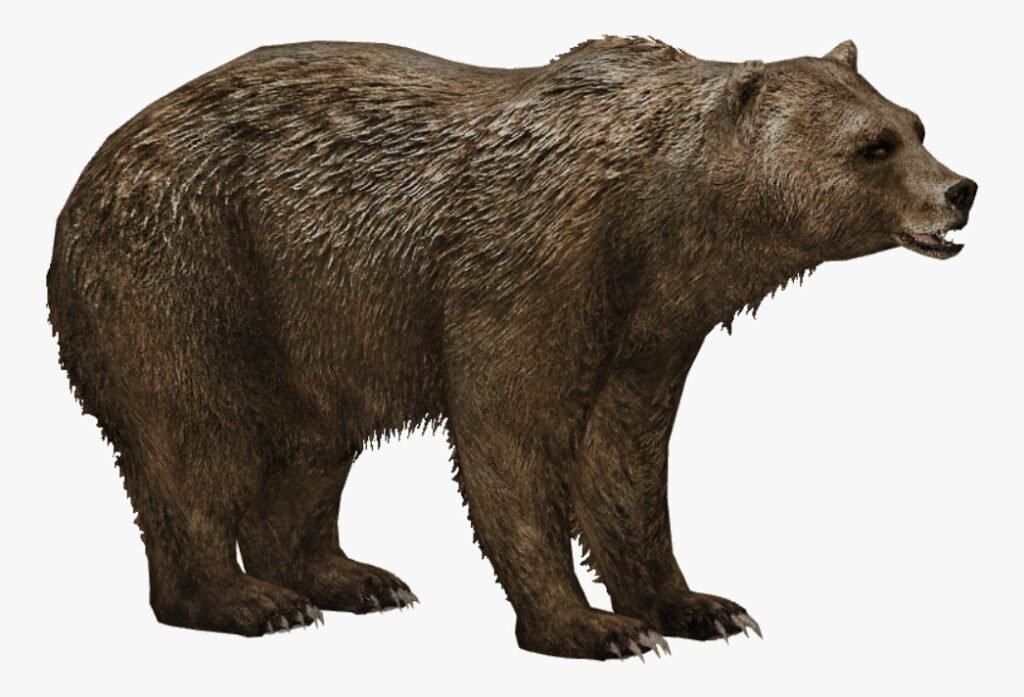
The Short-Faced Bear (Arctodus simus) is one of the largest and most powerful bears to have ever lived. This prehistoric species, which roamed North America during the Pleistocene epoch, is believed to have been a hypercarnivore, feeding on large prey such as bison and mammoths. Despite its massive size, it is thought to have been a swift runner, capable of reaching high speeds. The Short-Faced Bear went extinct around 11,000 years ago, likely due to climatic changes and the extinction of its prey species.
Quick Top 10 Facts about Short-Faced Bear
| SCIENTIFIC NAME | Arctodus simus |
| CLASSIFICATION | KINGDOM: Animalia PHYLUM: Chordata CLASS: Mammalia ORDER: Carnivora FAMILY: Ursidae |
| SIZE | Height: Up to 12 feet (3.7 meters) when standing on hind legs. Weight: 3,500–4,500 pounds (1,600–2,000 kg) |
| SPECIES | The Short-Faced Bear is a member of the genus Arctodus. |
| APPEARANCE | Massive body with long limbs and a relatively short face. It had a broad skull, large teeth, and a muscular build. |
| LIFE SPAN | Estimated lifespan of 20–30 years in the wild, though this is based on fossil evidence. |
| HABITAT | The Short-Faced Bear lived in North America, primarily in forests, open woodlands, and grassy plains. |
| DIET | Primarily a hypercarnivore, the Short-Faced Bear likely hunted large animals such as bison and mammoths, though it may also have consumed plant matter. |
| NATURAL PREDATORS | As an apex predator, the Short-Faced Bear had no natural predators except possibly other large carnivores. |
| COUNTRY | North America, particularly in regions that are now part of the United States and Canada. |
| GESTATION PERIOD | Estimated to be about 6–9 months, similar to modern bears. |
| CONSERVATION STATUS | Extinct (went extinct around 11,000 years ago). |
Amazing Facts About Short-Faced Bear
1. Enormous Size
The Short-Faced Bear was one of the largest terrestrial carnivores to ever exist, with some individuals standing up to 12 feet tall when on their hind legs.
2. Hypercarnivore
Unlike most modern bears that are omnivores, the Short-Faced Bear was likely a hypercarnivore, specializing in hunting and eating large prey such as bison and mammoths.
3. Speed and Agility
Despite its massive size, the Short-Faced Bear was likely a fast runner, capable of reaching speeds of up to 30 mph (48 km/h), enabling it to chase down prey.
4. Strong Limbs
With long, muscular limbs, the Short-Faced Bear was built for speed and strength, allowing it to overpower its prey with ease.
5. Short Face, Large Teeth
The bear had a relatively short face compared to modern bears, with large, powerful teeth designed for catching and consuming large animals.
6. Social Behavior
While little is known about their social behavior, the Short-Faced Bear likely lived a solitary life, much like modern bears.
7. Powerful Jaw Strength
The Short-Faced Bear’s jaw strength was exceptional, enabling it to crush bones and tear through tough animal hides to access nutritious meat.
8. Preyed on Megafauna
It likely hunted and scavenged large megafauna species of the Pleistocene, including mammoths, mastodons, and bison.
9. Extinct by Climate Change
The Short-Faced Bear went extinct around 11,000 years ago, likely due to a combination of climate change and the disappearance of its prey species.
10. Fascinating Fossil Evidence
Fossilized remains of the Short-Faced Bear provide valuable insights into the diet, behavior, and lifestyle of this ancient predator.

Short-Faced Bear Overview
One of the most powerful and mysterious carnivorous creatures from the Pleistocene Epoch, which lasted from around 2.6 million to 11,700 years ago, is the Short-Faced Bear (genus Arctodus). Palaeontologists and wildlife enthusiasts continue to be fascinated by this bear because of its enormous size, strong physique, and characteristically short face. The evolution, physical attributes, behavioural qualities, and extinction of the Short-Faced Bear, along with its ecological relevance, will all be covered below:
1. Background of Evolution and Species
All contemporary bears are members of the Ursidae family, which includes the Short-Faced Bear. It belonged to the genus Arctodus, which included a number of huge bear species. Arctodus simus, often known as the Giant Short-Faced Bear, is the most well-known species. A much smaller cousin, Arctodus pristinus, is one of the other species in the genus. An outline of its categorisation and evolutionary history is provided below:
Short-Faced Bear Species
- Arctodus simus: Among the biggest terrestrial carnivores in history, this species is regarded as the largest of the Short-Faced Bears. It is thought to have developed in North America during the Pleistocene, when it roamed the woods and plains.
- Arctodus pristinus: This smaller cousin, which lived in a comparable era to A. simus, was also a member of the genus Arctodus. Compared to its bigger sibling, which was more suited to open landscapes, it was better adapted to living in wooded environments.
Short-Faced Bear Origin
It is thought that the Short-Faced Bear descended from previous bear species, most likely from an old lineage that moved to North America from Asia. According to fossil evidence, the genus Arctodus evolved from the species A around 1.8 million years ago. The late Pleistocene saw the apex of simus.
2. Dimensions and Physical Features
The Short-Faced Bear is distinguished from contemporary bears by its remarkable physical attributes. Despite sharing a family with modern polar bears and grizzly bears, it had a few distinct characteristics. Let us examine its physical characteristics:
Short-Faced Bear Size and Weight
Dimensions According to some estimations, the Giant Short-Faced Bear (Arctodus simus) was 12 feet (3.7 meters) tall while standing on its hind legs, making it gigantic by any measure. It is thought to have been one of the biggest terrestrial carnivores in history, weighing between 2,500 and 3,500 pounds (1,100 and 1,600 kilogrammes). Even the greatest grizzlies or Kodiak bears weighed only over 1,500 pounds (680 kilogrammes), making them dwarfs in comparison to contemporary bears. With an estimated weight of 1,500 pounds (680 kilogrammes), the lesser species, Arctodus pristinus, was still enormous but not as intimidating.
Short-Faced Bear Skull and Jaws
Jaw Structure and Short Face Face: The Short-Faced Bear’s short, flat face was its most distinguishing characteristic. The Short-Faced Bear had a shorter nose and a more compact skull than contemporary bears with longer faces. This characteristic has often been mentioned as one of the primary causes of the bear’s nickname, “Short-Faced.” Jaw and Teeth: It has strong jaws and big, pointed teeth that could have torn through flesh and crushed bones. Its teeth resembled those of contemporary predators like wolves and large cats, and its dental anatomy was tailored for a carnivorous diet.
Short-Faced Bear Limbs and Speed
Speed and Limbs Limbs: In contrast to contemporary bears, the Short-Faced Bear’s limbs were noticeably longer and thinner. It is thought that this adaption allowed it to sprint faster than the majority of bears. According to some estimations, it was among the quickest big carnivores of its day, capable of reaching up to 40 miles per hour (64 km/h). Claws and Digits: The bear may not have depended as much on digging or climbing as contemporary grizzly bears, as shown by the fact that its claws, albeit still big, were not as pronounced. Rather, it was probably a chase predator due to its physical characteristics, which allowed it to run after prey quickly and nimbly.
3. Short-Faced Bear Diet and Hunting Behaviour
Compared to current bears, who are sometimes seen as opportunistic omnivores, the Short-Faced Bear was predominantly a carnivore, and evidence suggests that it had a more aggressive hunting strategy.

Short-Faced Bear Diet
- Large herbivores, such mammoths, bison, and mastodons, which were common in the Pleistocene, probably made up the Short-Faced Bear’s main diet.
- But it could have also eaten the remains that other predators had left behind.
- The Short-Faced Bear was most likely a pursuit predator, using its extraordinary speed to hunt and ambush prey.
- Similar to modern cheetahs, some experts speculate that it used speed to chase down huge prey.
- Though primarily carnivorous, it may have sometimes consumed fruits or plant matter.
Short-Faced Bear Behavior
Characteristics of Behaviour Like many contemporary bear species, the Short-Faced Bear is thought to have lived alone. It probably lived in isolation and travelled large regions in quest of food. Some evidence indicates that Short-Faced Bears may have gathered in locations with plenty of food supplies, despite their solitary character. They could have sometimes fought over territory with other huge carnivores, such as dire wolves and saber-toothed cats.
4. The Short-Faced Bear’s Extinction
Like many other Pleistocene megafauna, the Short-Faced Bear’s demise is still hotly debated among experts. The following are the most widely acknowledged hypotheses about its extinction:
Climate Change and Habitat Loss
Changes in Climate Significant climatic shifts, including warmer temperatures and ice sheet retreat, took place when the Pleistocene gave way to the Holocene. The huge herbivores that the Short-Faced Bear depended on for sustenance vanished as a result of these ecosystem-altering events. The Short-Faced Bear population would have been under a great deal of stress due to the decrease in prey supply, which was probably caused by the loss of open habitats and the shrinking of grasslands.
Human Impact on Short-Faced Bear
Human Impact The Short-Faced Bear may have declined as a result of overhunting and competition for food by early humans who hunted and collected. The existence of early human tools and the overlap in the habitats of people and bears may have contributed to the bear’s demise, even though there is little concrete proof of human hunting.
Predator Competition
Competition from Other Predators Other huge carnivores, such as the dire wolf (Canis dirus) and saber-toothed tiger (Smilodon), coexisted with the short-faced bear. The Short-Faced Bear’s chances of surviving would have been further hampered by the direct rivalry between these predators for the same food supplies.
FAQ (Frequently Asked Questions) about Short-Faced Bear
Q: What is the Short-Faced Bear?
Ans: The Short-Faced Bear (Arctodus simus) is an extinct species of bear that lived during the Pleistocene epoch, known for its enormous size and speed.
Q: How big was the Short-Faced Bear?
Ans: The Short-Faced Bear could grow up to 12 feet tall when standing on its hind legs and weighed up to 4,500 pounds (2,000 kg).
Q: What did the Short-Faced Bear eat?
Ans: It was likely a hypercarnivore, preying on large animals such as bison, mammoths, and other megafauna.
Q: Why did the Short-Faced Bear go extinct?
Ans: The Short-Faced Bear went extinct around 11,000 years ago, likely due to climate change and the extinction of its prey species.
Q: How fast could the Short-Faced Bear run?
Ans: Despite its size, it could run at speeds of up to 30 mph (48 km/h), making it a swift predator.
Q: Where did the Short-Faced Bear live?
Ans: It lived in North America, particularly in forests, woodlands, and grasslands across what is now the United States and Canada.
Q: How long did the Short-Faced Bear live?
Ans: The Short-Faced Bear had an estimated lifespan of 20–30 years based on fossil evidence.
#ShortFacedBear #PrehistoricAnimals #IceAge #Megafauna #Pleistocene #BearFacts #ExtinctAnimals
Our sources and references about Short-Faced Bear
1: Wikipedia – Short-Faced Bear
2: Britannica – Short-Faced Bear
3: National Geographic – Short-Faced Bear
4: Paleo Blog – Short-Faced Bear