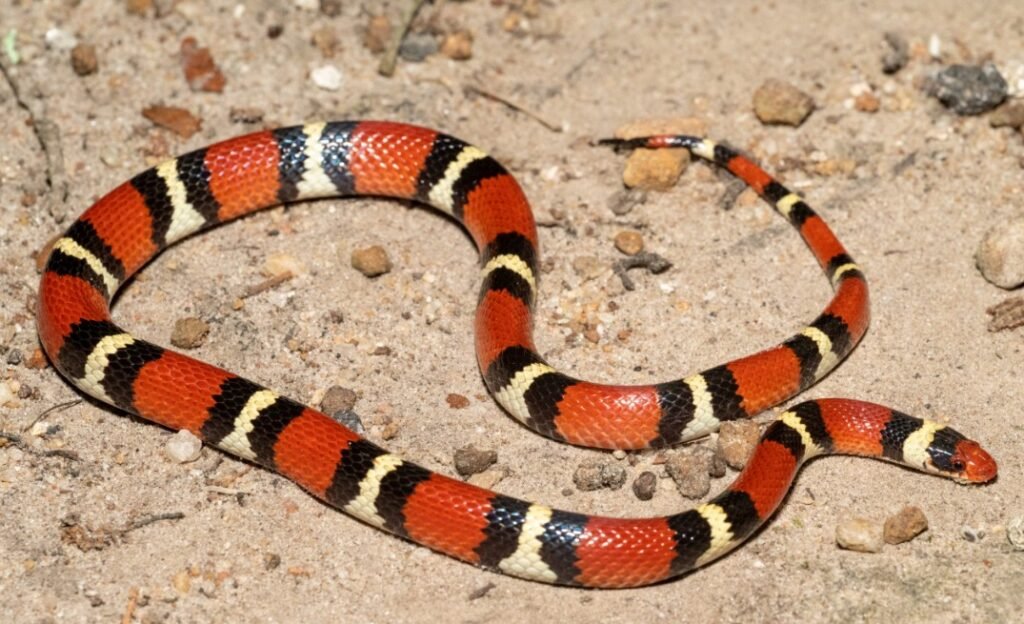
The Scarlet Kingsnake (Lampropeltis elapsoides) is a strikingly beautiful non-venomous snake found in the southeastern United States. Known for its vibrant red, black, and yellow bands, the Scarlet Kingsnake closely resembles the venomous coral snake but is completely harmless. These snakes are excellent climbers and burrowers, inhabiting a variety of habitats including woodlands, grasslands, and coastal areas. Despite their resemblance to the dangerous coral snake, Scarlet Kingsnakes are beneficial in controlling pest populations such as rodents and insects.
Quick Top 10 Facts about Scarlet Kingsnake
| SCIENTIFIC NAME | Lampropeltis elapsoides |
| CLASSIFICATION | KINGDOM: Animalia PHYLUM: Chordata CLASS: Reptilia ORDER: Squamata FAMILY: Colubridae |
| SIZE | Length: 46–91 cm (18–36 inches) |
| SPECIES | Scarlet Kingsnake |
| APPEARANCE | Vibrant red, black, and yellow bands; a pattern that mimics the venomous coral snake but is harmless |
| LIFE SPAN | 15–20 years in the wild |
| HABITAT | Woodlands, grasslands, coastal areas, and areas with loose, sandy soils |
| DIET | Small rodents, lizards, eggs, amphibians, and insects |
| NATURAL PREDATORS | Hawks, large mammals, and other snakes |
| COUNTRY | Found in the southeastern United States, particularly in Florida, Georgia, Alabama, and South Carolina |
| GESTATION PERIOD | Incubation of eggs: 60–70 days |
| CONSERVATION STATUS | Least Concern globally, but some local populations face threats from habitat destruction |
Amazing Facts About Scarlet Kingsnake
1. Mimicry of the Coral Snake
The Scarlet Kingsnake’s bright coloration closely resembles that of the venomous coral snake, a defensive mimicry that helps protect it from predators.
2. Non-Venomous and Harmless
Unlike the coral snake, Scarlet Kingsnakes are non-venomous and pose no danger to humans. Their colorful appearance serves as a warning to potential predators.
3. Master of Camouflage
While they are bright and colorful, Scarlet Kingsnakes can also blend into their environment when necessary, particularly when they burrow under leaves or soil.
4. Active Hunters
These snakes are active hunters, preying on a variety of small animals, including rodents, frogs, and lizards.
5. Excellent Climbers
Scarlet Kingsnakes are skilled climbers and often seek out trees, shrubs, or logs to explore their environment.
6. Burrowers by Nature
When not hunting or basking, they are often found hiding in burrows or crevices, which provides protection from predators.
7. Solitary Creatures
They are solitary animals, only coming together to mate. Scarlet Kingsnakes are not typically found in large groups.
8. Nocturnal Habits
While they are known to be active during the day, they are more commonly nocturnal, hunting at night when the temperature is cooler.
9. Fewer Natural Predators
Due to their mimicry of the coral snake and their relatively small size, Scarlet Kingsnakes have few natural predators.
10. Beneficial to Farmers
By controlling populations of rodents and insects, Scarlet Kingsnakes are valuable in agricultural areas, reducing pest damage.
The Vibrant and Non-Venomous Scarlet Kingsnake
The dazzlingly gorgeous, non-venomous scarlet kingsnake, technically known as Lampropeltis elapsoides, has captivated the attention of both wildlife and reptile enthusiasts. The scarlet kingsnake, which is well-known for its striking colouring and striking similarity to some of the most poisonous snakes in North America, is a prime example of Batesian mimicry, a survival strategy that enables it to imitate deadly species without really posing a threat.
1. Physical Features of the Scarlet Kingsnake
Distinctive Appearance and Identification
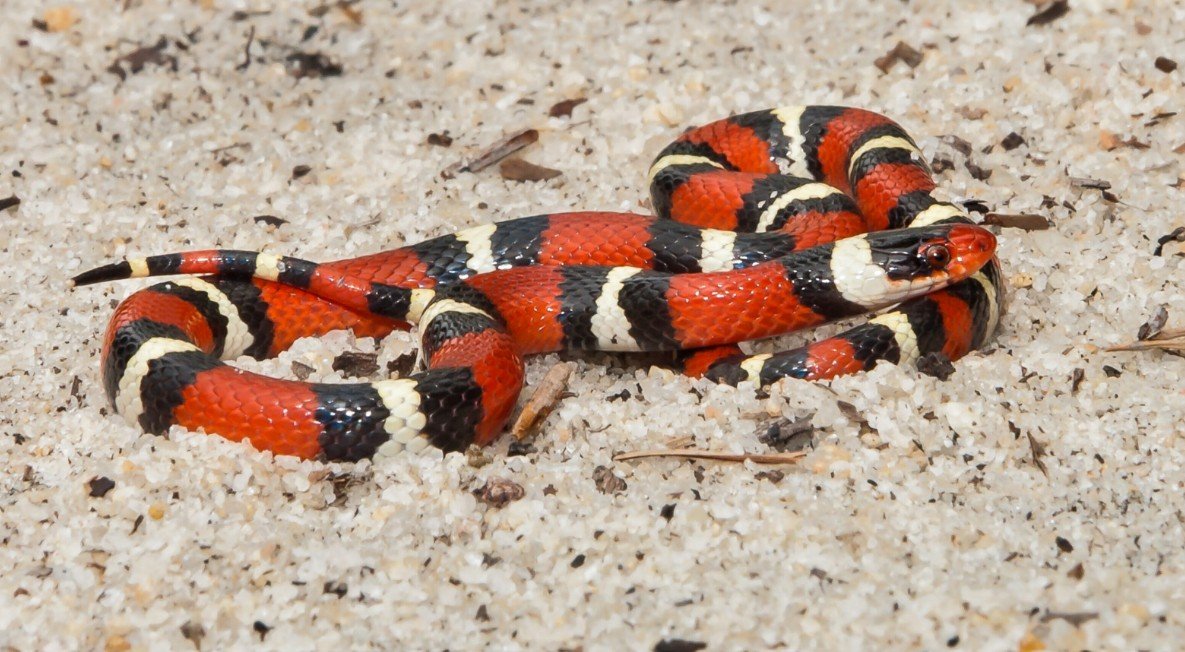
The Colubridae family, which comprises a range of non-venomous snakes, includes the scarlet kingsnake. The remarkable pattern of alternating red, black, and yellow or white stripes around its body is what makes this species so well-known. It is frequently incorrectly frightened because of its look, which strongly resembles that of the very poisonous coral snake (Micrurus fulvius), a species endemic to North America.
Key Attributes of the Scarlet Kingsnake
- Colouration: The scarlet kingsnake’s tricoloured look is its most distinguishing feature. Bright red bands are interspersed with black, yellow, or white bands on its body. Depending on the individual, these colours might differ somewhat; some snakes have more subdued tones or more brilliant hues.
- Size: The size of scarlet kingsnakes is very tiny. Although some individuals may grow up to 36 inches (91 cm), they typically reach a length of 18 to 24 inches (46 to 61 cm). They are strong and swift despite their little stature.
- Head: With a noticeable black band over its eyes, the scarlet kingsnake has a somewhat pointed head. This design helps repel possible predators by making it resemble other poisonous snakes, especially the coral snake.
- Body: The snake appears sleek and glossy due to its slim body and silky scales. The texture of the scarlet kingsnake is smooth, as opposed to rough, like certain other snake species.
2. Distribution and Habitat of the Scarlet Kingsnake
Geographical Range
The southeastern United States is home to the majority of scarlet kingsnakes, which flourish there in a range of environments such as woods, grasslands, and scrublands. They may be found as far west as Mississippi, and their range stretches from southern North Carolina to Florida.
Favourite Habitats
- Pine Woods and Forests: The scarlet kingsnake is often found in places with plenty of cover, such deciduous woodlands or pine forests, where they may conceal themselves under fallen leaves, logs, and other debris.
- Dry, Sandy Habitats: They are also often found in sandy places where burrows and shelters are easily accessible, including sandhills, scrublands, or open fields.
- Urban and Suburban Settings: Scarlet kingsnakes have adapted to urban and suburban settings as a result of human development, often residing in parks, yards, and gardens where they may get food and shelter.
Being terrestrial, scarlet kingsnakes spend the most of their lives on the ground. They are skilled climbers, nevertheless, and may sometimes scale trees or bushes to find food or cover. During the day, they would rather remain concealed in burrows, behind rocks, or inside rotting logs; they only come out at night or in the early morning.
3. Diet and Behaviour of the Scarlet Kingsnake
Nocturnal Nature and Feeding Habits
Being a nocturnal predator, the scarlet kingsnake is most active at night when the temperature is lower. These snakes can travel quickly across the ground because of their exceptional agility. The main goals of their behaviour and habits are breeding, hunting, and survival.
Nutrition and Prey
- Diet: As a carnivore, the scarlet kingsnake mostly consumes amphibians, insects, and other small reptiles. Lizards, frogs, tiny rodents, eggs, and even other snakes (including the young of poisonous species) are common prey items.
- Feeding Behaviour: As a constrictor, the scarlet kingsnake usually encircles and squeezes its victim to immobilise it before devouring it whole. It has a reputation for being very opportunistic and will exploit any prey that is in its immediate vicinity.
Batesian Mimicry and Protection
The red kingsnake’s use of Batesian mimicry is among its most intriguing features. The scarlet kingsnake’s vivid colouring is meant to mimic that of the very poisonous coral snake, which naturally preys on a variety of tiny reptiles. Although the scarlet kingsnake poses no threat to people or other animals, its resemblance to the coral snake serves to shield it from predators who could steer clear of it out of concern for its safety.
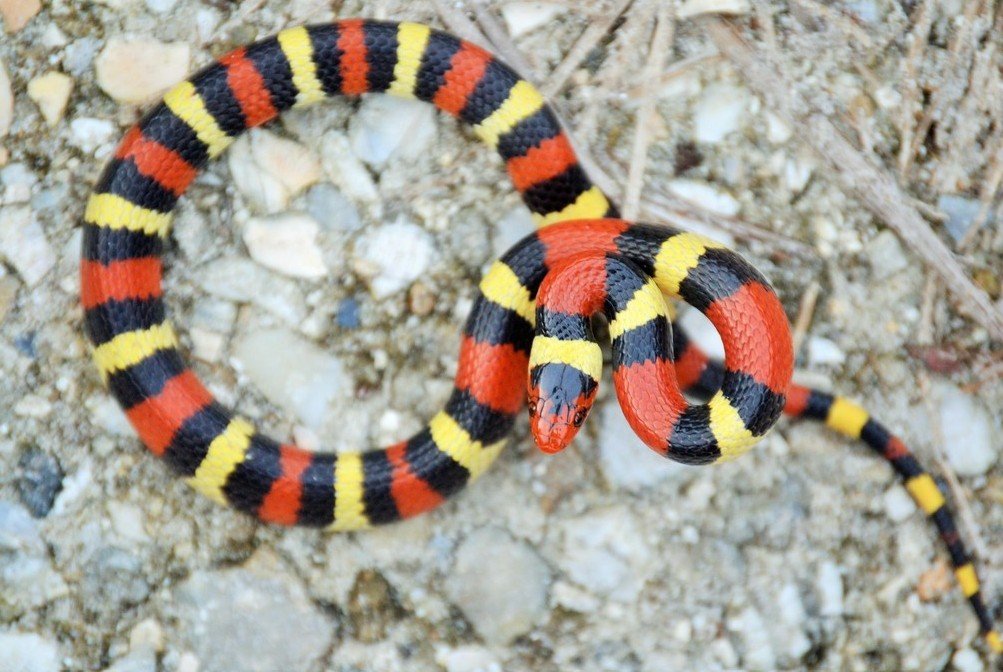
To differentiate between the coral snake and the scarlet kingsnake, the rhyme “Red on yellow, kill a fellow; red on black, friend of Jack” is often used. This mnemonic aids in emphasising the primary colour patterns that set the venomous coral snake apart from the non-venomous scarlet kingsnake. The coral snake’s red bands are surrounded by yellow, while the scarlet kingsnake’s are surrounded by black.
4. Lifespan and Reproduction of the Scarlet Kingsnake
Reproductive Behaviour
Like the majority of snake species, scarlet kingsnakes are oviparous, which means they lay eggs instead of giving birth to live offspring. In the spring and early summer, scarlet kingsnakes usually have their reproductive season.
- Mating: During the breeding season, male scarlet kingsnakes often vie for access to females. They could fight with other males, pushing and wrestling each other away with their bodies.
- Egg Laying: The female will lay a clutch of four to ten eggs after mating, and these are usually placed in a warm, protected location. The female gives the eggs little attention while they are incubating, which takes about 60 to 70 days.
- Hatching: The fully developed eggs hatch into young snakes that are self-sufficient from birth. They can already hunt tiny prey when they hatch, usually measuring 6 to 8 inches in length.
Despite having a comparatively lengthy lifetime for a tiny snake—up to 10 to 15 years in captivity—scarlet kingsnakes often have lower lifespans in the wild because of environmental conditions and predation.
5. Conservation Status of the Scarlet Kingsnake
Population Stability and Threats
The scarlet kingsnake’s population is steady across its range, and it is currently not regarded as endangered or vulnerable. But like many other animal species, the scarlet kingsnake could have to deal with issues including road fatalities, urbanisation, and habitat degradation.
Human Impact and Protection
- Habitat Destruction: In places where development encroaches on the native territories of scarlet kingsnakes, deforestation and urban expansion have resulted in the loss of adequate habitats for these snakes. Nonetheless, because of their relative adaptability, these snakes have flourished in both urban and rural environments.
- Road Mortality: One of the main causes of death for scarlet kingsnakes, like many other ground-dwelling animals, is being struck by cars when crossing roadways.
Efforts to preserve natural habitats, reduce road mortality, and increase public awareness of these snakes’ harmless nature might help assure their continuing existence even if they are not presently in danger.
6. The Scarlet Kingsnake in Popular Culture
Symbolism and Public Fascination
Because of its striking appearance and relationship with mimicry, the scarlet kingsnake has attracted the attention of many people. The scarlet kingsnake is still a common pet in the reptile trade, despite maybe not being as well-known as some other snake species, including pythons or boa constrictors.
Scarlet Kingsnake as a Pet
Because of their spectacular colouration, placid disposition, and manageable size, scarlet kingsnakes are a favourite among snake aficionados. Because they just need basic habitat conditions that are comparable to those in their natural home—such as a terrestrial enclosure with plenty of hiding places and a temperature gradient—they are simple to care for in captivity.
FAQ (Frequently Asked Questions) about Scarlet Kingsnake
Q: What is a Scarlet Kingsnake?
Ans: The Scarlet Kingsnake is a non-venomous snake known for its red, black, and yellow bands. It is often mistaken for the venomous coral snake but is harmless.
Q: Where do Scarlet Kingsnakes live?
Ans: They are found in the southeastern United States, particularly in woodlands, grasslands, and coastal areas.
Q: What do Scarlet Kingsnakes eat?
Ans: Their diet includes small mammals, lizards, amphibians, eggs, and insects.
Q: How long do Scarlet Kingsnakes live?
Ans: Scarlet Kingsnakes can live 15–20 years in the wild.
Q: Are Scarlet Kingsnakes dangerous?
Ans: No, they are non-venomous and pose no threat to humans. Their bright coloration is a defense mechanism.
Q: How can you tell a Scarlet Kingsnake from a Coral Snake?
Ans: The Scarlet Kingsnake has a distinctive pattern of red, black, and yellow bands, but unlike the venomous coral snake, the red and yellow bands do not touch each other.
Q: Are Scarlet Kingsnakes good pets?
Ans: Yes, they make great pets due to their docile nature, manageable size, and easy care requirements.
Q: How do Scarlet Kingsnakes reproduce?
Ans: They lay eggs, which incubate for 60–70 days before hatching.
Q: What are the threats to Scarlet Kingsnakes?
Ans: Habitat loss and the illegal pet trade pose some threats to their populations.
Q: Are Scarlet Kingsnakes endangered?
Ans: While not globally endangered, some local populations face threats from habitat destruction.
#ScarletKingsnake #NonVenomousSnakes #Kingsnakes #Wildlife #SnakeFacts #SnakeMimicry #Conservation #SoutheasternUSA
Our sources and references about Scarlet Kingsnake
1: Wikipedia – Scarlet Kingsnake
2: National Geographic – Scarlet Kingsnake
3: Reptiles Magazine – Scarlet Kingsnake