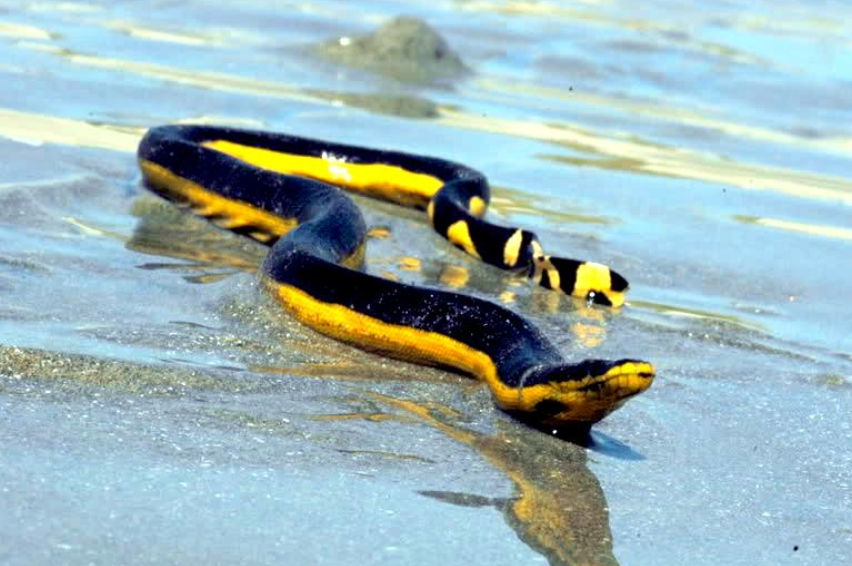
The Yellow-Bellied Sea Snake is a highly venomous species of sea snake found in the Indian and Pacific Oceans. It is named for its bright yellow belly and dark upper body. This snake is highly adapted to marine life and is known for its strong swimming ability and venomous bite, which it uses to catch fish and small marine creatures.
Quick Top 10 Facts about Yellow-Bellied Sea Snake
| SCIENTIFIC NAME | Pelamis platura |
| CLASSIFICATION | KINGDOM: Animalia PHYLUM: Chordata CLASS: Reptilia ORDER: Squamata FAMILY: Elapidae GENUS: Pelamis SPECIES: P. platura |
| SIZE | Length: 3–4 feet (90–120 cm) |
| HABITAT | Found in the warm waters of the Indian and Pacific Oceans, primarily along the coasts of Southeast Asia, Australia, and the Philippines |
| DIET | Feeds primarily on fish, including small fish, and eels |
| SPECIES | Yellow-Bellied Sea Snake, a highly venomous species known for its bright yellow underside |
| COUNTRY | Native to the Indian and Pacific Oceans |
| GESTATION PERIOD | Egg-laying species; lays eggs that hatch in the ocean |
| LIFE SPAN | Typically 6–10 years in the wild |
| CONSERVATION STATUS | Least Concern; although their populations are stable, they are still vulnerable to habitat degradation and climate change |
Amazing Facts About Yellow-Bellied Sea Snakes
1. Highly venomous
The Yellow-Bellied Sea Snake is highly venomous, using its potent neurotoxic venom to catch and immobilize its prey.
2. Exceptional swimmers
This snake is an excellent swimmer, with a paddle-like tail that helps it move efficiently through the water.
3. Bright yellow belly
One of the most distinctive features of the Yellow-Bellied Sea Snake is its bright yellow underside, which contrasts with its dark upper body.
4. Fully marine lifestyle
Unlike other snakes, the Yellow-Bellied Sea Snake spends its entire life in the ocean, rarely coming ashore.
5. Adapted for underwater life
It has special adaptations, such as its flattened tail and salt glands, that allow it to thrive in its aquatic environment.
6. Non-aggressive towards humans
Despite its venomous nature, the Yellow-Bellied Sea Snake is not typically aggressive and will usually avoid humans if possible.
7. Important role in marine ecosystems
It helps maintain the balance of marine ecosystems by preying on fish and eels, thus controlling their populations.
8. Can hold its breath for long periods
The Yellow-Bellied Sea Snake can hold its breath for several hours, allowing it to stay submerged for extended periods while hunting.
9. Reproduces through egg-laying
Unlike some sea snakes, the Yellow-Bellied Sea Snake lays eggs in the ocean, which hatch into larvae that later grow into adult snakes.
10. Vulnerable to climate change
Changes in ocean temperatures and coastal habitat degradation due to human activities are potential threats to the Yellow-Bellied Sea Snake’s population.
Introduction to the Intriguing Yellow-Bellied Sea Snake
Pelamis platura, the official name for the yellow-bellied sea snake, is one of the most fascinating and hazardous marine animals on the planet. This poisonous snake has fascinated both researchers and marine fans with its long, thin body and brilliant yellow underside. Because of its completely maritime existence, the Yellow-Bellied Sea Snake stands apart among the other members of the Elapidae family, which also includes cobras, kraits, and coral snakes. Even though the general public seldom sees it, it plays a significant role in the marine ecology. We will examine the yellow-bellied sea snake’s physical characteristics, habitat, behaviour, nutrition, reproduction, and conservation status given below:
A Look at the Yellow-Bellied Sea Snake’s Physical Features
The yellow-bellied sea snake is well-known for its unique look and unique adaptations to its aquatic lifestyle. This very poisonous snake is a wonder of evolutionary design since its traits are ideal for an aquatic lifestyle.
Size and Shape of the Body
Medium in size, the yellow-bellied sea snake usually reaches a length of 1.5 to 1.8 meters (5 to 6 feet). The snake can travel through the water with elegance because of its elongated and thin body. The snake can swim more quickly and encounter less resistance while navigating the water because of its form. It is lightweight while having a somewhat lengthy body, which is necessary for surviving in the water where buoyancy is crucial for locomotion.
Markings and Colouration
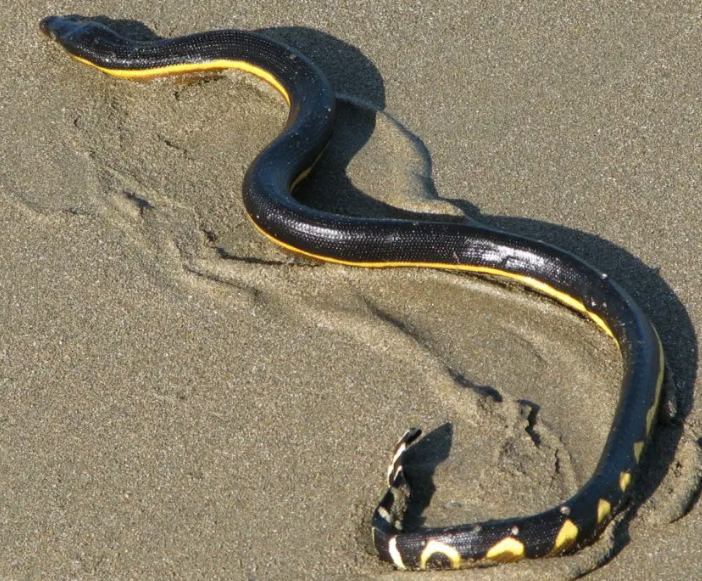
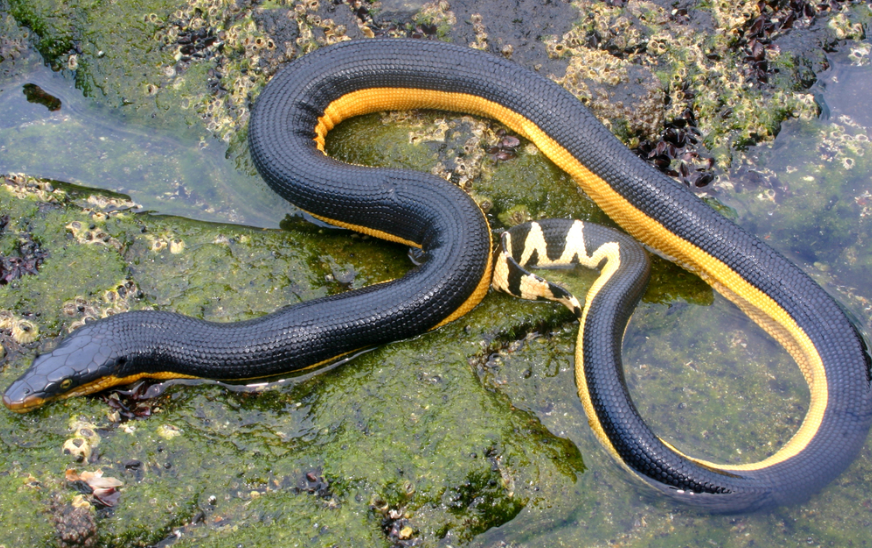
The yellow-bellied sea snake’s unique colour pattern is its most noticeable characteristic. The snake has a brilliant, vivid yellow belly and a dark, brownish-grey or black back. Because it blends in with the ocean’s surface, its colouration helps the snake evade predators in the water. It is simple to recognise from a distance because of the golden colouring, which is especially noticeable around the belly. Furthermore, a gradient look is often produced towards the tail when this yellow underbelly becomes white.
Defence Mechanisms and Venomous Fangs
The yellow-bellied sea snake is a poisonous member of the Elapidae family. It can inject poison into its victim because of its two hollow teeth. Small fish and other marine life are rendered immobile and killed by this very deadly venom. Although the yellow-bellied sea snake may be harmful to humans, it usually does not act aggressively. Hunting is more likely to involve the use of its venom than defence.
The Yellow-Bellied Sea Snake’s Natural Environment
The warm, tropical, and subtropical seas of the Indian and Pacific Oceans are the only places where the yellow-bellied sea snake may be found. It is often found on the shores of the Pacific islands, Australia, and Southeast Asia. Although it may be found in deeper ocean areas, this snake favours shallow coastal waters.
Range and Distribution
The yellow-bellied sea snake is found in a variety of aquatic environments. It is found on the shores of nations including the Philippines, Malaysia, Thailand, Indonesia, and Australia. These snakes may also be found in the open ocean, where they may follow currents and move between islands. They often live in places with warm water temperatures, usually between 20 and 30°C (68 and 86°F), and they choose locations with muddy or sandy bottoms.
Adaptations to the Marine Environment
The yellow-bellied sea snake is completely suited to aquatic life. It can swim more easily and manoeuvre more easily in the water because of its laterally flattened shape. The snake can travel through the water quite well because its tail is flattened and functions as a paddle. Another adaptation is its capacity to breathe air since it has to surface from time to time to absorb oxygen. However, since it can hold its breath for lengthy periods of time, it can remain underwater for longer periods of time.
Yellow-Bellied Sea Snake Feeding Behaviors
Primarily carnivorous, yellow-bellied sea snakes use specialised hunting methods to catch their food in the water. They use venom and swift movements to hunt tiny fish and eels, which make up the majority of their food.
Methods of Hunting and Prey
Yellow-bellied sea snakes are ambush predators, meaning they usually wait for their victim to approach before attacking. The victim becomes paralysed by their deadly bite, which facilitates swallowing. Because of their exceptional swimming abilities, these snakes pursue swift-moving fish, eels, and other aquatic life with their long, lean bodies. Because the yellow-bellied sea snake’s venom is neurotoxic, it targets the victim’s neurological system, making it impossible for them to flee after being bitten.
Diet and Feeding Practices
Although fish and eels make up the majority of the Yellow-Bellied Sea Snake’s diet, it is also known to consume crabs and cephalopods. It uses its excellent eyesight and specialised hunting skills to find its prey throughout both day and nighttime hunting. The snake is a highly adaptive creature that can hunt well and go for long stretches of time without sustenance.
Yellow-Bellied Sea Snake Reproduction
When it comes to reproduction, the Yellow-Bellied Sea Snake is different from other snake species. It is ovoviviparous, meaning that rather than laying eggs, the female gives birth to live young. For a species that lives in aquatic conditions where it would be difficult to deposit eggs on land, this adaptation is very advantageous.
The Process of Mating and Gestation
Male Yellow-Bellied Sea Snakes will vie for females throughout the mating season. In order to establish dominance, the males will often fight, and the winner will mate with the female. The female gives birth to live young after a gestation period of many months. The female usually gives birth to four to ten young at a time; however, the exact number of offspring might vary. The infants can swim right away after birth since they are completely grown at birth.
Development and Offspring
As soon as they are born, juvenile yellow-bellied sea snakes can hunt and swim by themselves. They start their lives in the same coastal waters as their parents and are born with a black back and yellow belly, much like the adults. These young animals develop swiftly and start to behave similarly to their adult counterparts while hunting.
The State of the Yellow-Bellied Sea Snake’s Conservation
Despite not being listed as endangered at this time, the yellow-bellied sea snake is at risk of becoming extinct. These include pollution, habitat degradation, and unintentional entrapment in fishing nets. Furthermore, in certain places, people persecute snakes because of their deadly nature.
Dangers to the Population
Degradation of habitat is the main danger to the Yellow-Bellied Sea Snake’s population. The ecology of the snake is negatively impacted by pollution, coastal development, and the devastation of mangrove forests and coral reefs. The snake’s existence is also seriously threatened by overfishing and bycatch, which occurs when the snake inadvertently becomes entangled in fishing nets.
Conservation Activities
To preserve the yellow-bellied sea snake and its native environment, conservation measures are being taken. Some locations have created marine protected areas (MPAs) to conserve significant ecosystems, and many international organisations are attempting to lessen the effects of overfishing and pollution. Although more awareness and protective measures are still required to guarantee the snake’s continuing existence, its poisonous nature also guarantees that people do not directly target it as a danger.
FAQ (Frequently Asked Questions) about Yellow-Bellied Sea Snake
Q: What is a Yellow-Bellied Sea Snake?
Ans: The Yellow-Bellied Sea Snake (Pelamis platura) is a highly venomous marine snake found in the tropical and subtropical waters of the Indian and Pacific Oceans. It is easily identifiable by its yellow belly and black upper body. Known for its aquatic lifestyle, it is one of the most widespread sea snakes.
Q: Where does the Yellow-Bellied Sea Snake live?
Ans: The Yellow-Bellied Sea Snake inhabits tropical and subtropical coastal waters, ranging from the Indian Ocean to the western Pacific Ocean. They are typically found in open ocean waters, but they may also be seen near shorelines or in bays, estuaries, and coral reefs. They prefer calm, warm waters with a high density of fish.
Q: What does the Yellow-Bellied Sea Snake eat?
Ans: The Yellow-Bellied Sea Snake primarily feeds on small fish, fish eggs, and occasionally squid. It hunts by using its venom to immobilize its prey and then swallowing it whole. This species is known for being an efficient hunter, swimming gracefully and hunting in the open ocean.
Q: How big is the Yellow-Bellied Sea Snake?
Ans: The Yellow-Bellied Sea Snake is relatively small compared to some other sea snakes, growing to an average length of 1.2 to 1.5 meters (4 to 5 feet). Some individuals can grow even longer, though they rarely exceed 2 meters (6.5 feet). Its slender body and distinct coloration make it easily recognizable.
Q: What does the Yellow-Bellied Sea Snake look like?
Ans: The Yellow-Bellied Sea Snake has a distinctive appearance, with a black or dark brown upper body and a bright yellow belly. This coloration is believed to help it camouflage in the water, making it less visible to predators and prey. Its body is long, cylindrical, and slender, adapted for swimming and hunting in the ocean.
Q: Are Yellow-Bellied Sea Snakes dangerous?
Ans: Yes, the Yellow-Bellied Sea Snake is venomous and can be dangerous to humans. Its venom contains potent neurotoxins that can cause paralysis and respiratory failure if envenomation occurs. However, attacks on humans are rare, as these snakes are generally not aggressive and tend to avoid people. They primarily use their venom to subdue prey rather than to defend themselves.
Q: How does the Yellow-Bellied Sea Snake defend itself?
Ans: The Yellow-Bellied Sea Snake is not particularly aggressive but will defend itself if threatened. It can swim away quickly, using its tail to propel itself through the water. Its venom serves as an effective weapon to immobilize prey, and though it may bite when threatened, it generally prefers to avoid confrontation with larger animals, including humans.
Q: How long do Yellow-Bellied Sea Snakes live?
Ans: Yellow-Bellied Sea Snakes have a lifespan of around 6 to 10 years in the wild. However, their life expectancy can vary depending on environmental conditions and threats such as predation or human-related activities. Their population is considered stable, although they face some threats from habitat degradation and pollution.
Q: Are Yellow-Bellied Sea Snakes endangered?
Ans: Yellow-Bellied Sea Snakes are not currently considered endangered, but like many marine species, they are vulnerable to the impacts of habitat loss, pollution, and climate change. Conservation efforts to protect marine ecosystems are crucial for ensuring their continued survival.
Q: Can Yellow-Bellied Sea Snakes be kept in captivity?
Ans: Keeping Yellow-Bellied Sea Snakes in captivity is not recommended, as they are wild animals that require very specific marine environments and conditions. Additionally, their venomous nature makes them potentially dangerous for inexperienced handlers. Conservation efforts should focus on preserving their natural habitats rather than attempting to keep them in captivity.
#YellowBelliedSeaSnake, #PelamisPlatura, #VenomousSnakes, #MarineLife, #SeaSnake, #OceanConservation, #ReptileConservation, #TropicalWildlife, #SnakeFacts, #MarineEcosystems
Our sources and references about Yellow-Bellied Sea Snake
1: Wikipedia – Yellow-Bellied Sea Snake
2: Australian Museum – Yellow-Bellied Sea Snake
3: National Geographic – Yellow-Bellied Sea Snake
4: Australian Reptile Park – Yellow-Bellied Sea Snake