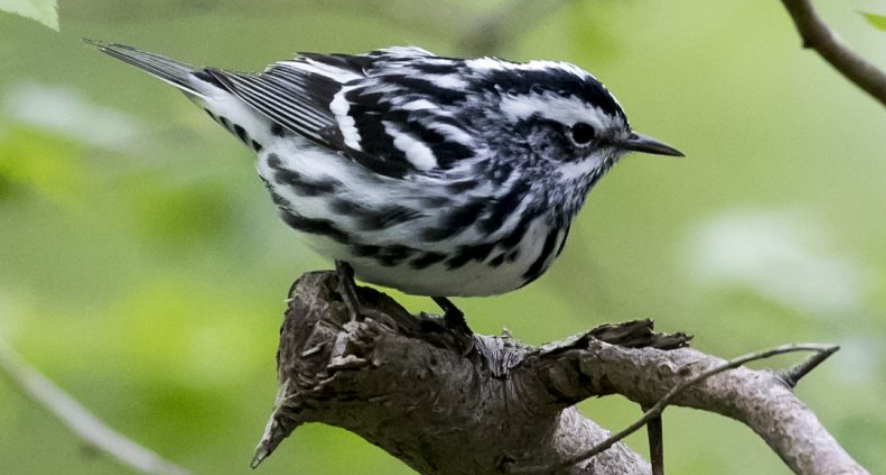
A small songbird found in North America. Black and White Warblers are known for their unique foraging technique of climbing tree trunks in search of insects. They are migratory, often found in forests.
Quick Top 10 Facts about Black and White Warbler
| SCIENTIFIC NAME | Mniotilta varia |
| CLASSIFICATION | KINGDOM: Animalia PHYLUM: Chordata CLASS: Aves ORDER: Passeriformes FAMILY: Parulidae GENUS: Mniotilta SPECIES: M. varia |
| SIZE | Length: 4.3–5.1 inches (11–13 cm), Wingspan: 7.1–8.7 inches (18–22 cm), Weight: 0.3–0.5 oz (8–15 g) |
| HABITAT | Forests and woodlands across North America, especially deciduous and mixed forests during breeding season |
| DIET | Insectivorous; feeds primarily on insects and spiders found on tree bark and foliage |
| SPECIES | Black and White Warbler, a unique wood-warbler with tree-climbing habits like a nuthatch |
| COUNTRY | Breeds in North America (Canada & USA); winters in Central America, the Caribbean, and northern South America |
| GESTATION PERIOD | Incubation period of 10–12 days; fledging occurs around 8–12 days after hatching |
| LIFE SPAN | Up to 8 years in the wild |
| CONSERVATION STATUS | Least Concern; populations are stable though affected by habitat loss and deforestation |
Amazing Facts About Black and White Warbler
1. They look like zebra-striped songbirds
With their striking black-and-white plumage, these warblers are easy to recognize and stand out among other forest birds.
2. They climb trees like nuthatches
Unlike most warblers, Black and White Warblers forage by creeping along trunks and branches, probing bark for insects.
3. They’re early migrators
These birds are among the earliest warblers to return to breeding grounds in spring and one of the first to leave in fall.
4. They have a distinctive squeaky song
Their song sounds like a high-pitched, rapid “wee-see, wee-see, wee-see,” which can be heard during the breeding season.
5. Males sing to defend territory
Male Black and White Warblers use their song not only to attract mates but also to keep rival males at bay.
6. They build nests on the ground
Despite spending time in trees, these birds nest on or near the forest floor, usually well-hidden among leaves and brush.
7. They have a wide migratory range
These warblers travel thousands of miles, from Canada and the U.S. to Central and South America for the winter.
8. They are solitary during migration
Though social during breeding, they usually migrate alone or in loose flocks rather than in tight groups.
9. Females incubate the eggs
Only the female incubates the eggs, while the male may assist with feeding the chicks once they hatch.
10. They’re important insect predators
By consuming large numbers of insects, including pests, Black and White Warblers play a key role in forest health.
Origin and habitat of the Black and White Warbler bird
The scientific name for the Black and White Warbler is Mniotilta varia. It is a tiny songbird from the Parulidae family. Its main habitat is North America, with the eastern and central regions being particularly important. Black and White Warbler species may be easily identified by their characteristic black and white plumage, which also helps them blend in with the bark of trees.
Unique characteristics and appearance of the Black and White Warbler bird
With its striking black-and-white striped appearance and unusual foraging habits, the black-and-white warbler is an intriguing bird. It is a vital component of our ecosystem because of its adaptability to different environments and its role in controlling insects. The beauty and variety of our avian companions may be better appreciated if we are aware of and respect these facts about the black and white warbler.
Migration patterns of the Black and White Warbler
This migratory bird migrates to the southern sections of North America, which include Central America and the Caribbean, in the winter. The Black and White Warbler spends its breeding season in the northern parts of the continent. Throughout their trip, black and white warbler birds may be spotted in a variety of locations, including urban parks, woods, and forests.
Physical appearance and body type of the Black and White Warbler
Measuring between 4.5 and 5 inches in length and 7.5 and 8 inches in wingspan, the Black and White Warbler has a thin body. Because of its outstanding camouflage against the tree bark provided by its black and white striped plumage, it may hunt for insects and spiders by crawling up and down tree trunks and branches. The Black and White Warbler is distinguished from other species of warblers by its unique foraging strategy; these species often consume insects that are located in the leaves.

Fascinating facts about the Black and White Warbler
All things considered, the Black and White Warbler’s distinctive black and white coloration and peculiar eating habits make it a fascinating bird species. Because of its migratory habits and capacity to blend in with tree bark, it is an intriguing topic for biologists and bird watchers alike. A little songbird that is a member of the wood-warbler family is the black-and-white warbler (Mniotilta varia). Its unique plumage with black and white stripes distinguishes it from other warblers. The intriguing details regarding this unusual bird are as follows:
Unique features, long, thin bill and zebra-like stripes of the black and white warbler
The eye-catching black and white stripes on the black and white warbler help you identify it. Black and white Warbler underparts and wing bars contrast with its black back and head. Its body is striped in a manner akin to that of a piano key or zebra. Black and white warbler feathers enable it to blend in with the bark of the trees, where it spends much of its time searching for insects to eat.
Habitat range and distribution across North America of the black and white warbler
North America is home to this species of warbler in a variety of environments. Mature deciduous woods are preferred by them throughout the mating season, particularly those with a deep understory. In addition, urban parks and gardens, forested wetlands, and mixed woods are home to them. They are observable in a variety of environments during migration, including fields with shrubs and coastal regions.
Behavior and Diet of the black and white warbler
The distinctive feeding habits of the black and white warbler are well known. This species of warbler favours foraging on tree trunks and branches above other species, which hunt the treetops for insects. It hunts for insects and spiders by inserting its pointed beak into bark cracks and fissures. A nuthatch or a creeper would exhibit similar behaviour.
The creeping habit of the Black and White Warbler bird
The black-and-white warbler’s habit of “creeping” is another fascinating behaviour. The Black and White Warbleruses the strong feathers on its tail to provide stability. It can reach insects concealed in the bark thanks to this behaviour, which also helps it cover more land while foraging.
Seasonal long-distance movements of the black-and-white warbler
Long-distance migrants include the black-and-white warbler. It breeds in North America and spends the winter migrating to Central and South America. They may be seen in a variety of environments throughout their journey, including coastal regions, woods, and woodlands. Their characteristic cry, which sounds like a high-pitched “wee-see,” is what makes them unique and is often repeated quickly.
Ecological Importance of Black and White Warblers as Insectivores
Because they are insectivores, black and white warblers mostly eat spiders and insects. They eat moths, ants, caterpillars, beetles, and other tiny arthropods. Their large tongue and pointed beak are used to scrape food out of the leaves and bark of trees. The ecology benefits from these warblers since they are crucial in managing bug populations.
Reproduction behavioral and Mating habits of black-and-white warblers
In the mating season, male black-and-white warblers use song to mark territory and entice females. In order to protect the Black and White Warblerarea and draw in a partner, the male sings a high-pitched, buzzy trill. Using grass, leaves, and strips of bark, the female constructs a cup-shaped nest on the ground or within a tree hollow. She produces 4-5 eggs in a clutch, which she takes 12–14 days to hatch. The hatchlings are fed, and the eggs are incubated by both parents alternately.

Threats and Conservation efforts internationally for the black and white warbler
According to the International Union for Conservation of Nature, the black and white warbler is a species of least concern (IUCN). The Black and White Warbler’s geographical distribution is broad, and its population is constant. Threats to the species include habitat loss and fragmentation, however, much as they do for many other bird species. Particularly during the mating season, conservation efforts should concentrate on maintaining and rebuilding these birds’ appropriate habitats.
FAQ (Frequently Asked Questions) about Black and White Warbler
Q: What is a Black and White Warbler?
Ans: The Black and White Warbler (Mniotilta varia) is a small songbird native to North and Central America. It is easily recognizable by its striking black-and-white striped plumage and its habit of creeping along tree trunks and branches, much like a nuthatch or creeper.
Q: Where does the Black and White Warbler live?
Ans: This warbler species breeds in North America, especially in deciduous and mixed forests of Canada and the eastern United States. In winter, it migrates to Central America, the Caribbean, and northern South America. It prefers mature forests, woodlands, and even gardens during migration.
Q: What does the Black and White Warbler eat?
Ans: Black and White Warblers primarily eat insects and spiders. They forage by climbing along tree bark, probing crevices for hidden insects. Their diet includes caterpillars, beetles, ants, and other small invertebrates.
Q: What is unique about the Black and White Warbler’s behavior?
Ans: Unlike most warblers, the Black and White Warbler forages by creeping along trunks and large branches, much like woodpeckers or nuthatches. Its distinctive foraging method and tree-climbing ability set it apart from other warbler species.
Q: How big is the Black and White Warbler?
Ans: The Black and White Warbler is a small bird, about 5 inches (13 cm) in length, with a wingspan of 7.5 to 8.7 inches (19 to 22 cm), and it weighs around 0.3 to 0.5 ounces (9 to 15 grams).
Q: Do Black and White Warblers sing?
Ans: Yes, males have a high-pitched, squeaky song that sounds like “wee-see, wee-see, wee-see.” They use their song to defend territory and attract mates during the breeding season.
Q: Are Black and White Warblers migratory?
Ans: Yes, they are migratory birds. They breed in North America and migrate south to Central America, the Caribbean, and parts of northern South America during the winter months.
Q: Are Black and White Warblers endangered?
Ans: No, they are not currently considered endangered. The species has a wide range and a stable population, though habitat destruction and deforestation can pose localized threats.
#BlackAndWhiteWarbler, #Warbler, #Songbirds, #BirdWatching, #BirdLovers, #ForestBirds, #MigratoryBirds, #TreeClimbers, #InsectEaters, #BirdPhotography, #NatureFacts, #BackyardBirds
Our sources and references about Black and White Warbler
1: Wikipedia – Black-and-white Warbler
2: All About Birds – Black-and-white Warbler
3: Audubon Field Guide – Black and White Warbler
4: Birdwatching Bliss – Black and White Warbler