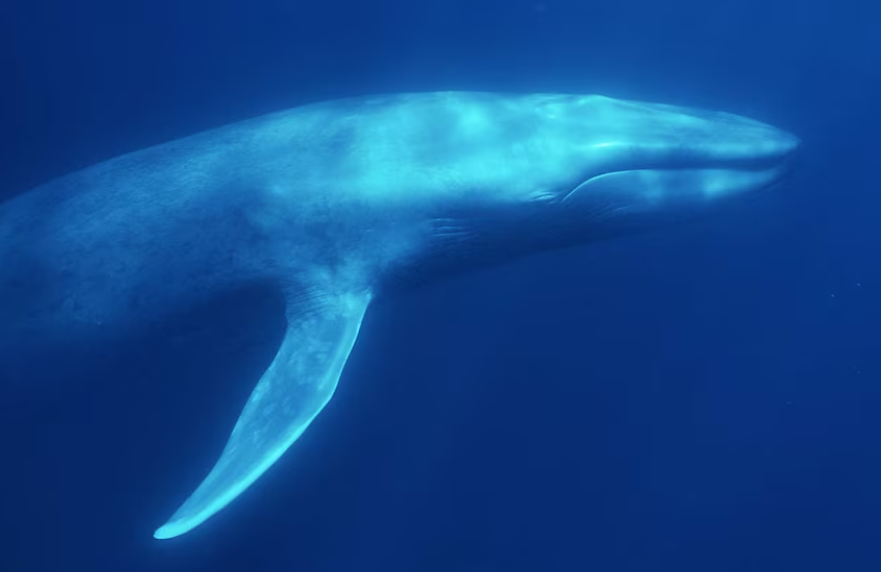
Quick Top 10 Facts about Blue Whale
| SCIENTIFIC NAME | Balaenoptera musculus |
| CLASSIFICATION |
KINGDOM: Animalia CLASS: Mammalia ORDER: Artiodactyla FAMILY: Balaenopteridae PHYLUM: Chordata GENUS: Balaenoptera |
| SIZE | Up to 100 feet (30 meters) long; weighs up to 200 tons (181,000 kg) |
| HABITAT | Found in all oceans, especially in deep open waters |
| DIET | Primarily krill (tiny shrimp-like animals); can consume up to 4 tons of krill per day |
| SPECIES | Blue Whale |
| COUNTRY | Global distribution – migratory; seen in the Atlantic, Pacific, Indian, and Southern Oceans |
| GESTATION PERIOD | Approximately 10–12 months |
| LIFE SPAN | 70–90 years; some individuals may live over 100 years |
| CONSERVATION STATUS | Endangered – threats include ship strikes, climate change, and noise pollution |
Amazing Facts About Blue Whales
1. Largest animal to ever live
Blue whales are the largest animals known to have ever existed on Earth, even bigger than dinosaurs.
2. Their heart is the size of a car
A blue whale’s heart can weigh around 400 pounds and is about the size of a small car!
3. Long-distance travelers
They migrate thousands of miles every year between feeding and breeding grounds.
4. Loudest animal on Earth
Blue whales can produce calls that reach up to 188 decibels — louder than a jet engine.
5. Their tongue weighs as much as an elephant
Just their tongue can weigh nearly 3 tons!
6. Consume thousands of krill daily
A single adult blue whale can eat up to 40 million krill in one day.
7. Calves are huge at birth
A newborn blue whale calf is about 23 feet long and weighs 2–3 tons.
8. Fast swimmers
Despite their size, they can reach speeds up to 20 mph when alarmed.
9. Breathe through blowholes
They come to the surface every few minutes to breathe, releasing a spout that can be seen from miles away.
10. Still recovering from whaling
Blue whale populations were decimated by commercial whaling in the 20th century, but conservation efforts are helping them recover.
Size and length of blue whale as the largest animal on Earth
The blue whale, or Balaenoptera musculus, is the largest animal to have ever existed on Earth. It is a marine species that belongs to the baleen whale suborder and may be found in oceans all around the globe. These incredible beasts are really remarkable, with a maximum length of 98 feet and a maximum weight of 200 tonnes. They are a very interesting subject because of their size, behaviour, and position as a protected species. We can better appreciate and save these amazing species for future generations if we have greater knowledge about them.
Unique physical features, such as the blue-gray coloration and mottled skin
The term “blue whale” comes from the distinctive bluish-grey coloration of these animals. But under other lighting conditions, their skin might seem more speckled or even yellow. They have a streamlined body structure, a long, slender tail, and two pectoral fins. Their broad, flat heads contain their enormous jaws, which may open wide to ingest large volumes of water and prey.
Feeding behaviour of blue whales, focusing on their diet of krill and small fish
Krill, a tiny shrimp-like crustacean that these gentle giants filter through their baleen plates, is their primary food source. Blue whales have a unique way of eating called lunge feeding, which entails their running into a school of krill and opening their mouths to ingest a lot of food and water at once. Despite their enormous size, blue whales are filter feeders and do not have teeth. After filtering the water from their mouths with the baleen plates on their lips, they swallow the krill.
Migration patterns, including their movement between feeding and breeding grounds
Blue whales are migratory creatures that travel vast distances in search of food and suitable breeding grounds. They embark on these audacious journeys every year, often across whole oceans. During the mating season, males produce complex songs that may be heard over long distances; this might be done for communication purposes or to attract possible partners. These might be unique, multi-minute tunes for each individual.
Current conservation status of blue whales, highlighting their endangered status
Unfortunately, in the past, blue whales have been seriously endangered by human activities, particularly commercial whaling. Because of the dramatic decline in their population, they were in danger of becoming extinct. Despite this, they have recovered, and because of international regulations and conservation efforts, they are now protected as an endangered species. These incredible species’ long-term future rests on protecting their habitats, reducing ocean pollution, and implementing sustainable fishing practices.
Fascinating facts about the blue whale
Blue whales, the biggest mammal on Earth, continue to enthral scientists and environmental lovers in equal measure. These amazing animals are renowned for their enormous size and distinctive features.
Size and physical characteristics of the Blue Whale
The blue whale is a true ocean behemoth. They have the potential to reach lengths of 100 feet and weights of 200 tonnes. Their mouths alone have the potential to weigh as much as an elephant, to put this into perspective.
Diet and feeding habits of Blue Whales
Blue whales consume some of the tiniest marine life, despite their enormous size. Krill, which are small invertebrates that resemble prawns, make up the majority of their food. Up to 4 tonnes of krill may be eaten by one blue whale in a single day.
Habitat and Migration patterns of Blue Whales
It is well known that blue whales have extraordinary migratory patterns. They cover great distances in pursuit of food and spawning sites. One of the most widely dispersed animals on Earth, some populations wander thousands of kilometres annually.
Vocalisations and long-distance range of their calls
Blue whales are well-known for their low-pitched, profound vocalisations. Underwater, these noises are used for mating and communication and may be heard for kilometres. They make some of the loudest noises of any animal when they call.
Current conservation status of blue whales
International law today protects blue whales, despite the fact that they were formerly hunted to the point of extinction. Although their numbers are gradually increasing, they are still in danger from things like ship hits and becoming tangled in fishing gear. To guarantee their long-term existence, conservation initiatives are essential.
Lifespan and Longevity of blue whales
Some blue whales may live up to 90 years, which is quite a lengthy lifetime. But the average lifespan of a blue whale is between 70 and 80 years. Their fragility as a species is exacerbated by their low reproduction rate and poor growth rate.
Blue whales heart being the size of a small car
A blue whale’s heart is quite amazing. It is several hundred pounds in weight and around the size of a compact automobile. The blue whale’s heart beats at a comparatively moderate pace of around 10 beats per minute, despite its enormous size.
Mating and social interactions of blue whales
Although they are mostly solitary animals, blue whales do display some social behaviour. Particularly during the feeding or breeding seasons, they are often seen in couples or small groups. These exchanges, however, are often fleeting and small.
Breathing and diving activities of blue whales
Like other animals, blue whales are air-breathing creatures. They breathe in and out via blowholes on top of their skulls. They can dive to depths of more than 1,000 feet and hold their breath for up to 20 minutes at a time.
Presence of baleen plates in their mouths, used for filter-feeding
Blue whales are anatomically distinct in a number of ways. Their baleen plates may extend up to ten feet in length, and they are used to filter krill out of the water. Additionally, they have a characteristic ridge running the length of their backs called a dorsal fin that aids in stability while swimming.
FAQ (frequently asked questions) about Blue Whale
Q: What is a Blue Whale?
Ans: The Blue Whale is the largest animal known to have ever existed. It is a marine mammal belonging to the baleen whale suborder and can grow up to 100 feet long and weigh over 200 tons.
Q: Where do Blue Whales live?
Ans: Blue Whales are found in all the world’s oceans except the Arctic. They prefer deep ocean waters and migrate between feeding grounds in cold waters and breeding grounds in warmer tropical and subtropical seas.
Q: What do Blue Whales eat?
Ans: Blue Whales primarily feed on krill—tiny shrimp-like animals. During feeding season, a Blue Whale can consume up to 4 tons of krill per day by taking in massive mouthfuls of water and filtering out the krill using their baleen plates.
Q: How do Blue Whales communicate?
Ans: Blue Whales use low-frequency vocalizations, often called songs or calls, to communicate over long distances. These sounds can travel hundreds of miles underwater and are believed to be used for navigation, feeding, and mating.
Q: How long do Blue Whales live?
Ans: Blue Whales typically live between 70 to 90 years, although some individuals have been known to live over 100 years. Scientists estimate age by examining layers in their earplugs, similar to tree rings.
Q: Are Blue Whales endangered?
Ans: Yes, Blue Whales are listed as endangered due to historical whaling, which drastically reduced their population. Although their numbers are slowly recovering, they still face threats from ship strikes, climate change, and ocean noise pollution.
Q: How do Blue Whales reproduce?
Ans: Female Blue Whales give birth to a single calf after a gestation period of about 11 to 12 months. Calves are around 20–25 feet long at birth and nurse for several months, gaining hundreds of pounds per day.
Q: How do Blue Whales breathe?
Ans: Blue Whales are mammals and breathe air through lungs. They surface to breathe, exhaling through their blowholes in a powerful vertical spout that can reach up to 30 feet high.
Q: How fast can a Blue Whale swim?
Ans: Blue Whales typically cruise at speeds of about 5 miles per hour but can reach speeds of up to 20 miles per hour in short bursts when they are alarmed or trying to flee predators.
Q: Why are Blue Whales important to the ecosystem?
Ans: Blue Whales play a crucial role in marine ecosystems by helping regulate the food chain and supporting plankton growth through nutrient recycling. Their fecal plumes release nutrients that stimulate plankton blooms, which are vital to the oceanic food web and carbon cycle.
#BlueWhale, #WhaleWatching, #OceanGiants, #MarineLife, #WhaleLovers, #EndangeredSpecies, #WildlifePhotography, #NatureLovers, #SaveTheWhales, #OceanConservation, #WhalesOfInstagram, #DeepSeaCreatures, #BluePlanet, #MajesticWhales, #MarineMammals
Our sources and references about Blue Whale
1: Wikipedia – Blue Whale
2: National Geographic – Blue Whale Facts
3: World Wildlife Fund – Blue Whale
4: NOAA – Blue Whale Educational Resources